

Cruelty has always been a rite of passage in coming-of-age stories, but few films capture the quiet terror of adolescent social hierarchies as vividly as The Plague. Set at a water polo summer camp in the summer of 2003, writer-director Charlie Polinger’s striking debut transforms the awkward, anxiety-ridden world of early teenage boyhood into something that feels almost mythic in its emotional intensity. What begins as a familiar tale of trying to fit in gradually morphs into something far more unsettling – a psychological drama that carries the uneasy weight of a horror film without ever needing traditional genre scares.
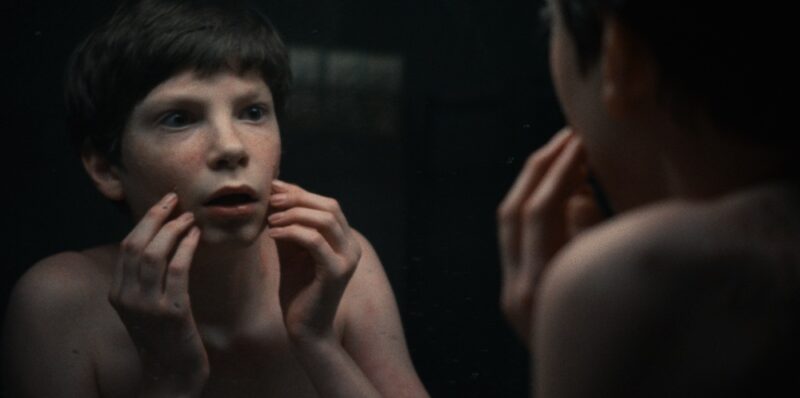
The story centres on Ben (Everett Blunck), a socially anxious 12-year-old arriving at the Tom Lerner Water Polo Camp hoping to find his place in the group. Like many kids at that age, he quickly learns that survival depends on reading the room – and in this case, that means aligning himself with camp alpha Jake (Kayo Martin) and his pack of swaggering followers. Their favourite target is Eli (Kenny Rasmussen), an eccentric outsider with a strange skin condition that the boys have mockingly dubbed “the plague.” What begins as teasing gradually escalates into something far darker, with Ben caught in the middle between empathy and the desperate need to belong.
Polinger approaches this material with remarkable restraint and confidence for a first-time director. There’s an understanding that the smallest moments – a glance across a locker room, a whisper among boys, the slight shift in group dynamics – can carry more dread than any overt horror device. The film’s depiction of peer pressure feels painfully authentic, capturing the moment when childhood games slide into something more dangerous. As the rumour spreads that Ben himself may have contracted Eli’s mysterious affliction, the camp’s fragile social order begins to turn on him with frightening speed.
What elevates The Plague beyond a standard coming-of-age drama is the quality of its performances. Blunck gives a remarkably nuanced performance as Ben, embodying the nervous energy of a kid who understands right from wrong but fears the cost of standing alone. His internal struggle – between complicity and compassion – drives the film’s emotional core. Martin, meanwhile, is chillingly convincing as Jake, a boy who has already mastered the dark art of social dominance. Rasmussen brings an affecting vulnerability to Eli, whose quiet acceptance of his outsider status makes the cruelty aimed at him feel even more brutal.
Hovering around the edges of the chaos is camp leader Daddy Wags, played with understated intrigue by Joel Edgerton. Edgerton’s performance perfectly captures the uneasy role of an adult who is present but never fully able to penetrate the secret world of the boys under his watch. His character’s attempts at guidance feel well-meaning yet strangely distant – a reminder that adolescence often unfolds in a space adults can observe but rarely control.
Visually, the film has a haunting elegance that belies the ugliness of its subject matter. Shot on 35mm, the cinematography bathes the camp in warm, sun-drenched nostalgia, creating a striking contrast with the cruelty simmering beneath the surface. The imagery often feels almost lyrical, giving the story the weight of a modern fable about belonging, shame, and the quiet violence of social exclusion.
The film’s score (courtesy of Johan Lenox) plays a crucial role in sustaining that mood. Rather than relying on obvious horror cues, the music creeps into scenes like a slow-building anxiety – pulsing beneath the boys’ interactions and subtly amplifying the tension. It gives the film a hypnotic rhythm, making moments that might otherwise seem mundane feel charged with impending dread.
Polinger has cited films like The Shining and Full Metal Jacket as influences, and you can sense that lineage in the film’s fascination with group psychology and power dynamics. Yet The Plague ultimately feels entirely its own: an unnerving portrait of adolescence that understands how easily cruelty can become ritual, and how fragile empathy can be in the face of social survival.
By the time the film reaches its devastating climax – a moment that is both shocking and strangely cathartic – it has burrowed deep under the skin. The Plague is not an easy watch, but it’s an unforgettable one: a haunting exploration of boyhood, shame, and the terrifying moment when children realise just how much power they hold over one another.


FOUR AND A HALF STARS (OUT OF FIVE)
The Plague is now screening in Australian theatres.
