
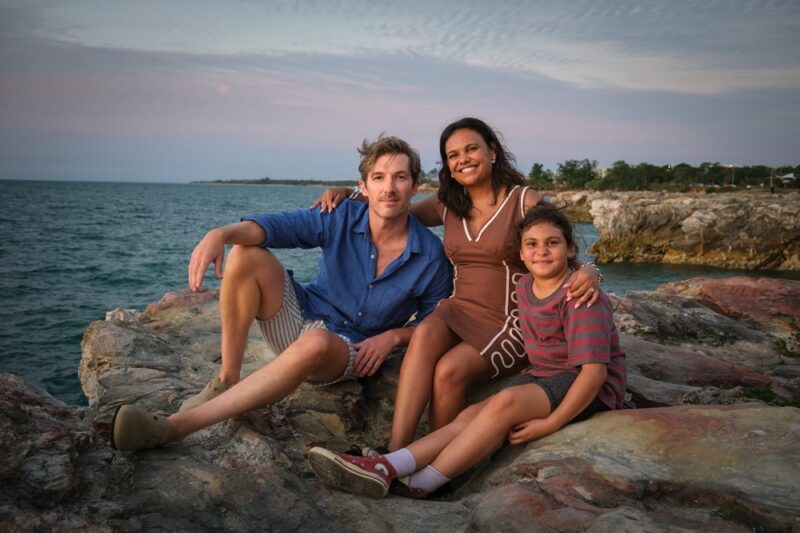
When Miranda Tapsell first brought audiences into the vibrant world of Top End Wedding, it felt like a joyous corrective to the romantic comedy formula – a film bursting with culture, community and the unapologetic warmth of family. But the story doesn’t end with the fairy-tale wedding. In the new series continuation, Top End Bub, Tapsell and co-creator Joshua Tyler explore what happens after the confetti settles.
The show picks up with Lauren and Ned navigating grief, responsibility and the unexpected realities of building a family – particularly when they suddenly become guardians to young Bub. What unfolds is a story that balances chaos, comedy and heartbreak, while centring the strength of a Tiwi Islander matriarchy and the importance of community.
Speaking with our Peter Gray as the series is set to premiere on ABC TV and ABC iview, Tapsell reflects on writing joy into Indigenous stories, the pressures of expectations within strong matriarchal families, and why comedy can sometimes reveal the most uncomfortable truths. She also discusses the power of representation behind the camera, and why leaning fully into cultural specificity can make stories feel even more universal.
I actually spoke with you and Gwilym back in September when the show first came out. Now that it’s heading to ABC and really out in the world, it’s great to have the chance to chat again.
Thank you for chatting to me again.
One thing I wanted to ask about is the idea of what comes after the happily-ever-after. Top End Wedding ends on this triumphant romantic note, but the series disrupts that fairy tale with grief. Were you interested in interrogating the myth that love solves everything?
That’s definitely an element of it. But what I was really interested in was looking at families in all the different ways they form.
Josh (Tyler, co-creator and writer) and I were thinking about a sequel during lockdown – it gave us something to get up and do every day. As we talked about it, we realised that a lot of shows explore new motherhood through pregnancy and labour. But there are so many other ways to become a family. And there’s also a huge discussion, particularly with my generation, about whether we even want children.
So we wanted to explore all of that. How do you find happiness after the happily-ever-after?
I also love that the show centres a Blak matriarchy and plays it with warmth and comedy rather than trauma. It feels quietly radical. Was humour almost a Trojan horse for shifting perceptions? You’ve spoken before about deliberately portraying Indigenous families as organised, loving and structurally strong, which pushes back against some really damaging narratives.
Oh, 100 percent. That’s how my mob have gotten through hard times. Especially when we’re dealing with grief and loss, it’s about leaning on each other and bringing joy out in one another. That’s such an important part of our communities – well, the community I know anyway – so I really wanted to bring that into the show.
Lauren and Ned taking on Bub is very loving, but also messy and imperfect. And Lauren’s search for Bub’s father almost feels like she’s trying to “solve” grief. When you approached that, did you see it more as the instincts of a lawyer, or as a daughter trying to fix something that can’t be fixed?
Oh, that’s such an interesting question. When it finally came time to put my acting hat on, I approached it as a daughter trying to fix something that can’t be fixed. Then, when she realises she may have had good intentions but handled it the wrong way, she switches into her shark-lawyer mode to try and cover herself.
You’ve spoken about how your mum and aunties had incredibly high expectations of you growing up. Is your character, Lauren, partly a love letter to those women – or also a gentle rebellion against them?
I think it’s a bit of both. On one hand, I wanted to acknowledge what’s gotten my community to where we are now – how my family in particular created stability for themselves. That’s because of the matriarchy. But at the same time, the question I wanted to ask was, “When do you let yourself off the hook?”
With those expectations comes enormous pressure. When do you give yourself some slack? When do you get to put yourself first? And when will other people let you do that?
Comedy often feels like a form of survival. You began in drama, but people now associate you strongly with comedy. Do you think comedy gets underestimated because it makes pain look easy?
Sometimes people worry that comedy diminishes or minimises the issues being explored. But so many incredible comedic writers are able to tackle serious topics through humour and still make people think. It doesn’t necessarily make people more comfortable. In fact, I’ve been really touched by how awkward people have been watching the show. It’s sparked conversations in people’s homes. I love that comedy can do that. For me, the balance between pathos and levity feels natural. Those things can coexist, we don’t need to overthink it as creatives.
When you’re writing chaotic comedic scenes, are you consciously balancing absurdity with emotional truth? Or is it more instinctive? Something that comes from how your family tells stories?
My family are incredible storytellers. Not many of them work in the arts, but they’re brilliant at telling a story and landing a punchline. My mum used to say, “Turn the television off – we’re going to sit around and chat.” So that’s where a lot of that instinct comes from.
But I also have to give credit to Josh Tyler. He constantly pushes me to be braver with the absurdity. Sometimes I want my characters to stay on the “right side” – to make thoughtful, considerate decisions. And Josh reminds me that people don’t always do that. When grief comes into the picture, people make insane choices. So sometimes it’s about throwing things at the wall and seeing what sticks.
Behind the camera there’s also a lot of representation – Shari Sebbens directing, Libby Collins producing. You’ve always championed bringing people along for the journey. Did you encounter resistance to that, or do you feel the industry is ready to trust Indigenous creatives beyond acting roles?
We’re trying to make things during a recession, and the industry is constantly having to prove that what we do matters – that we’re not just entertainment people enjoy after work. So budgets are tightening, and that affects creative decisions. But the conversation I often find myself having is, “Why don’t you think this will pay off? Why is this considered such a big gamble?”
When you’ve got people like Shari, Libby, Elaine Crombie, Ursula Yovich, Guy Simon, and little Gladys-May (Kelly) in the cast – it’s a slam dunk. The first question I ask when someone says it’s too expensive or complicated is simply “Why?”
One of the things I love about the story is that it’s very specific but also universal. When Top End Wedding premiered at Sundance and resonated internationally, did that give you the confidence to lean even more boldly into Tiwi culture in the series?
Absolutely. I wasn’t worried about whether people would relate to it, even if they’d never been to the islands. People from different cultures will still recognise their own families. They’ll say, “Oh my God, I have a loud auntie like that,” or “I have a cousin like that.” We’re also living in Bad Bunny’s era now, you know? Artists aren’t watering down their culture to make it easier for someone else to understand.
I went to his show on Sunday night…
Oh, my God, me too! It was incredible. That spirit – sharing culture with joy – is something I want to bring into my work too.
I love that the show suggests family isn’t just something you inherit, it’s something you practise. What do you hope non-Indigenous audiences might relearn about community from watching the show?
One thing I love about becoming a screenwriter is that I don’t have to have all the answers. I understand how important community is. I have my parents helping me with my kids – I can’t imagine starting a family without that village. But at the same time, I felt liberated asking questions like, “Is it wrong to have your own ambitions? Is it wrong to step away from the pack sometimes?”
Those were the things I wanted to interrogate. But ultimately, celebrating community was really important to me, because with the uncertain future we’re facing, we’re going to need it.
Well, I remember when I first saw the film it felt like such a celebration of joy, and the series extends that while adding a lot of emotional depth. It’s a show that really centres joy unapologetically. Thank you for the film, the show, and for taking the time to chat today.
Thank you, that’s very kind. You’ve made my afternoon.
Top End Bub is available to stream now on Prime Video. It will also now be available to stream on ABC TV and ABC iview from March 7th, 2026.
