

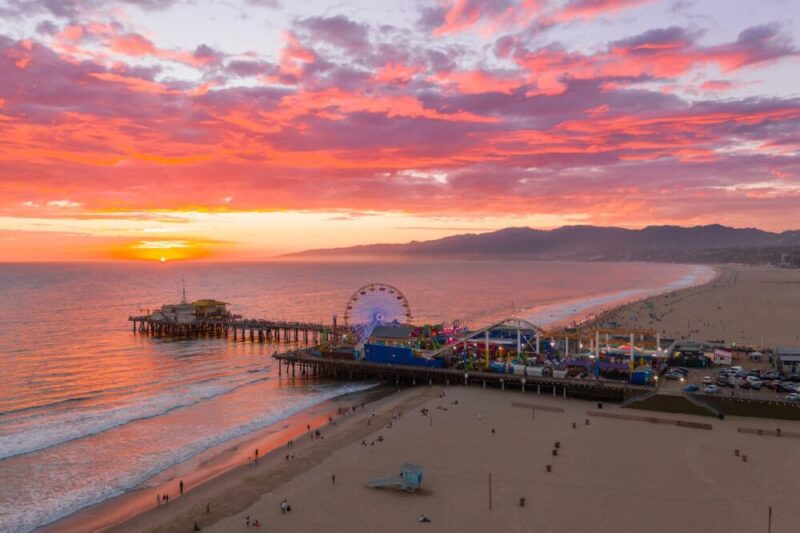
Santa Monica Pier is my bookend whenever I do a multi-city trip in the USA. At least my preferred one.
I’m one of those masochists who actually enjoys having LAX as an entry point to any US adventure, because it sets the scene. The City of Angels is sprawling, sunny and varied. It’s the perfect way to slink into a grand adventure, while slowly shifting my mentality from Aussie to American (the good kind).
New York gets its sense of largeness from its iconic skyscrapers; L.A. gets it from its natural features.
I like to adopt a local’s mindset, as much as possible
Glossy print features would call that a “sense of place”. I call it travelling well, externalising your capacity for self-examination and empathising with a city. One of the best ways to do this is that little word plastered across every guidebook ever written: landmarks.
Landmarks are clichés, but they are also anchors. They sit on a well of romanticism that’s been built up since the Golden Age of Travel and are caked with the excitement of discovery, from millions of people seeing a new city for the very first time.
I know whenever I go to New York City, I make it a point to visit at least one of the iconic observation decks. Top of the Rock is clearly the best (especially now they have the Skylift) and purest example, leaning over the world’s most powerful skyline. When I’m in Chicago, I like to take the same architecture boat tour, paying attention to others’ reactions at that pivotal moment when the boat turns around on the Chicago River and reveals the most beautiful cityscape in North America.
I’ll never stop wanting to do those things whenever I touch down. They make my imagination sing a thousand words.
Why? It’s like watching your favourite movie with someone who has never seen it before. Empathising with their reactions, nodding knowingly as they gasp, laugh and cheer – it’s the closest thing you can get to seeing something for the first time.
I do believe that’s why YouTube “reaction” channels are so popular – mirror neurons are powerful; mine tingle like spidey senses when I’m around first-timers experiencing something they never had before. I’m excited for them, and that makes me excited for me.
Santa Monica Pier is my version of that in L.A. I’m not going to Grand Central Market to fill my batteries, nor am I hiking up to the Hollywood sign (something I’ve still never done). The two Getty Museum sites are incredible, but I need somewhere densely packed with:
- Tourists
- Optimism
- Romance
- Excitement
I also need somewhere that feels like the city I’m in.
The Getty Villa, for example, doesn’t feel like L.A., it feels like ancient Rome.
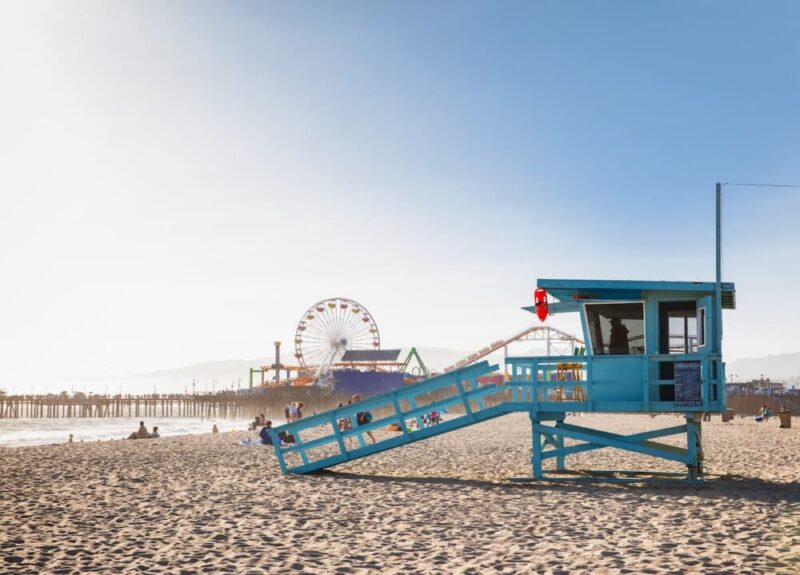
Okay, so why does Santa Monica Pier mean so much to you?
I was going through quite a rough patch in 2024 and, almost out of necessity, decided I needed a very, very long time away from Sydney. I spent three months in the US (as well as a bit up in British Columbia), and it became the solo trip for me. The one I’ll never stop talking about. The one that has helped me become a more thoughtful traveller and writer, and the one that’s given me the insight and experience necessary to develop my own voice in the travel space.
My tertiary background in Psychology means I’m always, even unwittingly, playing mind games with myself when I’m on the road, and thinking deeply about how big cities evolve through their arts, music and food scenes. Through that evolution, iconic landmarks have always remained constants; reminders of how necessary travel is, and will always be.
That’s why I wanted to start and end in the same place. I also wanted to end and start in the same place. With as many of the same conditions as possible. Listening to the same music, walking the same routes, and even eating at the same places. At the end of the trip, I wanted to reassess who I had become, like I could reach out and wave to a past self who was still fresh in my mind.
I believe this is the best way to approach transformative, nostalgic travel, especially if you have something to heal.
The unsurprising rise in solo travel is often tied to a need for healing, confidence and growth. Orienting landmarks like this do take on a newfound importance. This kind of extended travel is infinitely better if you’re building up your own set of symbolism.
Santa Monica Pier, for me, will always symbolise a beginning and an end. It’s also the “first L.A. experience” for most Aussies, given they pick this pocket so often, for obvious reasons. Firstly, it’s the closest to the airport. Second, Ocean Avenue is every bit as sepia cinematic as the Sunset Strip or Miami’s Ocean Drive. There’s also a lot of fucking squirrels.
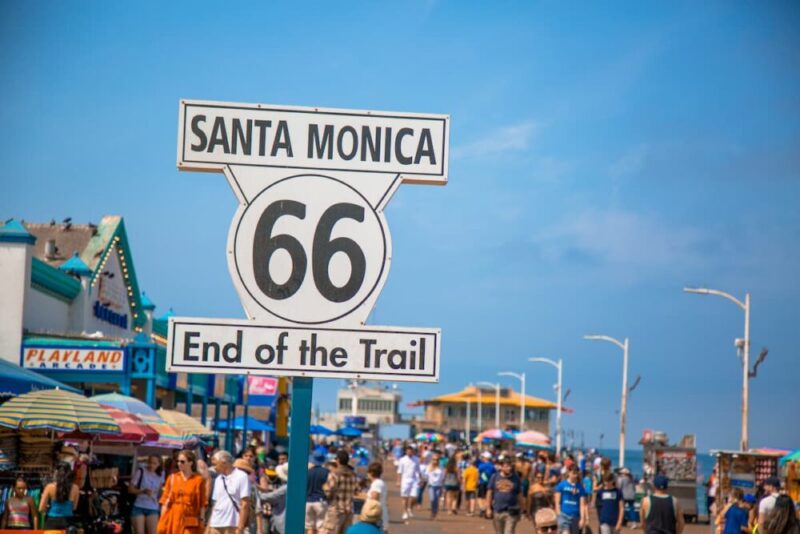
Which makes sense, since Santa Monica Pier is a literal end
One of the most notable things about Santa Monica Pier, aside from its natural setting, is that it’s the endpoint of Route 66.
The windy highway, the watershed that birthed the great American road trip, traditionally started in Chicago, weaved its way through the likes of St Louis, Oklahoma City, Santa Fe and Flagstaff, and brought all types of people to this 500-metre-long, 91-metre-wide icon. It’s an open-air museum; the longest in the world.
Santa Monica Pier first opened in 1909 after sixteen months of construction, giving the West Coast its very first concrete pier at the time. And while it was built to satisfy the city’s sanitation needs, it wasn’t long before the pier became L.A’s most beloved attraction, helped along eventually by a now-historic indoor carousel, the hand-carved and deeply intricate Looff Hippodrome and, eventually, a series of classic seaside eateries like The Albright and Bubba Gump Shrimp Co.
Furthermore, the pier widens to include an amusement park and a gaming arcade with a rotating roster of (genuinely entertaining) street performers. The vibe buzzing here from day to night, on either side, people set up on the soft sand and watch the waves roll in, while the far end of the pier offers thoughtful looks out to the Pacific Ocean.
The local council tried to demolish the pier to replace it with a resort hotel in 1973, but the plans threw locals into a spin. This isn’t like Times Square, which New Yorkers avoid like the plague. The pier is part of the sun-worshipping, Sydney-esque lifestyle that Santa Monica offers.
Which is another reason why I love starting here: it feels just enough like home, gently shoehorning me into America’s chaotic charm and wrapping me with a “welcome home” once it’s all done.
Much of Santa Monica Pier’s romantic appeal is tied to Route 66 in general. Last year, I was able to do at least some of the route, between Chicago and St Louis, and thought of it like one big monument to the Golden Age of Travel, with hundreds of oddities, legacy marketing gimmicks and exploratory history to be found.
And while my personal scope of Route 66 lore is missing a big chunk, I can only imagine how rewarding it would feel to walk right up to the end of that pier, take a selfie in front of the “End of the Trail” sign, and exhale the memories of the Mother Road.
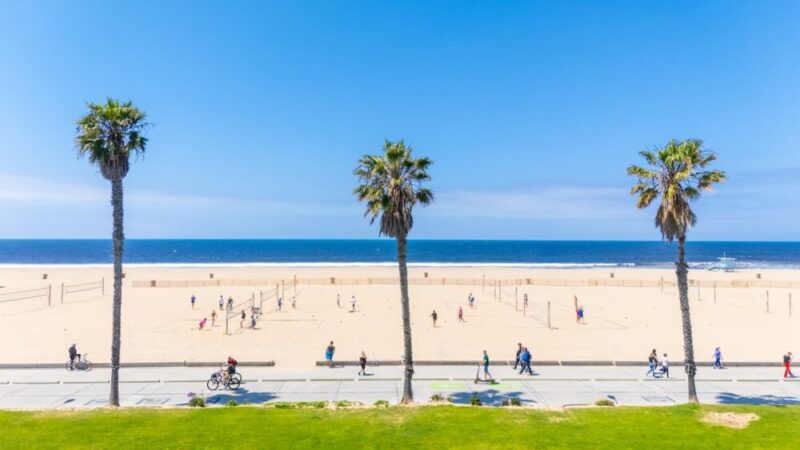
I don’t think I could ever visit L.A. without wanting to walk along Pacific Park just before sunset, right before the day sinks into the Pacific. That aura of Hollywood magic permeates the area, the orange hues hitting the more colourful buildings, like the bold pink-and-purple Barbie Beach House and the brilliant turquoise Art Deco Georgian Hotel. Seagulls in the distance.
The chef’s kiss of postcards.
Yet it’s this fabled pier that’ll always define the city.
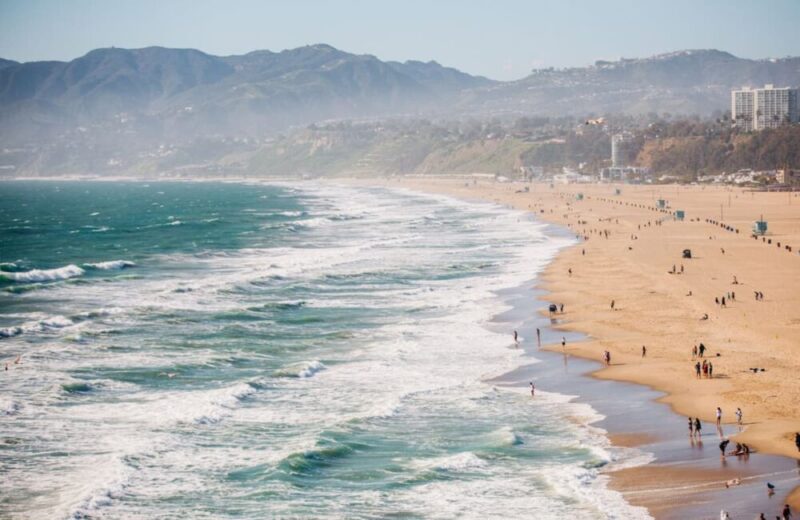
Tips for visiting Santa Monica
Santa Monica is included in the service area for driverless rideshare service Waymo. The city is also much closer to LAX than some of L.A.’s other famous pockets, so the ride is very affordable (about half the price of an Uber). LAX, however, is not included in the service area. But some of the airport hotels are.
The end of the area, from my experience, is the Hilton Los Angeles Airport. If you want to save a good chunk of change, I suggest catching a quick Uber over and then ordering a Waymo from there (similar process to Uber).
If you’re looking for somewhere to stay, I highly recommend The Pierside. Santa Monica has some of the West Coast’s most beloved hotels, like The Georgian and Shutters on the Beach, but this spacious four-star is both affordable and directly opposite the Pier. They also make a great coffee at the Surfing Fox, so you can grab-and-go while you walk down to the pier (or even one beach over to Venice).
Santa Monica is also the gateway to the Pacific Palisades. It’s worth catching a quick Uber down to that ultra-wealthy area. If nothing else, go have dinner at Italian icon and celebrity-spotting fav Giorgio Baldi and head up to the hills to visit the transportive Getty Villa.
Is mixing nostalgia and wellness the next big travel trend?
Last year, the Luxury Group by Marriott International found that 93% of high-net-worth travellers prefer to return to destinations they already love. I think everyone is familiar with those destinations that you can’t put away. You can never stop thinking about them.
It’s because a part of you is there, and they can’t wait to see you again.
“They’re purposeful returns”, reads the report. The study found that these repeat visitors are motivated to travel with more depth than on their previous trip. People want to reconnect with local communities or relive special moments with family and friends.
The same study also found that itineraries are becoming more intentional, the average short stay has increased from 3 to 4 nights, and 62% plan every detail ahead of time. But wellness also took a big chunk of the report, with 90% of travellers citing wellness experiences as a key factor in their booking decisions. This is up from 80% in 2024.
And by wellness, we are no longer talking only spa retreats and bathhouses. The industry is slowly adding more modalities, some based on science, others based on bullshit. Forst immersions, nutrition programs, sound healing, and sleep therapies. It’s like intersectionality, but for you and only you.
When nostalgia and wellness are racing alongside-by-side, it tells me that people are increasingly seeking out comfort. The world is not a nice place right now. Social media has been ruined by confected moral certainty and identity fusion, so people are now looking to escape the battlefield now and then, and retreat to their happy place(s).
It’s commonly recommended that you read your favourite book at different points through your life, to see what you pull out of it as a function of where you’re at in life at that moment. I think of travel in a similar way.
Travelling is an immense privilege to begin with, and getting to even have “favourite places” around the world takes that privilege to the next level. If you’re able to, I suggest going back to where you found the most meaning. And doing it alone.
Chris Singh travelled to the City of Santa Monica as a guest of Visit Santa Monica.
