
There is something almost old-fashioned in the way writer/director Zak Hilditch approaches the end of the world in We Bury the Dead: less as a spectacle of chaos, more as a slow, sad reckoning with what remains when everything familiar has vanished. His latest film feels heavy with mourning from its very first frames, suffused with an atmosphere that privileges dread and melancholy over outright terror. While it never fully transcends its genre framework, it is thoughtful enough to feel like more than just another zombie movie – it is a meditation on grief dressed in the trappings of survival horror. Daisy Ridley anchors this tonal balancing act with a performance that is both brittle and compassionate, grounding even the most heightened moments in recognizable human pain.
Hilditch’s visual language does a lot of the emotional work. Tasmania, draped in mist and silence, becomes an elegiac landscape of empty streets, abandoned homes, and eerily still bodies laid out in fields. The film is consistently beautiful in a bleak, funerary way, as if the camera itself is mourning alongside its characters. There are images here – lines of wrapped corpses, burning motorboats drifting out to sea, stone ruins cradling a newborn – that linger with the potency of visual poetry. Yet for all its aesthetic strengths, the movie occasionally stumbles when it shifts from mood-driven storytelling into more conventional horror rhythms, complete with predictable jolts and familiar undead mechanics.
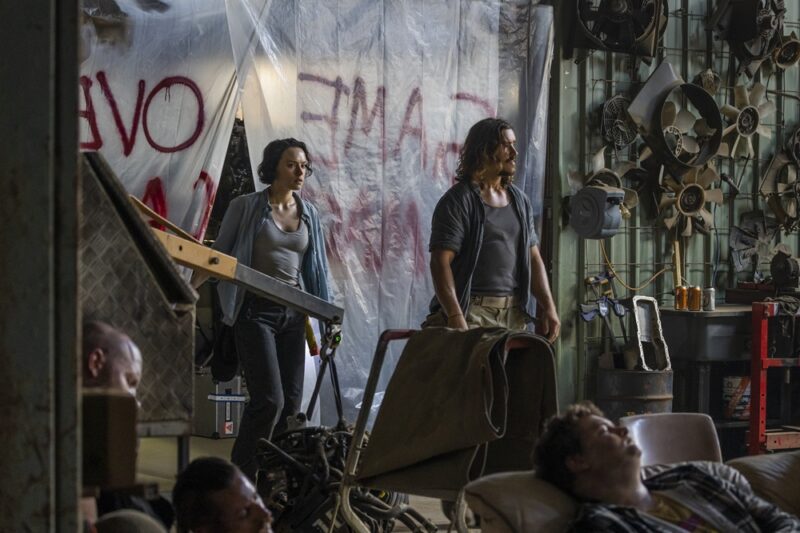
In the wake of a disastrous experimental military detonation off Tasmania’s eastern coast, Hobart has been obliterated, and much of the surviving population has been left brain-dead – though not entirely inert. Some of the dead begin to move again, driven by instincts that are at once frightening and strangely purposeful. Ava (Ridley), an American physiotherapist whose husband was in Woodbridge when the blast occurred, volunteers for an Australian “body retrieval unit,” tasked with collecting the deceased and alerting soldiers when the undead reawaken. What starts as a grim, methodical mission soon fractures into something far more personal when Ava abandons her post to search for her missing husband, Mitch (Matt Whelan), turning the film into a haunting cross-country odyssey through a broken island.
Ridley is the film’s emotional throughline, and she is doing some of her most compelling work here. Ava is not an action hero but a woman undone by guilt, longing, and the slow realization that her marriage was already fracturing before the world fell apart. Hilditch smartly weaves in flashbacks that reveal the cracks in her relationship with Mitch – infertility, infidelity, unspoken resentments – giving weight to her journey beyond simple survival. Her encounters with other survivors, particularly the volatile soldier Riley (Mark Coles Smith) and the conflicted volunteer Clay (Brenton Thwaites), function less as plot devices and more as mirrors reflecting different ways of coping with loss: obsession, denial, self-sacrifice, and desperation.
Where the film is most interesting is in its treatment of the undead themselves. Rather than presenting them as mindless predators, Hilditch suggests that they are animated by unfinished business – grief that refuses to let go, love that lingers beyond death. Some of the most chilling scenes involve the undead behaving not violently, but with unsettling calm: digging their own graves, tending to one another, or, in one devastating moment, walking away from their living child. These choices elevate the film above standard zombie fare, even if Hilditch occasionally retreats into more familiar genre territory when the narrative momentum demands it.
Ultimately, the film’s emotional ambition is both its greatest strength and its limitation. It reaches for something profound – a story about how people carry their dead, how guilt and love outlast the body – but doesn’t always have the structural discipline to sustain that reach. The pacing can feel lopsided, and the tension between artful grief drama and survival horror never quite resolves. Still, there is enough beauty, heartbreak, and conceptual intrigue here to make the experience worthwhile. It may not reinvent the undead genre, but it buries its roots deep enough in human emotion to leave a quiet, lingering ache long after the final image fades.


THREE STARS (OUT OF FIVE)
We Bury the Dead is now screening in Australian theatres.
