

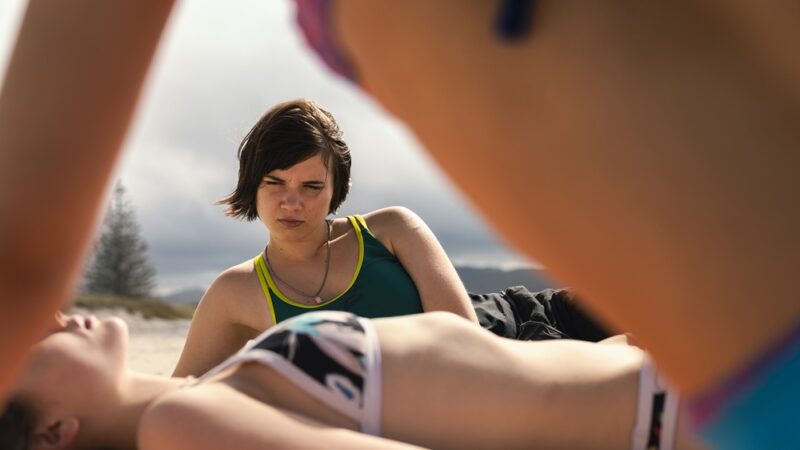
Set in rural New Zealand in 2006, Big Girls Don’t Cry revels in its own humid, jangling state of being. Writer/director Paloma Schneideman, emerging from Jane Campion’s orbit (the director serving as an executive producer), has made a debut that feels lived-in rather than observed, patiently slipping inside the skin of a 14-year-old girl who doesn’t yet have the language to name what she wants, but feels it everywhere.
At the center is Sid Bookman, played with piercing subtlety by newcomer Ani Palmer. Sid is all antennae – watching, absorbing, mirroring – her identity flickering between who she is and who she thinks she needs to be. Palmer rarely “acts” in the traditional sense; instead, she listens with her whole body. Every glance is evaluative, every posture an experiment. It’s the kind of performance that feels effortless while being astonishingly controlled, communicating entire interior worlds with the tiniest shift in expression.
Sid lives with her father, Leo (Noah Taylor), in a house that hums with emotional vacancy. Their relationship isn’t hostile, just hollow – a shared silence that leaves Sid hungry for connection elsewhere. Schneideman wisely avoids melodrama, letting awkward pauses and half-finished conversations speak volumes. That restraint extends across the film, which trusts discomfort rather than smoothing it over.
The film opens with a deeply unsettling online encounter that immediately establishes its stakes. In a pre-smartphone era of dial-up tones and MSN Messenger pings, Sid pretends to be older than she is, wandering into digital spaces where desire, danger, and curiosity blur. Schneideman never sensationalizes this; instead, she treats it as tragically ordinary – a reflection of a generation whose awakening was tangled up with the early internet’s dark glitter.
Sid’s orbit soon pulls her toward Lana (Beatrix Rain Wolfe) and her circle of older teens – cooler, sharper, and casually cruel in that very specific adolescent way. Lana isn’t framed as a villain, but as a gravitational force Sid can’t resist. Wolfe gives her an easy charisma that makes Sid’s fixation completely understandable, even as the dynamic grows emotionally precarious. These girls feel recognizable rather than caricatured: brittle, performative, and deeply insecure beneath their bravado.
Just as compelling is Sid’s bond with Freya (Rain Spencer), an American exchange student staying with her sister. Where Lana represents aspiration, Freya offers something warmer but more ambiguous: attention that feels validating yet complicated. Spencer plays her with an intriguing mix of openness and mystery, making their relationship feel both tender and slightly off-kilter – exactly like adolescence itself.
Visually, the film is intimate almost to the point of claustrophobia. Maria Ines Manchego’s handheld cinematography drifts toward faces, skin, and breath, keeping us anchored in Sid’s perspective even when things become painful to watch. Schneideman isn’t afraid of awkwardness; she lets moments stretch past comfort, capturing how humiliation and longing often coexist in the same breath.
If Big Girls Don’t Cry has a weakness, it’s that it doesn’t reinvent the coming-of-age wheel. Its themes of loneliness, imitation, desire, and the ache of wanting to belong are familiar territory. At times, the film feels more like a beautifully calibrated mood piece than a narrative that truly surprises. Compared to recent efforts as Eighth Grade or Dìdi, Schneideman’s debut is less formally adventurous, leaning instead on emotional authenticity.
But that authenticity is also precisely what makes the film land. Schneideman refuses to romanticize adolescence or wrap it in a tidy bow. Sid doesn’t emerge transformed or “fixed.” She simply knows a little more about herself, about others, and about how vulnerable she is in a world that doesn’t always protect her; that quiet, unspectacular realization carries real weight.
In the broader Sundance landscape of growing-up stories – from Lady Bird to My Old Ass to this year’s own slate of youth-driven films – Big Girls Don’t Cry finds its place as a tender portrait of queer girlhood in the mid-2000s: belly-button piercings, chatrooms, and all. It recalls the raw awkwardness of Eighth Grade with a touch of Thirteen’s restless energy, but filtered through a distinctly New Zealand sensibility.
Ultimately, Big Girls Don’t Cry doesn’t announce itself with fireworks. It lingers. It aches. It embarrasses you in the way your own teenage memories do. And in doing so, it marks Schneideman as a filmmaker of rare sensitivity, and Palmer as a startling new talent we’ll be watching for years to come.


THREE AND A HALF STARS (OUT OF FIVE)
Big Girls Don’t Cry is screening as part of this year’s Sundance Film Festival, running between January 22nd and February 1st, 2026. For more information on tickets and session times, head to the official site here.
