

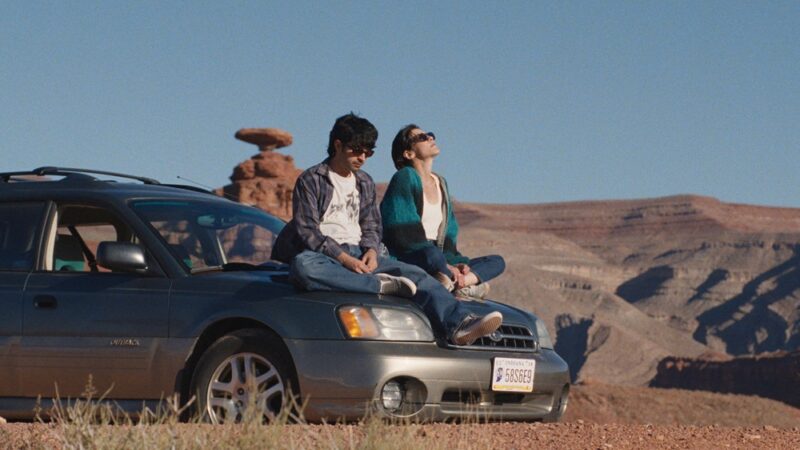
Ramzi Bashour’s Hot Water arrives as a gentle, road-worn meditation on movement, belonging, and the complicated geometry of parent-child love. More interested in texture than plot, the film drifts across America with a perceptive eye, finding both beauty and banality in the stretch of highways that carry a Lebanese mother (Lubna Azabal) and her troubled American son (Daniel Zolghadri) toward an uncertain future. The result is a film that is often affecting, intermittently striking, but also frustratingly diffuse – a debut rich in promise that doesn’t always know where to focus its gaze.
At the center of the film is Layal (Azabal), a tightly wound, intelligent woman whose life in Indiana feels both rooted and slightly out of place. When her son,Daniel (Zolghadri), is expelled from high school after a violent outburst with a hockey stick, she impulsively decides to drive him across the country to live with his father in Santa Cruz. What follows is a familiar but visually alluring procession of American iconography: endless cornfields, skeletal wind farms, snowy peaks, crimson desert rock, and the gaudy blaze of Las Vegas. Bashour shoots these landscapes with a lyrical patience that lends their journey an almost mythic quality, even as the film repeatedly undercuts that grandeur with the small, messy realities of family tension.
Azabal and Zolghadri are the film’s strongest assets. Their performances feel lived-in and quietly volatile – two people who love each other deeply but don’t quite know how to communicate. Layal’s phone calls to Beirut, where her sister updates her on their mother’s failing health, add a layered sense of displacement, reminding us that this road trip is about more than physical distance. Daniel, meanwhile, is a bundle of simmering resentment and adolescent insecurity, trying on versions of himself as he inches toward adulthood. Their dynamic is compelling enough that one occasionally wishes Bashour would slow down and sit with them longer rather than pushing them from stop to stop.
Where Hot Water falters is in its sense of narrative priority. Some of the film’s most distinctive material feels strangely sidelined. Brief glimpses of Layal teaching Arabic to her mostly white students – especially a charming, awkward pronunciation lesson – suggest a sharper, more culturally specific comedy that the film never fully embraces. Similarly, a fleeting, wordless moment of Daniel practicing pickup lines in the mirror is unexpectedly revealing, hinting at the vulnerability beneath his bravado. These scenes feel like tantalizing hints of a more incisive character study that remains largely unexplored.
Instead, the road is populated with a series of quirky encounters that land with mixed success. Dale Dickey’s turn as a free-spirited, proverb-spouting hippie registers as more ornamental than essential, a detour that stalls rather than deepens the journey. More effective are the quieter, stranger interactions – like a deadpan pre-teen motel clerk who calmly declares his vegetarianism while recommending fast food, or an encounter with an odorous hitchhiker that initially exposes a generational rift between mother and son before uniting them in shared disgust. These moments give the film its most authentic, offbeat pulse.
Ultimately, Hot Water is a film of currents rather than destinations – thoughtful, sometimes moving, and undeniably handsome, but also uneven in its storytelling. Bashour shows a keen sensitivity to landscape, culture, and performance, yet he doesn’t always seem certain which aspects of his story deserve the brightest light. As a debut, it’s a compelling glimpse of a filmmaker with a distinctive voice, even if the journey itself occasionally feels more interesting than the place it’s headed.


THREE STARS (OUT OF FIVE)
Hot Water is screening as part of this year’s Sundance Film Festival, running between January 22nd and February 1st, 2026. For more information on tickets and session times, head to the official site here.
