

Night Nurse arrives already cloaked in intrigue: a psychosexual thriller set not in a glossy penthouse or shadowy alleyway, but inside the pristine, hushed corridors of a luxury retirement community. It is, on paper, a promisingly perverse collision of caregiving, exploitation, and desire – a place where intimacy is transactional, trust is fragile, and vulnerability can be weaponized. Debut writer-director Georgia Bernstein clearly understands the potency of this setting. Unfortunately, while Night Nurse is frequently striking to look at and conceptually daring, it is also burdened by a lethargic pace and a central relationship that never quite ignites, leaving the film feeling more like a mood exercise than a gripping thriller.
The film opens with an unsettling stillness as Eleni (Cemre Paksoy), fresh-faced and eager, waits in a sleek conference room overlooking an indoor aquatic center. Below, elderly residents drift through their gentle exercises, bodies moving slowly in the water, but Bernstein imbues the scene with an almost predatory tension. There is something faintly wrong about the rhythm of the movement, the murmured conversations, and the way one man, Douglas (Bruce McKenzie), suddenly locks eyes with Eleni as if he has already chosen her. It is a smart, wordless introduction to the film’s central dynamic: the watchful patient and the impressionable caregiver.
After a cool, clinical interview with Doctor Mann (Mimi Rogers), Eleni is hired as Douglas’s overnight nurse. The setup is classic slow-burn erotic thriller territory – a young woman in a strange new environment, paired with a wealthy, manipulative older man whose charm feels like a thin veneer over something far more dangerous. Bernstein leans into this with confidence, allowing the facility itself to become a character: polished surfaces, echoing hallways, and an omnipresent sense that privacy is an illusion.
From a purely aesthetic standpoint, Night Nurse is often gorgeous. Lidia Nikonova’s cinematography bathes the film in dusky ambers, sickly greens, and midnight blues, recalling late-night cable thrillers without tipping into parody. The lighting keeps the blacks muted rather than inky, creating a soft, almost narcotic visual haze that mirrors Eleni’s gradual descent into moral ambiguity. Sam Clapp’s score, with its lilting piano lines, airy flutes, and subtle electronic undercurrents, further amplifies the film’s dreamlike quality, at times evoking a sultrier, more artful version of a classic Skinemax thriller.
Where the film begins to falter is in its pacing and narrative propulsion. Bernstein seems determined to move at a glacial tempo, stretching out moments of silence and stillness that are meant to feel laden with tension but instead grow repetitious. Scenes linger long after their dramatic purpose has been served, as if the filmmaker is hoping that simply slowing everything down will automatically lend the material gravitas. At times, this works – particularly in early scenes where Eleni is still finding her footing – but too often the film feels stuck in a soporific haze.
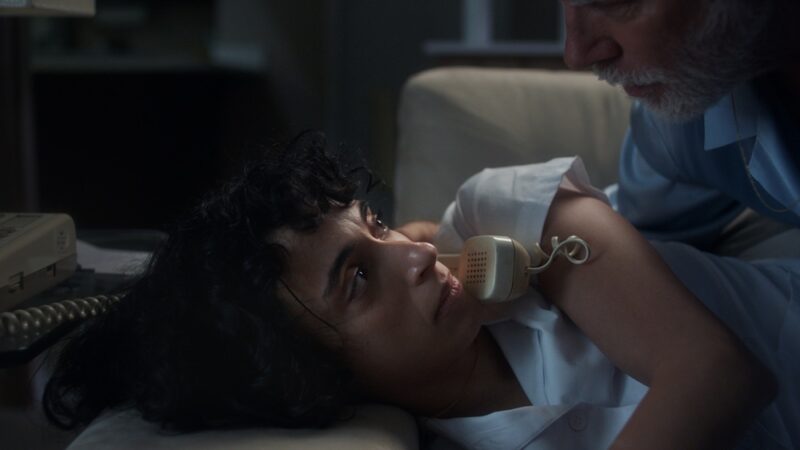
The plot truly kicks into gear when Douglas introduces Eleni to his scam. Late one night, he casually picks up his landline and, with unsettling ease, begins coaching her through a call in which she impersonates a troubled granddaughter needing money to be bailed out of jail, with Douglas posing as a lawyer, a larger picture scheme intending to extract money from another resident. Eleni, initially hesitant, quickly becomes complicit, and the film pivots from a simmering character study into a tale of exploitation. It is here that Bernstein reveals her most provocative – and arguably most flawed – idea: that caregiving, manipulation, and sexual power can become intertwined in intoxicating, destructive ways.
Eleni is not alone in this descent. She shares an apartment within the facility with Mona (Eleonore Hendricks), her daytime counterpart, who is already deeply entangled in Douglas’s scheme. Together, the two nurses slip into a strange, pseudo-harem dynamic, lounging in Douglas’s apartment, playing along with his con, and basking in the control he exerts over them. Bernstein leans heavily into the film’s erotic undercurrents during these sequences, framing Eleni and Mona as both victims and willing participants in a morally murky game.
And yet, for all its stylistic boldness, this is where Night Nurse becomes increasingly frustrating. The film never fully convinces us why these two women – particularly Eleni – would surrender so much of themselves to a man who is not only deceitful but openly chauvinistic and manipulative. Douglas is drawn as a smarmy ringleader, but Bernstein stops short of truly interrogating his power or the psychological dynamics at play. Instead, the film lingers on moody imagery and suggestive glances, hoping atmosphere will compensate for underdeveloped motivation.
As the scam escalates and draws unwanted attention from other residents and staff, Night Nurse attempts to pivot into darker, riskier territory. But by this point, it has lost much of its narrative momentum. Rather than feeling like an inevitable crescendo, the film’s later twists come across as somewhat forced, pushing Eleni into actions that make her increasingly difficult to sympathize with. What begins as a compelling portrait of a young woman seduced by danger devolves into a story where she seems less like a complex character and more like a vessel for Bernstein’s thematic preoccupations.
This is perhaps the film’s greatest weakness: its characters are more interesting as ideas than as people. Paksoy is intriguingly cast and often mesmerizing to watch, but her inner life remains frustratingly opaque. Hendricks fares slightly better, bringing a sly, lived-in energy to her role, but even she ultimately feels underwritten. McKenzie, meanwhile, is suitably repellent but never quite as charismatic or threatening as the film wants him to be.
None of this is to say that Night Nurse is without merit. Bernstein demonstrates a strong command of mood, composition, and tone – hallmarks of a filmmaker with real potential. There are moments of genuine tension, flashes of psychological insight, and a bold willingness to explore taboo dynamics that many filmmakers would shy away from. The concept of nurses being drawn into a patient’s con is inherently compelling, and in a sharper, more tightly paced version of the film, it could have been truly electrifying.
As it stands, however, Night Nurse feels like a tantalizing misfire: a film that looks and sounds seductive but too often moves at a crawl, mistaking slowness for depth. Bernstein’s eye is undeniable, and her ambition admirable, but this debut ultimately collapses under the weight of its own languor. One leaves Night Nurse admiring its craft while wishing, quite desperately, that it had a stronger pulse.


TWO AND A HALF STARS (OUT OF FIVE)
Night Nurse is screening as part of this year’s Sundance Film Festival, running between January 22nd and February 1st, 2026. For more information on tickets and session times, head to the official site here.
