
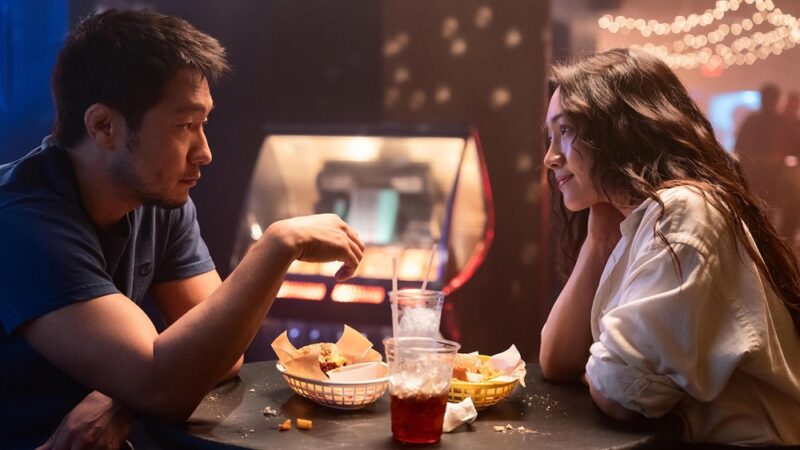
Bedford Park announces Stephanie Ahn as a filmmaker unafraid of emotional exposure – sometimes to a fault, but more often to devastating effect. Set between the push and pull of cultural obligation and personal survival, the film traces Audrey, a Korean American woman shaped by sacrifice as a love language, and Eli, an ex-wrestler whose body has outlived his certainty. What unfolds is not a conventional romance so much as a slow, bruising excavation of what it costs to belong – to a family, a culture, and, eventually, to yourself.
The narrative catalyst arrives when Eli is involved in a minor car accident that leaves Audrey’s mother injured, an incident that unwillingly binds two strangers together. What initially unfolds as a purely transactional arrangement – obligation, guilt, and practical necessity dictating their interactions – slowly evolves into something more intimate and emotionally charged. As Eli attempts to make amends and Audrey navigates the weight of familial duty, their forced proximity becomes a space for unspoken griefs to surface, allowing connection to emerge not through romance, but through shared vulnerability and quiet recognition.
The performances are superb across the board, anchoring the film’s quiet intensity. Moon Choi delivers a restrained, heartbreaking turn as Audrey, communicating years of inherited expectation through the smallest gestures. It’s the kind of performance that doesn’t announce itself as impressive until you realize how deeply it’s gotten under your skin. Son Suk-ku, meanwhile, brings a wounded stillness to Eli, playing him not as a savior or a project, but as someone equally unsure of where to place his pain. Their chemistry is hesitant, fragile, and deeply human – a bond formed less through grand declarations than shared silence.
Ahn’s direction is deliberate, even austere, trusting the audience to sit with discomfort rather than rushing toward catharsis. This patience is both the film’s greatest strength and its most testing quality. Bedford Park moves at a measured pace that mirrors its characters’ emotional paralysis, but viewers expecting narrative momentum may find themselves restless. The film resists easy release, lingering instead in unresolved feelings and emotional stalemates; a choice that feels thematically honest, if occasionally punishing.
What ultimately elevates Bedford Park is its ability to speak from a deeply specific cultural experience while reaching toward something universal. The tension between self-sacrifice and self-love, between filial duty and personal desire, transcends its Korean American context without ever diluting it. Ahn’s script understands that love, especially within immigrant families, is often expressed through endurance rather than affirmation, and it asks whether that inheritance can be transformed without being betrayed.
There are moments where the film’s earnestness threatens to tip into heaviness, where its introspection circles rather than advances. But even in its most demanding stretches, Bedford Park remains emotionally sincere and richly observed. It’s a film that asks a lot of its audience – patience, empathy, vulnerability – and repays it not with neat answers, but with a quiet, lingering ache.
Heartbreaking, beautifully acted, and deeply personal, Bedford Park may test some viewers’ endurance, but for those willing to meet it on its own terms, it offers something rare: a love story that understands healing as a process, not a resolution.


THREE AND A HALF STARS (OUT OF FIVE)
Bedford Park is screening as part of this year’s Sundance Film Festival, running between January 22nd and February 1st, 2026. For more information on tickets and session times, head to the official site here.
