

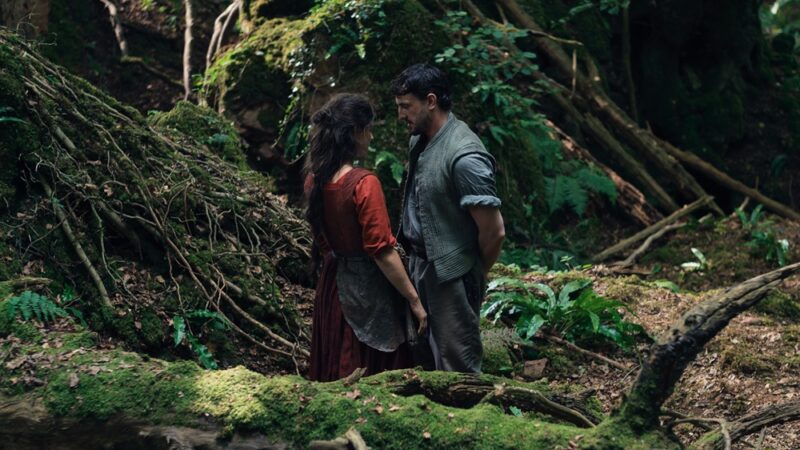
Hamnet is a film that feels less like it’s being watched than lived alongside. It moves with the hush of grief, the ache of memory, the strange, half-lit space where love continues after loss has shattered its original shape. From its opening scroll – a simple historical truth that “Hamnet” and “Hamlet” were once interchangeable – the film signals its quiet ambition: not to mythologise Shakespeare, but to humanise the wound that may have given rise to his most enduring work.
This is not a biopic, nor a literary exercise in reverence. It’s a love story fractured by plague, by distance, by the unknowable cruelty of chance. Chloé Zhao directs with an almost elemental patience, letting the forest breathe, the wind carry whispers, and silence speak louder than dialogue ever could. Stratford and London feel like opposing emotional climates – one rooted in earth and intuition, the other restless, performative, and estranged.
Jessie Buckley’s Agnes is the film’s beating heart. She is astonishing and thunderous, feral and tender in equal measure. Buckley doesn’t play grief as something that arrives all at once; she allows it to seep, to corrode, to rearrange Agnes from the inside out. Her connection to the natural world – the hawk, the woods, the cave that feels like a portal between realms – gives her a spiritual authority that unsettles everyone around her. When Agnes loses her gift of foresight after Hamnet’s death, it feels like a second bereavement: the future itself has gone dark.
Paul Mescal, quietly devastating, resists the temptation to lionise William Shakespeare. His William is a man split in two – husband and father in Stratford, artist and survivor in London – forever failing to reconcile those selves. Mescal plays him with restraint and sorrow, his brilliance inseparable from guilt. The writing of “Hamlet” is not framed as triumph, but as necessity: a way to keep breathing when the air has been knocked from his lungs.
At the centre of it all is Jacobi Jupe’s Hamnet, whose performance is nothing short of heartbreaking. There’s an openness to him, a gentleness that makes his fate unbearable even as the film moves inexorably toward it. His bond with sister Judith (Olivia Lynes), his desire to protect her, his vision of himself standing on a stage calling for his mother – these moments linger like bruises you keep touching long after they’ve formed.
Zhao’s greatest achievement is how she frames art not as consolation, but as transformation. Agnes’s fury when she first sees “Hamlet” performed – the sense that her son’s name has been violated – is raw and justified. But as the play unfolds, something shifts. When William appears as the ghost, when the dying Hamlet reaches out and Agnes reaches back, the boundary between life, theatre, memory, and spirit dissolves. The audience’s collective gesture, hands extended, feels like a shared act of mourning across centuries.
The final image – Hamnet smiling, stepping backstage through a dark opening that mirrors Agnes’s forest cave – is devastating and strangely hopeful. Not because grief ends, but because love finds another way to move.
Hamnet is a film about carrying love differently after loss: how it changes shape, how it finds new vessels, how it refuses to disappear. It doesn’t ask to be admired so much as felt. And once it settles inside you, it doesn’t leave.


FIVE STARS (OUT OF FIVE)
Hamnet is screening in Australian theatres from January 15th, 2026.
