

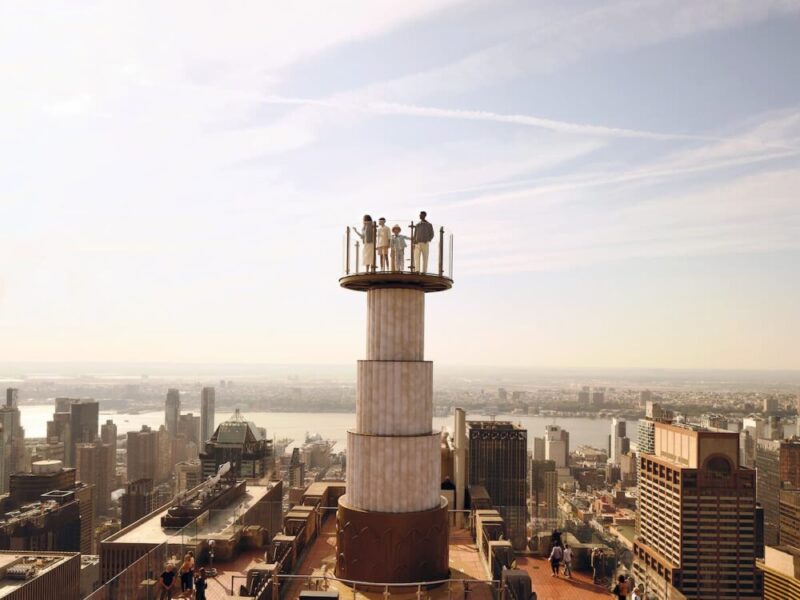
New York City’s famous Top of the Rock represents its limitless ambitions in many ways that Manhattan’s other observation decks cannot. And I can qualify that by looking at how warm and energising the feeling of nostalgia is.
Whether it’s your first time up to the iconic deck, or your fifth, you’ll know that feeling. It’s hard to describe, really.
Most people grow up with some sort of mental map in their head of what New York City looks and sounds like. When they actually see it for the first time, that mix of anticipated familiarity and actual observation collides in a deeply affecting way. And for most visitors, it’s here where it typically hits the hardest.
Of the several main observation decks that offer various perspectives of the city, it’s this one that feels most connected to the restless concrete jungle because of its position, grounded in Midtown where the skyline reads like a full panorama, rather than an angle.
Because of the 360-degree view, you’re able to make more seamless connections between Manhattan’s masterful cityscape, and the scale of it all hits you like a palette of pastrami as soon as you walk out onto any of the three outdoor observation decks.
The visual impact has a harder texture to it as a result. And because the observation decks are fully outdoors, above some of the city’s tallest skyscrapers, there’s a filmic quality you just don’t get when staring at such ambition through glass. As such, it seems like the excitement is much more palpable.
And that’s exactly why I make it a point to head on up whenever I’m in town.

Just once is never enough
New York’s observation decks are considered in the same way as Ellis Island and Times Square. You only really need to do them once, ticking them off the ol’ bucket list before moving on to things with more replay value. Top of the Rock hits differently, and I think a lot of it has to do with empathy.
As I wrote in this piece about Santa Monica Pier, there’s something to be said about being around people who are seeing this city for the very first time. The excitement is infectious. I get that tinge of second-hand nostalgia every time someone rushes to point out the Chrysler Building or squints to catch an eyeful of Lady Liberty.
It’s got plenty to do with biology. Think of why watching other people react to things on YouTube has become such a popular category in the past ten years. Empathy is a powerful tool, and watching people experience something for the first time is the closest you’ll get to that first moment. You know, that one where your eyes couldn’t stop darting excitedly from one end, staring at the Empire State Building. To the other, with its god-smaking view of Central Park and beyond.
There’s a great deal of dynamism up here as well, particularly with the 2024 opening of the multi-coloured Skylift.
What is the Top of the Rock Skylift?
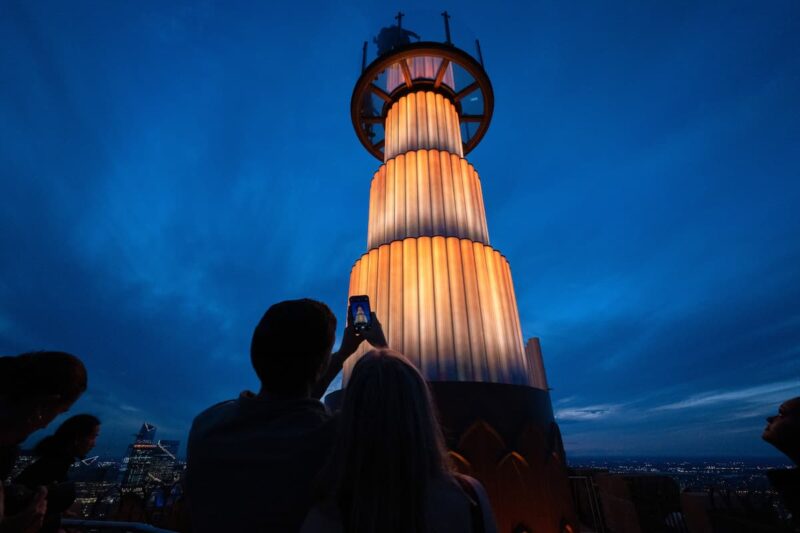
Opened in 2024, Skylift is the latest innovation for New York’s observation decks, built as a circular 360-degree open-air platform; the three-tiered device lifts a few guests above the 70th-floor observation deck for an even taller, more immersive viewing experience. When fully extended, the silhouette looks like a wedding cake; the LED body adds a nice tech-forward detail to what’s already an electric skyline.
The glass platform lifts three stories above the 70th floor deck, rising above any obstacles for an aggressively open, unobstructed view. Once onboard, you’re lifted around 30 feet in the air and spun around, slowly, for a truly spectacular view of Manhattan and beyond. The only view that beats this one is soaring over Manhattan in a doors-off helicopter.
Skylift’s architecture is impressive in and of itself as well. It’s built to represent a mini Rockefeller Centre with art deco styling modernised by 69 programmable LED pixel flutes that can change colours as the base extends into the sky. A camera has been built into the centre, so all you have to do is walk around while it takes a panoramic photo for you.

What about The Beam?
There’s another neat way to see New York’s skyline atop Rockefeller Plaza. Head to the middle observation deck, the one on the 69th floor, and you’ll find The Beam. There are two of them, recreating the famous steel beam that was featured in the iconic 1932 black-and-white photograph Lunch Atop a Skyscraper. You know, the one taken from a stomach-churning height as eleven ironworkers post on a steel beam while dangling above the city.
You only get to recreate the photo, though. You and your friends sit on the beam, and it lifts into the air before slowly turning around so you get unobstructed views of Central Park and beyond. You aren’t wooshing out into the night’s sky, so it’s not as adrenaline-inducing as it sounds. That works against the experience as well. The Skylift is much more essential, with The Beam getting most of its value from the souvenir photograph you get at the end.

Tips for visiting Top of the Rock
Time your visit
Everyone knows sunset is going to be the busiest time up here, and it’s hard to time things in Manhattan. You don’t necessarily want to give up two hours of your day if you don’t have to, but I recommend showing up 90 minutes before sunset. You’ll not only get the clarity of daylight first, but you should easily be able to grab a front row seat to one of the greatest sunsets on earth.
Calm down at The Weather Room
This indoor-outdoor transition space is where you should slow down, acclimate, and get your bearings. It’s climate-controlled and less windy, so if you’re waiting for the crowds to thin out, or you’re just taking your time, it’s worth popping on over here for a Martini.
Don’t think of it as somewhere to retreat from the view. Think of it as a palate cleanser between visits outside. New York has a way of overwhelming your senses, particularly from up here, and stepping back inside for ten or fifteen minutes makes that next walk onto the observation deck feel surprisingly fresh. Floor-to-ceiling windows ensure you’re never disconnected from the skyline, but the quieter atmosphere means this is one of the only places where you can really take it all in without the families running around. And there’s a lot to take in.
Eat dinner downstairs
Most observation decks have their own restaurants now. Some have fine-dining, others casual. Rockefeller Centre is at an advantage because it hits all those price points. There’s Le Rock for classic French dishes, but I can’t speak to the quality. I can, however, rave about my experiences at Naro, the rink-level Korean eatery from the same team behind my favourite restaurant in America, Atomix.
There’s nothing Junghyun “JP” Park can do wrong in my eyes. From the butter-soft Korean Fried Chicken at nearby diner Atoboy, to the creativity on display here. I’ve only visited twice, once it leaned further into a fine dining format, with set menus and premium soju, and another when they brought it down a notch to something a bit more casual.
I’m not sure what version you’ll get when you head into Naro, but both times were exceedingly delicious. Clearly JP has strong relationships with top suppliers because the ingredients are packed full of flavour, delicate and not overly complicated. You won’t get the same experience if you opt out of the drinks pairing, though. Cocktails here are some of the best in the city (not joking), pulling out interesting combinations like one with popcorn-infused rum, mezcal, oat milk and honeydew.
You only get to recreate the photo, though. You and your friends sit on the beam, and it lifts into the air before slowly turning around so you get unobstructed views of Central Park and beyond. You aren’t whooshing out into the night’s sky, so it’s not as adrenaline-inducing as it sounds. That works against the experience as well. The Skylift is much more essential, with The Beam getting most of its value from the souvenir photograph you get at the end.
To plan your day at Top of the Rock, head to the Rockefeller Centre website.
Where to Stay in New York City
1 Hotel Central Park (for sustainable luxury) | REVIEW
Few luxury hotel brands have committed to sustainability as convincingly as 1 Hotels, and its Central Park property is one of the best examples. Just steps from the park, the five-star hotel feels almost like an extension of it, layering reclaimed wood, exposed brick, greenery and organic materials throughout its rooms and public spaces. The environmental thinking goes deeper than aesthetics, with filtered water taps, organic cotton linens and other small touches designed to cut waste without compromising comfort. Most importantly, the biophilic design provides a surprisingly effective antidote to Midtown Manhattan, making this a particularly restful base if you want to stay right in the thick of New York without feeling like it every time you return to your room. Expect to pay around US$900 per night on average.
New York Hilton Midtown (for sightseeing)
Location does a lot of the heavy lifting at New York Hilton Midtown. The enormous hotel sits on Sixth Avenue directly opposite the Museum of Modern Art, with Radio City Music Hall and Rockefeller Centre just two blocks away, so you can walk to Top of the Rock in a matter of minutes. Central Park is an easy stroll in the other direction, while Broadway and Times Square are both within a mile. Rooms are spacious by Manhattan standards and many look out across the Midtown skyline, making this a particularly practical base for travellers who plan on spending most of their time exploring. Expect to pay around US$400 per night on average.
Hilton New York Times Square (for big city energy) | REVIEW
Few locations throw you into New York quite as emphatically as Hilton New York Times Square. The 44-storey hotel rises above 42nd Street, putting Broadway theatres, Bryant Park and some of Midtown’s biggest attractions within easy walking distance while giving you enough elevation to escape some of the chaos below. Rooms are unusually spacious for the neighbourhood and the real draw is the view, with sweeping perspectives across Manhattan and the Hudson River, while select rooms even look towards the famous New Year’s Eve ball drop. It’s an easy recommendation for a first-time visitor who wants the full lights-and-skyscrapers version of New York waiting outside their hotel. Expect to pay around US$350 per night on average.
Tips for travelling in New York City
Look, you just can’t do New York City without data. It’s impossible. You can try to go rogue, but the city will eat you alive. Reservations? A lot of them are via Instagram now. Even the best parties require you to head to RSVP links at the last minute, when you’re out and about. An eSIM is simply a non-negotiable, and it’s worth budgeting for one no matter how long you’re going to be abroad.
There are a few brands, but I like using Simify. The eSIM offers preset blocks of data (such as fixed GB amounts or capped daily limits) for duration increments ranging strictly from 7 to 90 days. If you’re overseas for a long time, it tends to work out substantially cheaper than some competing eSIM brands.
But coverage is the most important thing to know, right? It’s more than fine in the US. Plans are data-only, so you won’t have a local number, but coverage is always quite strong as you’re using local networks from Simify’s partnerships around the world. You can check them out here.
