The AU Review’s Best Films of 2025

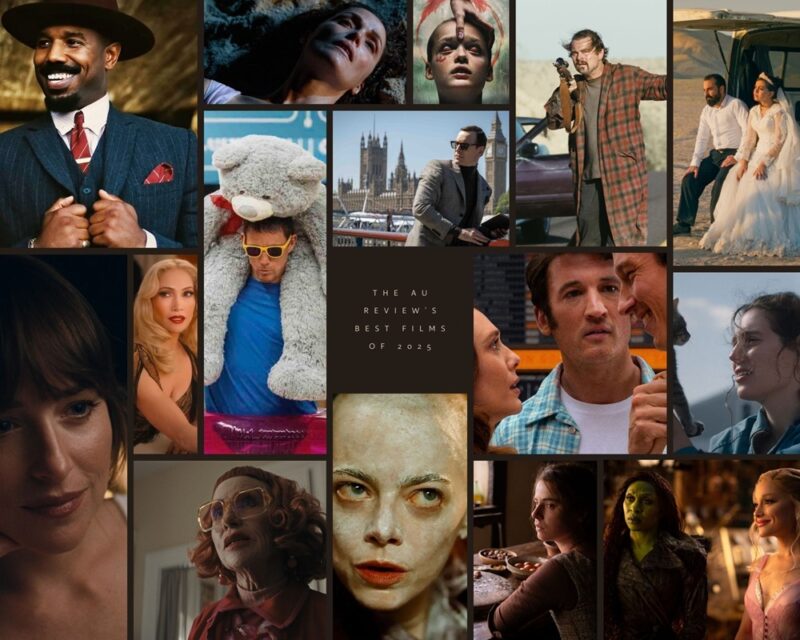
2025 has proven to be a year of cinematic surprises, a period where filmmakers pushed boundaries, challenged expectations, and delivered stories that linger long after the credits roll. From pulse-pounding thrillers that leave you breathless, to intimate dramas that pierce the heart with quiet, unflinching honesty, this year’s films navigated extremes – emotional, visual, and moral – with fearless precision.

We’ve seen inventive reimaginings of familiar tales, audacious genre experiments, and performances so magnetic they redefine what it means to inhabit a character. Audiences were haunted by tales of grief and trauma, captivated by darkly comedic takes on human relationships, and thrilled by high-stakes action and morally complex antiheroes. Whether exploring the consequences of violence, the fragility of love, or the unflinching truths of history, 2025 reminded us why cinema matters: it can provoke, delight, terrify, and stay with us long after the lights come up. Here is our roundup of the year’s most unforgettable films.

Black Bag

Black Bag is a sleek, dialogue-driven spy thriller that eschews heavy action for narrative tension and character intrigue, showcasing Steven Soderbergh at his most stylish and precise. Michael Fassbender and Cate Blanchett star as George and Kathryn, a married pair of master spies entangled in a web of secrecy, mistrust, and desire, as a compromised project forces George to interrogate colleagues over a tense week-long period. David Koepp’s sharp script balances suspense with wit, giving each character distinct motives and vulnerabilities, while Soderbergh’s direction keeps the 94-minute runtime taut and compelling. With its clever twists, intense character dynamics, and the magnetic chemistry of its leads, Black Bag is an intelligent, adult-oriented thriller that revitalizes familiar genre territory with elegance and flair.

Read our full review HERE.

Black Phone 2

Black Phone 2 proves that not all sequels are unnecessary, building on Scott Derrickson’s 2022 original with a bold, atmospheric follow-up that expands its supernatural and psychological dimensions. With The Grabber (Ethan Hawke) now tormenting victims from beyond the grave, the story shifts focus to Gwen (Madeleine McGraw), whose inherited psychic abilities allow her to confront lingering trauma and generational damage, while her brother Finn (Mason Thames) reluctantly aids her. Set against the chilling backdrop of a Christian winter camp, the film intertwines grisly, visually striking violence with emotional stakes, exploring the lasting effects of surviving brutality. Enhanced by a nostalgic 1980s aesthetic, immersive Super 8-style visuals, and a hypnotic score by Atticus Derrickson, the sequel manages to feel genuinely dangerous, suspenseful, and emotionally resonant, arguably surpassing its predecessor in both tension and thematic depth.

Read our full review HERE.

Bring Her Back

Bring Her Back firmly establishes Danny and Michael Philippou as modern horror auteurs, surpassing even the intensity of their debut Talk To Me with a 100-minute descent into dread and psychological terror. Opening with grainy, VHS-like imagery and a lifeless body, the film immediately immerses audiences in a world where brother-and-sister foster kids Andy (Billy Barratt) and visually impaired Piper (Sora Wong) face manipulation from their new carer, Laura (Sally Hawkins, chillingly excellent), whose own grief over her deceased daughter drives her to increasingly violent acts. The narrative explores trauma, generational grief, and the extremes people reach for love, all while delivering deliberately unsettling, graphic horror moments – from self-mutilation to teeth-focused terror – that push even seasoned genre fans. With immersive sound design, somber cinematography, and standout performances, Bring Her Back is a bleak, haunting, and masterfully crafted horror that cements the Philippou brothers’ prowess in the genre.

Read our full review HERE.

Bugonia

Yorgos Lanthimos’s Bugonia may be one of his most accessible films, but it remains a bleakly funny, unsettling satire that skewers corporate power, conspiracy culture, and humanity’s capacity for self-destruction. Reuniting with Emma Stone in her fourth collaboration with the director, the film centres on her icy pharmaceutical CEO Michelle Fuller, who is kidnapped by paranoid activist Teddy (a phenomenal Jesse Plemons) convinced she is an alien plotting Earth’s downfall. What unfolds is a tense, darkly comic chamber piece that balances farce with tragedy, using bee mythology, class allegory, and corporate hypocrisy to explore trauma, escapism, and the seductive clarity of certainty. As Teddy’s delusions are slowly contextualised through personal loss and systemic failure, Lanthimos and writer Will Tracy transform a bizarre premise into a mordant meditation on whether humanity deserves saving at all, leaving audiences to wrestle with the film’s apocalyptic cynicism and uneasy sliver of hope.

Read our full review HERE.

Eternity

David Freyne’s Eternity is a warmly classical, unexpectedly wholesome romantic comedy that playfully subverts the modern “A24 movie” expectation by embracing old-fashioned charm, wit, and emotional sincerity. Built around a clever afterlife conceit, Pat Cunnane’s script reimagines the classic woman-torn-between-two-men trope as Elizabeth Olsen’s Joan must choose eternity with either her longtime husband Larry (Miles Teller) or her first love Luke (Callum Turner), a romance cut short by war. The film’s limbo setting adds visual whimsy and comic invention, while Da’Vine Joy Randolph and John Early provide scene-stealing support as afterlife coordinators, balancing humour with heart. Anchored by sparkling chemistry and Olsen’s effortless comedic brilliance, Eternity recalls the golden age of rom-coms while feeling refreshingly sincere, delivering a funny, romantic, and emotionally resonant crowd-pleaser that may well become a modern genre classic.

Read our full review HERE.

Hamnet

Hamnet is a potentially triggering and emotionally wrenching film that offers a hauntingly unique take on a Shakespeare story we think we know. Jessie Buckley delivers a phenomenal performance as Agnes Hathaway, matched by Paul Mescal’s quietly devastating portrayal of William Shakespeare, as the couple grapples with the tragic death of their 11-year-old son, Hamnet – a loss that inspires the creation of Hamlet. With strong support from Emily Watson and Joe Alwyn, the largely fictionalized narrative explores the profound impact of grief on their marriage, leaving a lasting emotional impression.

Hamnet is scheduled for release in Australia on January 15th, 2026. Look for our full review coming soon.

If I Had Legs I’d Kick You

Mary Bronstein’s If I Had Legs I’d Kick You is a punishingly intimate, darkly comic portrait of motherhood as an all-consuming, thankless labour, anchored by a career-best performance from Rose Byrne. Shot in suffocating close proximity to Byrne’s Linda, the film immerses us in her unraveling world: a chronically ill child, an absent husband, professional and financial collapse, and a society quick to judge yet slow to offer empathy. By keeping Linda’s daughter largely unseen, Bronstein underscores the invisible weight of caregiving and Linda’s desperate struggle to retain an identity beyond motherhood, while encounters with figures like a suspiciously kind motel manager (A$AP Rocky) heighten the film’s relentless tension. Exhausting, unsettling, and bleakly funny, the film is an unforgettable, if emotionally draining, experience – one whose lasting power comes from Byrne’s fearless, full-bodied embodiment of a woman barely staying afloat.

Read our full review HERE.

It Was Just An Accident

Jafar Panahi’s It Was Just an Accident is a masterclass in restraint, a quietly devastating thriller that derives its immense power from moral tension, lived experience, and unsettling ambiguity rather than spectacle. Built around a deceptively simple premise, the film follows Vahid, a former political prisoner who abducts a man he believes was his former torturer, then seeks out fellow survivors to help identify him and share the unbearable responsibility of deciding his fate. Unfolding through charged conversations, silences, and hesitation, Panahi transforms memory and doubt into sources of suspense, refusing easy binaries around justice, trauma, or revenge. With humane, precise direction, deeply naturalistic performances, and a chilling final image that lingers as a moral reckoning, the film implicates the audience in its questions, standing as one of Panahi’s most powerful and enduring works.

It Was Just An Accident is scheduled for release in Australia on January 29th, 2026. Look for our full review coming soon.

Kiss of the Spider Woman

Bill Condon’s Kiss of the Spider Woman is a lush, deeply romantic, and boldly queer musical that finally gives Jennifer Lopez the movie-musical showcase she was always destined for, and she seizes it with star-redefining force. Playing the glamorous Ingrid Luna across a dazzling film-within-a-film, Lopez channels classic Hollywood sirens with commanding vocals, sensual physicality, and hypnotic screen presence, anchoring musical sequences that revel in colour, fantasy, and escapism. These heightened numbers are poignantly contrasted with the grounded prison drama between Tonatiuh’s revelatory Molina and Diego Luna’s restrained Valentin, whose evolving bond becomes the film’s emotional and political heart. Balancing spectacle with intimacy, fantasy with brutality, and longing with survival, Condon crafts a breathtaking ode to cinema, queerness, and the transformative power of imagination, with Lopez’s incandescent performance elevating the film into something truly unforgettable.

Read our full review HERE.

One Battle After Another

Paul Thomas Anderson’s One Battle After Another stands as one of his most ambitious and urgent works, blending anarchic black comedy, political satire, and visceral action into a scathing portrait of modern America. Loosely inspired by Thomas Pynchon’s Vineland, the film follows washed-up revolutionary Bob Ferguson (a ferocious Leonardo DiCaprio) and his teenage daughter as they’re hunted by the grotesquely corrupt Colonel Lockjaw (a terrifyingly unhinged Sean Penn), with the film gradually finding its rhythm after a deliberately chaotic, prologue-heavy opening. Beneath its farcical violence and manic energy lies a sharp meditation on power, corruption, and ideological decay, bolstered by standout turns from Chase Infiniti and Teyana Taylor. Demanding, unruly, and defiantly non-commercial, the film rewards patient viewers with a thrilling, pointed, and darkly hilarious experience that reaffirms Anderson’s status as one of contemporary cinema’s most vital voices.

Read our full review HERE.

Roofman

Roofman tells the astonishing true story of Jeffrey Manchester, a man who robbed 45 McDonald’s locations by entering through the roofs in a bid to provide for his daughter and improve his life, balancing criminality with a fundamentally kind-hearted nature. Under Derek Cianfrance’s direction and co-written with Kirt Gunn, the film blends humor, charm, and emotional weight, anchored by Channing Tatum’s effortlessly charismatic performance that makes Jeffrey’s mischief oddly endearing. From his first heist to his daring prison escape and inventive hideout in a Toys “R” Us, the film captures both the thrill and the human cost of his actions, including a tender, low-key romance with single mother Leigh Wainscott (Kirsten Dunst). While the true story ensures a bittersweet outcome, Roofman navigates its eccentric, almost farcical premise with care, delivering a heart-rending, darkly funny, and surprisingly accessible portrait of a man torn between freedom, love, and the consequences of his choices.

Read our full review HERE.

Sinners

Ryan Coogler’s Sinners is a liberated, audacious return to original filmmaking: a slow-burn 1930s Mississippi period piece that erupts into a ferocious vampiric horror, using blues mythology and supernatural violence to interrogate Black artistry, community, and survival under white supremacy. Framed through the eyes of young guitarist Sammie Moore (a striking Miles Caton), and anchored by Michael B. Jordan‘s magnetic dual performance as the Smokestack Twins, the film patiently builds a lived-in world of music, desire, ritual, and marginalised fellowship before unleashing brutal carnage that only deepens its emotional stakes. Drawing inspiration from Robert Johnson folklore, Coogler fuses sex, blood, and sound into an allegorical meditation on power, exploitation, and cultural inheritance, bolstered by Autumn Durald Arkapaw’s evocative cinematography, a richly textured ensemble, and a rousing, time-transcending musical vision. Bold, political, and wildly expressive, Sinners announces Coogler at his most fearless and artistically unbound.

Read our full review HERE.

Sorry, Baby

Sorry, Baby is a darkly comedic yet devastating exploration of trauma and its lingering effects, following teacher-in-training Agnes (Eva Victor, who also wrote the film) as she navigates life after a sexual assault by her professor. Told through vignette-style snapshots of her past, present, and tentative future, the film captures the quiet, often mundane moments – ranging from frustrating encounters with a female-heavy disciplinary board to tender instances like adopting a stray kitten – that carry immense psychological weight. Victor delivers a masterful, dryly comedic performance that internalizes Agnes’s pain while allowing space for uncomfortable humor, supported by Naomi Ackie, Lucas Hedges, and Kelly McCormack, who each enrich the story’s emotional texture. With its focus on subtlety, small gestures, and the intersections of friendship, justice, and survival, Sorry, Baby transforms ordinary moments into a powerful meditation on resilience and the complexity of moving forward after trauma.

Read our full review HERE.

Splitsville

Michael Angelo Covino’s Splitsville is a sharp, funny, and surprisingly heartfelt “unromantic comedy” that explores the messy, complicated realities of modern relationships. Centered on Carey (Kyle Marvin) and his wife Ashley (Adria Arjona), who faces divorce, and their friends Paul (Covino) and Julie (Dakota Johnson), whose open marriage fascinates Carey, the film navigates romantic, sexual, and platonic boundaries with wit and empathy. While its farcical situations generate laughs – most notably Carey’s impulsive entanglement with Julie – the emotional grounding of the characters makes the comedy resonate deeply. The ensemble delivers layered performances, with Marvin’s hapless Carey, Covino’s cluelessly charming Paul, and the dry, perceptive Johnson and Arjona anchoring the film’s relational dynamics. By earnestly portraying sexual and emotional exploration, Splitsville turns its grounded, messy realism into something unexpectedly romantic, relatable, and delightfully funny.

Read our full review HERE.

The Things You Kill

Alireza Khatami’s The Things You Kill is a haunting, intellectually charged thriller that transcends genre to explore transformation, masculinity, and inherited violence through ambiguity and symbolism. Centred on Ali, a Turkish language professor confronting unsettling truths about his family, the film begins as a restrained character study before deepening into a psychological reckoning driven by grief, suspicion, and self-destruction following his mother’s death. The arrival of a drifter, Reza, acts as a catalytic mirror to Ali, embodying traits he lacks and pushing the narrative toward a poetic, unsettling conclusion that resists literal explanation in favour of psychological resonance. Richly textured with thoughtful supporting characters and shaped by Khatami’s precise, patient direction, the film gradually reveals its intentions through its enigmas, ultimately proving as intoxicating as it is suspenseful.

Read our full review HERE.

Thunderbolts*

Thunderbolts* reinvigorates the MCU with a morally complex, emotionally resonant anti-hero story that balances drama, humour, and practical action set-pieces. Directed by Jake Schreier and written by Eric Pearson and Joanna Calo, the film follows a team of flawed operatives – including Florence Pugh’s standout Yelena Belova, Sebastian Stan’s Bucky Barnes, and Lewis Pullman’s Bob – tasked by CIA director Valentina Allegra de Fontaine (Julia Louis-Dreyfus) to eliminate rogue threats, only to confront their own personal demons along the way. Unlike recent MCU entries, Thunderbolts* foregrounds emotional stakes, mental health, and character-driven tension, allowing moments of reflection to coexist with thrilling action. The result is a surprisingly grounded, thoughtful superhero film that elevates its genre, with Pugh’s performance and the ensemble’s chemistry highlighting the potential for more mature, impactful storytelling within the Marvel universe.

Read our full review HERE.

Twinless

James Sweeney’s Twinless begins as a tender, offbeat study of grief and male connection before pivoting into a bracingly dark dramedy that challenges its audience to stay with an increasingly compromised protagonist. Anchored by Dylan O’Brien’s dual performance as estranged twins Roman and Rocky, the film explores loss, loneliness, and identity through a grief-support friendship between Roman and Dennis (played with unnerving precision by Sweeney himself), whose sweetness gradually curdles into something far more disturbing. Refusing conventional moral comfort, Sweeney leans into shocking reveals and pitch-black humour to examine the isolating intersections of sibling loss and queer longing, crafting a character whose actions are indefensible yet emotionally legible. Unsettling, audacious, and sharply observed, Twinless is a fearless portrait of grief’s ability to warp truth, desire, and self-perception.

Read our full review HERE.

Warfare

Warfare is an intensely immersive and harrowing Iraq War thriller, co-directed by Ray Mendoza and Alex Garland, that opts to depict not just events but the lived memories of the soldiers who experienced them. Opening with a rare moment of levity, the film quickly shifts into real-time tension as a Navy SEAL platoon conducts a surveillance mission in 2006, holding Iraqi families hostage and navigating the mundanity and terror of war. With a young, star-studded cast including Kit Connor, Will Poulter, and Joseph Quinn, the film emphasizes realism over heroism, stripping away the sense of safety audiences might expect and delivering relentless suspense, particularly after a sudden, brutal grenade attack shifts the narrative into full-throttle panic. Focused on a singular point in time and dedicated to wounded SEAL Elliott Miller, Warfare eschews broader context for a tightly crafted, unflinching depiction of combat that is both physically and emotionally devastating, making it one of the most viscerally authentic war films in recent memory.

Read our full review HERE.

Weapons

Zach Cregger cements himself as a major contemporary horror voice with Weapons, a darkly funny, deeply unsettling follow-up to Barbarian that more than lives up to its mounting hype. Structured as a fragmented, Magnolia-esque puzzle, the film builds dread through character, trauma, and mystery rather than immediate shocks, centering on the unexplained disappearance of 17 schoolchildren and the growing paranoia surrounding their teacher, played with gripping restraint by Julia Garner. Refusing easy answers or conventional escalation, Cregger patiently interweaves multiple perspectives into a slow-burn descent that rewards attentive, intelligent audiences, before unleashing a final act that is both emotionally resonant and brutally vicious. Smart, unnerving, and unapologetically bold, Weapons is proof that Cregger’s instinct for big genre swings is matched by a confident, evolving command of storytelling.

Read our full review HERE.

Wicked: For Good

Wicked: For Good delivers a stirring, emotionally richer conclusion to Jon M. Chu’s two-part cinematic adaptation of the beloved musical, picking up seamlessly from its predecessor as Elphaba (Cynthia Erivo) fights to expose the corrupt Wizard (Jeff Goldblum) while remaining demonized as the Wicked Witch of the West. The film leans into poignant drama over levity, with Erivo and Ariana Grande’s Glinda providing the emotional heart through their deep, resonant performances and soaring duets, particularly the finale, “For Good.” While certain narrative elements from The Wizard of Oz are pared back, and Michelle Yeoh’s serious take on Madame Morrible feels slightly at odds with the rest of the cast, the film immerses viewers in the struggle for justice, friendship, and courage, celebrating the power of love, selflessness, and embracing differences in a way that is both faithful to the stage show and cinematically enchanting.

Read our full review HERE.

Peter Gray

Seasoned film critic and editor. Gives a great interview. Penchant for horror. Unashamed fan of Michelle Pfeiffer and Jason Momoa. Contact: [email protected]