

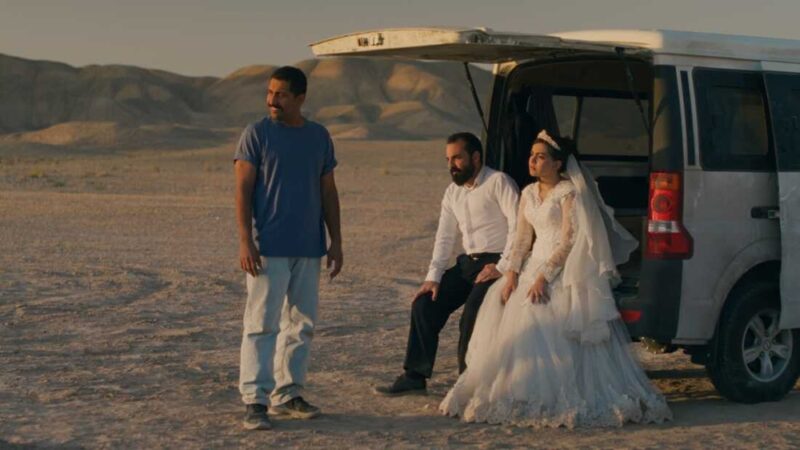
It Was Just an Accident is a quietly devastating triumph, a film that proves how little spectacle is needed when moral tension, lived experience, and cinematic restraint are in perfect alignment.
Working with an almost disarmingly simple premise, writer/director Jafar Panahi crafts a thriller that unfolds largely through conversation, hesitation, and silence. Yet the film is anything but static, with each exchange feeling electrically charged and every pause weighted with history. The suspense doesn’t come from plot twists or violence, but from the unbearable question hanging in the air of “What does justice look like when the system that failed you still exists?”
At its centre is Vahid (Vahid Mobasseri), a former political prisoner who unexpectedly encounters a man he believes was his tormenter in an Iranian prison (Ebrahim Azizi‘s Eghbal). Acting on instinct rather than certainty, Vahid abducts him with the intent of exacting long-deferred revenge, but doubt quickly creeps in, and what begins as a singular act of retribution becomes a collective reckoning.
Vahid seeks out others who endured the same cruelty (Georges Hashemzadeh‘s Salar, Mariam Afshari‘s Shiva, Mohammad Ali Elyasmehr‘s Hamid), asking them to identify the man and, in doing so, to share the impossible burden of deciding his fate. The film’s tension emerges not from what is done, but from what might be done, from the slow, agonising process of remembering, recognising, and confronting the moral cost of vengeance.
Panahi’s direction is characteristically precise and humane across It Was Just An Accident‘s tight 104 minutes. He allows scenes to breathe just long enough for discomfort to settle in, trusting the audience to sit with ambiguity rather than rushing toward resolution. The camera observes rather than judges, and in doing so, implicates us. Ultimately, we are not asked what we want to happen, but what we could live with happening.
The performances are uniformly excellent too, grounded in a realism that makes the film feel less like constructed drama and more like an overheard truth. These are people carrying invisible scars, speaking in fragments shaped by fear, memory, and survival. The dialogue, deceptively plain, accumulates into something quietly devastating.
What makes It Was Just an Accident so gripping is its refusal to simplify trauma or revenge into easy binaries. It’s a film about recognition, doubt, and the terrifying power of certainty, how quickly it can harden, and how fragile it actually is. Panahi transforms intimate conversations into moral battlegrounds, and somehow keeps the film propulsive without ever raising his voice.
And then there is the final frame – chilling, restrained, unforgettable. It lands as something of a shock, but in the final analysis more as a reckoning. One that echoes long after the screen goes dark.
In its economy, courage, and emotional precision, It Was Just an Accident stands as one of Panahi’s most powerful works, an effortlessly thrilling, deeply unsettling film that lingers both because of what it shows and what it dares to ask.

FIVE STARS (OUT OF FIVE)
It Was Just An Accident is screening in Australian theatres from January 29th, 2026.
