


In an age defined by curated selves and digital distance, Rental Family asks a quietly radical question: what if connection – even borrowed connection – could still save us? Directed with tender restraint by Hikari and anchored by a deeply humane performance from Brendan Fraser, the film follows a drifting American actor who finds work portraying stand-in husbands, sons, and friends for a Japanese agency catering to loneliness. What begins as performance slowly transforms into something far more unsettling and profound, as rehearsed intimacy gives way to real emotional stakes.
As the film arrives in Australian theatres, our Peter Gray spoke with Hikari and Fraser, their conversation moving beyond the mechanics of the film to the ache beneath it – how purpose is found through one another, how honesty can be both terrifying and liberating, and why Rental Family dares to suggest that even in an age of disconnection, the most meaningful roles we play might be the ones where we finally stop pretending.
With the film, there’s this haunting irony in the story. Brendan’s character is paid to be a part of other people’s lives, and it’s that act that finally makes him feel alive. What do you think that says about how we find purpose now – especially in this age of disconnection?
Hikari: You know, honestly, I think it’s because we’re so used to (technology), right? Everything is here. Connection, talking to family members, video chat, and that’s all great, but then it goes to Instagram or (X), you’re in a different world. Spending that much time on your cell phone or computer, whatever devices you use, it’s really taking away the time that you can use to just sit and look at each other. Look at us, we’re connecting, just you and me. And it’s not only in Japan, but it’s missing everywhere in the world. You know what I’m saying?
I think it’s just the way it is. And that’s what technology is hitting us towards, it’s really to isolate all of us. I don’t know if I’m answering your question, I apologise, but I really hope that the people who watch this movie will literally pick up the phone and say hello to whoever they haven’t spoken to. If I can make this movie to inspire connection with people, or if you feel like you’re stuck in this one little place where you feel you’re alone, I just want people to reach out and look around and see who’s there for you. The rental family may be a fake family, but then you also have friends who become your family, and just pay attention to those people and be appreciative of what you have rather than what you don’t. That’s what I want people to take away.
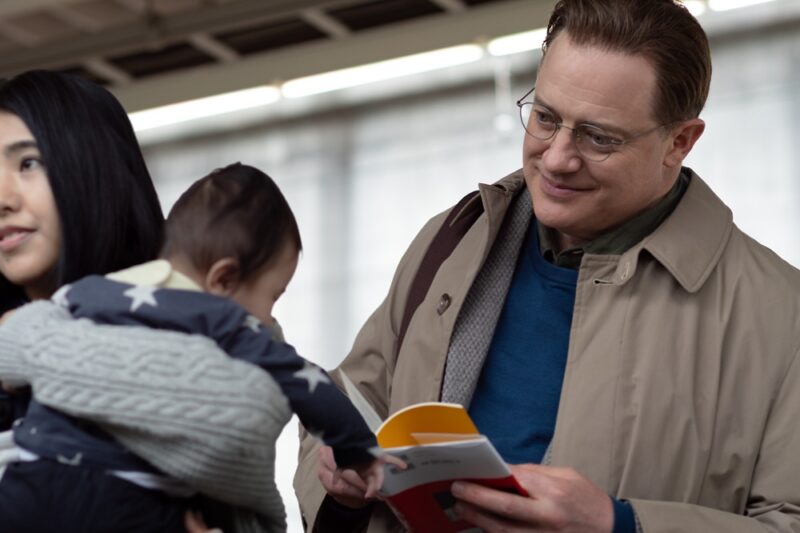
I know in Japan that emotional restraint can be seen as respect, while in the West openness is seen as sincerity. Working on a film that bridges both of those, did it challenge your own ideas of what honesty looks like at all?
Brendan Fraser: I understand the contrast of the cultures that you’ve described, and that’s really where the movie lives, isn’t it? It’s a fish out of water story. (My character), well it’s not explicitly filmed, but he likely comes from situation back wherever home is for him, in the West, not Japan, but there’s a reason why that’s behind him. He’s made a choice to leave that behind. It’s not in his interest. He’s not on the run, he’s not a wanted me, but he might be on the run emotionally. I’m in my 50s, and men in their 40s and 50s, we think about how we were raised. And if we’re lucky enough to not be among those kids of a generation who were under a father’s heavy hand or were not given enough cuddles themselves, or felt alone, or ignored. I think (my character) is definitely of that demographic, and either he knows it or not, he is looking for a father. He certainly doesn’t know that he has a paternal instinct. This very good one that lives within him that he can deploy to enact this ruse to help the mother of a kid get into a tight knit school.
He has some skills as an actor. I don’t know if he really is an actor. He might just be a guy who showed up. They needed a token white guy. He walked into an office. He played around with a giant toothbrush. They said, “You’re hired.” He showed up on a soundstage, they gave him a goofy costume, and they said, “Thank you very much.” He had a little money in his pocket, and that was seven years earlier. I don’t think he’s going to be looking to embark on a fabulous Oscar-chasing career, but what he is doing is trying to learn more about himself and where he is in the world. So when we meet this guy, he’s clearly lonesome on an epically proportionate scale. He spends his evenings over cans of beer, staring into the windows of his neighbours in their apartments, living their diverse and interesting lives in little cubicles. That doesn’t satisfy him. It’s not enough, and he doesn’t know what it is he needs. It’s good fortune that he embraces this merry band of pranksters, essentially, who are the rental family office, and they become his family. The movie is about the journey of finding fulfilment and finding resolution in a sincere way.
Rental Family is screening in Australian theatres from Boxing Day, December 26th, 2025.
