

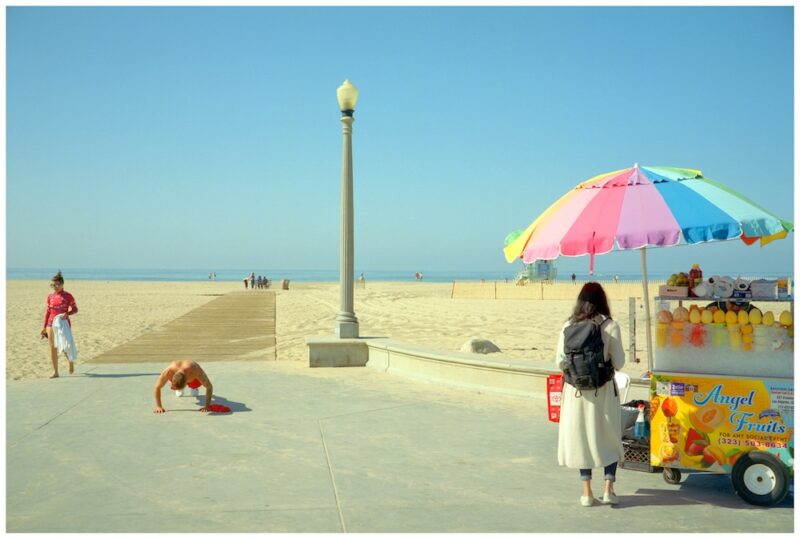
Debuting at ILA Immersive Light and Art for the 2026 Adelaide Festival, Manifest Destiny is an ambitious cross-disciplinary exhibition by acclaimed South Australian photographer Alex Frayne, in collaboration with digital artist Liam Somerville (Capital Waste) and composer Donnie Sloan (Empire of the Sun, Sneaky Sound System).
Blending analogue photography, 3D digital immersion and original composition, Manifest Destiny marks a first of its a kind– a convergence between traditional film photography and cutting edge digital art. We spent some time chatting to Frayne about his project.
Manifest Destiny is all about trips you’ve made to the USA. What drew you there and, how do you find these images? Do you scout them out, or do you stumble across them?
The idea was to get there and to travel and walk and bus and train to places that I had heard about and had a curiosity for but had never been to. Indeed, the whole essay is really a desire to understand and know a place that people tell me a lot about, who have never been there. I know a little bit about it through popular culture and movies and music, but I had that deep yearning that artists have to see for myself and understand something through the lens by being there; not seeing it on Facebook, not seeing it on Netflix, not seeing it on Fox News or the New York Times website, but by actually being immersed in the culture.
That’s the key word, immersion, but being immersed in American culture, and not just in the places that most people have heard about, but the places that no one’s heard about, giving myself the opportunity to see many sides of the place. It encompassed about 13 states, including West California, Nevada, Arizona, Texas, Oklahoma, Arkansas, and then down through the Deep South. So, in a sense, the reverse of how the colonialists came to America. They started in the east and headed west under the banner of manifest destiny, which was a philosophy that entailed colonising America from east to west. Not under the auspices of a president or a king or a queen, but under the Word of God himself. This is where religion creeps in. So, yeah, we’re starting in the west and gradually heading east. And I think this is really part one. Two and three could happen next, because I would like to see every state and get the full gamut, the whole shebang, of the American experience.

I mean that there’s an interesting point you just made about the image of the US. There is no one image. There’s an underlying theme. But I think I can look at your images and know where each was taken. You’ve captured the spirit of each of these places.
In my capacity as a photographer, artist, that’s right, not as a journalist, a tourist or a politician, but as an artist. So yeah, it’s one view of a truth.
Also your ability to capture people’s portraits as they are. You look at those portraits, and you can tell what those people stand for, who they represent, who they are.
America has this big brand of individualism, which is interesting, because Americans tend to conform to the law, right? They do tend to be diverse in the way they express themselves. Personal expression is much greater in America than in Australia. People express themselves through clothes, through the colour of their skin, through their attitude that you can capture through the lens. They’re making a statement in a certain individualism, which is fantastic for camera, because you hit up a place like San Francisco and you see so many diverse people, you just really have to point the camera and you that’s really refreshing. I’m not saying that Australia is a monoculture or that we don’t express ourselves, but it’s with a certain kind of Anglo-Saxon, colonialist, reserve and self-effacement. The Americans do it differently; they’re making a statement. When you frame them up, they will express who they are much more readily than some other cultures. That’s what’s going to draw me back again, is that sort of idea, you’re a kid in the candy store. Go to America with a camera, you’re gonna see this fantastic stuff, if you’re talking portraits, definitely.
How did it actually come together? Did you just randomly say I want to go to the US? Or did someone sponsor you?
I’m always thinking of the next project. I’ve done four books in South Australia, published landscape and portrait-based work. it’s really the curiosity that draws you to something. If the curiosity had drawn me somewhere else, I would have gone there. And indeed, when this is all over Red Rover, there’ll be another curiosity. I find that you have to accommodate your curiosity. You’re going to have to find a budget and apportion the budget over, one, two or three trips accordingly. You’re going to have to decide what formats you’re going to shoot, how you’re going to manage your flow. The thing about America is it is very expensive. I was thinking that it’s probably cheaper than anywhere in the world to travel and it isn’t because they’ve got an inflation crisis like US problems. You’ve got the tipping culture, which you know you have to because, you know, workplace laws are different.
It makes it very interesting. When you get the bill, it’s like the bill is some somewhere around this number.
Yeah, it’s somewhere around this number, and you’re just going to add 20% and if you’re staying in a hotel, you’re going to be adding luxury taxes they have in each different state. So, I learned pretty quickly that this was not going to be cheap. If I was going to make it work, I’d have to be frugal. Instead of hoovering around, which is the sort of first thing you do, well, that’s too expensive, so I’m going to hire a car. I’m going to hire a car for two weeks. That’s going to cost a grand, instead of spending five grand on getting lifts or paying people to take you from here to there. You just have to do it yourself. That that was a big realisation. When I hit the ground the second time, I was better equipped to start driving on the right-hand side of the road.
And they’re actually strange road rules, like four way stop signs and things.
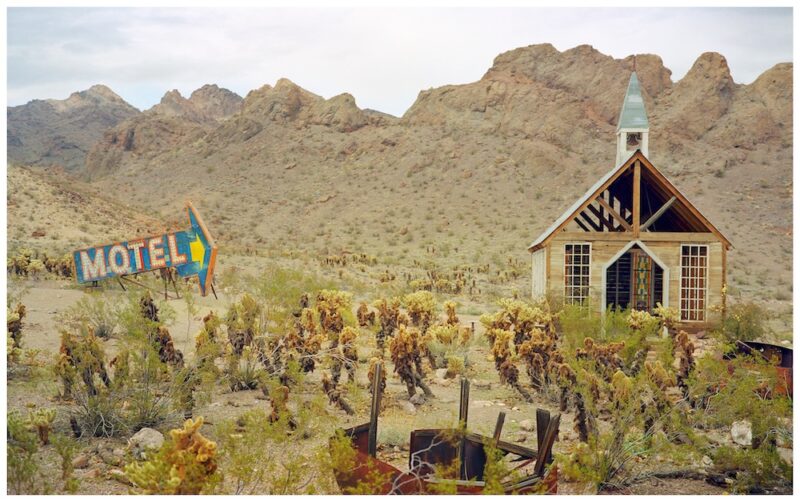
They have a give way. They call it a yield, and it’s slightly different to here. But, you know, the roads are amazing, gonna be honest, the roads interstate. Highways are just incredible. We don’t really have anything compared to that in Australia. Not only that, but you’ve also got the old interstate system, which is just off to the side where you find all the ghost towns. That’s what caused the ghost towns, the relocation of the interstates, a mile or two from the old interstates. So, you can actually do the whole trip off the main drag and find the “Empire in Decline” motif that is running through the series. It’s great to travel in America. It takes a little bit of head gymnastics to work it out, but it’s pretty good. And there’s a real courtesy. I didn’t encounter the sort of aggro stuff you get here. No- one’s kind of blasting their horns up your rear. You’d think it would be the opposite, because we’ve grown up with images of New Yorkers beating each other. It ain’t like that in the rest of America. There’s a certain courtesy, which comes when you see that in countries with huge populations
Re your comment about an Empire in decline. It’s an interesting observation that people are making; do you think Americans themselves are aware of that?
A very interesting question, because if you were to ask someone in California that question and then ask the same question to someone in Arkansas, you would probably get very different answers. There is a certain discontent among the coastal regions of America, which you could consider more progressive, but which have their own huge problems, versus the middle America situation. They don’t the sort of poverty in the city you see in the south. People there don’t sort of say, well, we’re in decline, and we need to study this and work it out; they’re often actually thinking about, how do I get a job? There’s huge unemployment and whole towns that have disappeared and populations that have halved in those middle American states, their focus is, quite rightly, on other things, other than the long view of History and America’s place in the hegemony. Whereas California, you’ll find a lot of people will put America on a spectrum of good health to bad health.
As an outsider looking into America, it sort of seems that Americans, like the “Make America Great Again” catchphrase, but who does that appeal to?
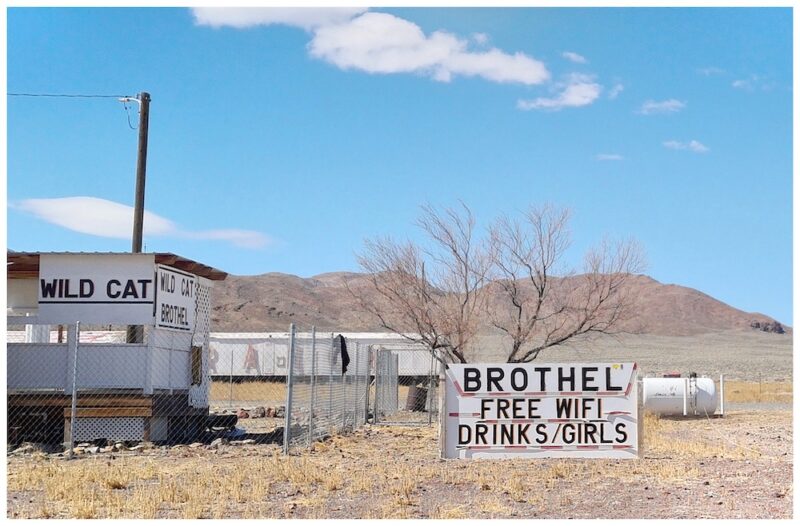
That appealed to people who have been whose jobs have gone. The MAGA movement is really an employment movement, and despite being based on sort of a falsehood, perhaps it does drill down into the fears of people’s employment prospects, especially in that middle America part that I’m talking about. That does resonate with that crowd. We’ll see the result of that experiment in a couple of years’ time when there’s another election. We get a lot in the media about that Trump phenomenon. We get a lot about the violence, the stuff that makes the news generally, of a pretty dark nature. But in America, the news is less so. You read about a kind of crazy war going on in within America, and there sort of is, but you’re not going to see that on the street. In middle America, life goes on as it probably went on for generations, just getting slightly worse every generation.
It’s a gradual, chipping away at the wealth and prosperity and employment prospects which leads to a decline of Empire. I think that’s certainly what we’re seeing. But it’s not kind of crazy town, like we think it might be. They have their problems, especially those ocean states like in the West, California and Washington State, they have real problems, which you don’t see the middle America. LA has 20,000 people living homeless in the middle of the city, downtown, in Skid Row, and that’s not something you see in Wink, Texas, where Roy Orbison grew up. You don’t see that in Wink, you see it in San Francisco, and you see in LA; those folks on the coast who actually probably do know about the decline there, they’ve got real problems.
Did the The ILA Immersive Manifest Destiny show come about in parallel with what you’re doing, or did it come about after you already started?
Probably on the third trip, I was starting to think about, what is the destination of this collection, 1000 or 1500 images on film – what’s going to become of them. It’s natural to start thinking about all that. When I came back, I decided to approach, firstly the Adelaide Festival of Arts, because I had some good experience at the 2023 show with Paul Grabowsky.
So, I decided to approach Leslie and the incoming director, Matt Lutton, and it was just like a sort of movie thing. You went in there and pitched the idea with accompanying images. Thankfully, they said yes. At the same time, I was talking about ILA as a potential venue, and then I met Bec Bates, and it became the actual venue. It’s one of those multipurpose venues. Not only do we have the gallery with the work, but we also have the light studio next to the gallery, which is a big immersive LED screen. I got onto Liam Somerville, (Capital Waste), and asked him, what can you do with 1000 stills? Can you animate? Can you render? He said yes to all the above. Next week he’s starting the actual process. There’ll be a short film in there, 20 minutes or so. I have no idea what, and maybe he’ll discover what it is as he’s working on it.
So, we had that extra prong of immersiveness, which I think was a fantastic thing, because I’m interested in this notion where I see myself as expanded photography. And, as in the 2023 show, that’s kind of expanded photography. This has definitely expanded, it’s immersive stuff. So that’s the kind of pathway that I’m on in life, where I fit. When I was younger, I saw the great William Yang do his show in about 1997 called “The North”. It had narration, and a very personal approach to his work. I think that kind of stuck with me over the years. Probably in that same vein of you know, festivals, collaborations, and expanding the work beyond just the sort of traditional gallery notions.
I like that idea – the image is one thing, but can it be more?
Yeah, can it be more? Technology’s moving at a pace. Can I exploit that technology to serve the image? That’s very satisfying, because, I tend to use old cameras that were fashionable in the 60s and 70s, and then to be able to digitise those film analogue images, and then give them a sort of Second Life, or an amalgam of collaborators working on the images. I guess it relates to my movie making background, which was my first career, post University. This is sort of an extension of that, which is interesting.
Manifest Destiny is presented by ILA (Immersive Light and Art) as part of the 2026 Adelaide Festival
The exhibition will run throughout the festival season with audiences experiencing a bold new intersection of film, photography, and digital art, where analogue meets the immersive future.
Venue: Level 1, ILA, 63 Light Square Adelaide
Dates: February 28 – March 15 2026
Tickets and more info HERE
Photos supplied by Alex Frayne.
