
This Christmas, Santa’s gonna slay!
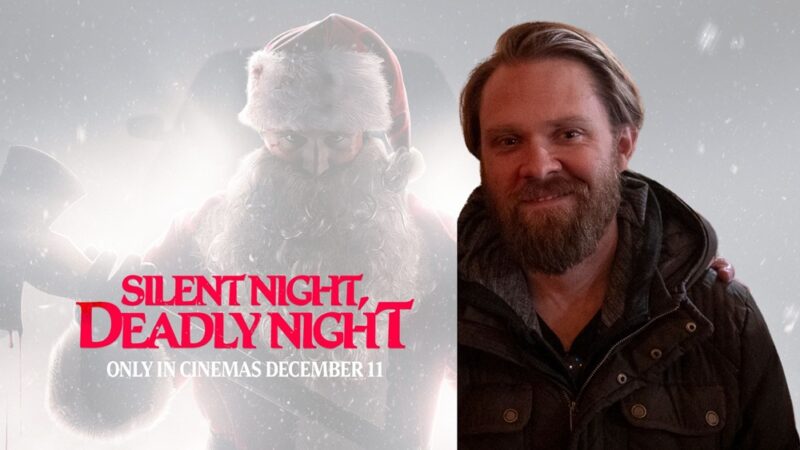
A reimagining of the controversial cult 1984 classic slasher film Silent Night, Deadly Night, director Mike P. Nelson is preparing to scare a new generation this festive season.
After witnessing his parents’ brutal murder on Christmas Eve, Billy transforms into a Killer Santa, delivering a yearly spree of calculated, chilling violence. This year, his blood-soaked mission collides with love, as a young woman challenges him to confront his darkness.
Talking to our Peter Gray ahead of the film’s release this week, Nelson spoke about the unlikely romantic angle that drove his desire to remake the original, why horror should remain fearless, and which element he finds most crucial when orchestrating on-screen violence.
Before talking about Silent Night, Deadly Night, I wanted to commend you on the 2021 remake of Wrong Turn. It was incredible. It went in such a different direction than the original, which is similar to this, so I wanted to fan out on that just briefly.
Oh, man, that means a lot. That was the movie that actually kind of hardened my a skin a little bit to the criticisms that were to come for doing another project with other IPs. That means a ton.
Obviously reimagining a cult film is risky. When you strip away the camp and the nostalgia of the original, what core emotional truth were you most excited or terrified to rebuild?
This is going to sound crazy, but I wanted to do a love story. That was first and foremost. That was a big thing. I wanted to pay homage to the original, and you can see that throughout. There’s some kills that feel like a Silent Night, Deadly Night film, and I wanted it to be a good, new introduction to Billy Chapman. But a new take on it. I wanted to have the love story. I wanted there to be this multi-layered thing were you have two characters, well actually three characters, and how they all intertwine and those stories cross. Not all is as it seems. To me, I think that’s what kind of helped me understand in keeping the people on their toes with the movie. That was important to me. It couldn’t just be a straightforward, like, “I’m just doing a slasher and it’s like the original, but a little different.” I wanted to give you something familiar, but then go off the rails. In terms of tone, it’s also important to have something that was nice and sweet and cozy, but wasn’t afraid to get dirty and messy and have a body count.
Well, on the mention of the body count, there’s obviously a sequence in the middle of the film where you really went for it. But speaking on the love story, that romance was really quite surprising. What made you decide the love could deepen the horror rather than soften it?
I wanted to do that cozy Christmas movie. The Pamela character in the original is sort of just there. You wonder if something is going to happen, and then Billy offs her. In terms of how that original film is, and the tone of that, it works perfectly. I wanted to bring in another final girl, and I thought Ruby (Modine) would be perfect for that. I wanted to give Pamela more. I wanted her to be somebody. I love creating strong women characters and working with great actresses. That was super important. I think what was great about Ruby and Rohan is they both really played well off each other. They had moments where they really came together. Overall, they connected well. There was a lot of great chemistry. I felt very blessed.
I will say, I did very much appreciate the little “Garbage day” line to shout out the original. I was wondering the whole time will this movie do anything with that…
And that was actually the original producer who says that in our movie.
The original film was demonized for “corrupting” childhood icons. Do you think horror should still be fearless in attacking cultural, sacred symbols? Or do you feel modern outrage has made filmmakers cautious in any way?
Honestly, I feel that’s horror’s M.O., man. I think nothing should be off limits. I think if you can come into something like this, and you’re not there to just simply exploit it, and I would even say this about the original, which was literally “Santa picks up an axe and just goes to town and kills a bunch of people and kids, blah, blah, blah.” I think the one thing that the original has going for is it is actually a story about trauma. It’s a story about abuse. It’s kind of crushing. It gets silly at times, and there is a tonality that is so bizarre, but I think as long as you can go in and you’re going to tell a really interesting story and you have some great characters…dude, go to town! Have some fun. This is horror.
The horror space is to explore, whether it be pop culture icons or dealing with weird, dramatic things in normal, everyday life, how can you make those things horrific? How can you take those moments to the extreme? That’s what horror is. And I think you can tell almost any story and put a horrific spin on it. Those are the movies I love. Those are the movies that I have the most fun watching.
I wanted to ask about when you’re designing a kill, do you start with the emotional meaning, the visual spectacle, or the shock factor? Which one scares you the most?
Gosh, all three of those things really play into it. Usually, if I’m doing a kill just for shock, it’s never that good. There’s got to be some sort of weird emotional weight, or something like that. If the kill is just to kill and do something gnarly and take the effects to the next level, I’m already desensitized towards that. If you can make me feel like, “Oh no, don’t do that,” that’s the kind of violence in filmmaking that I enjoy watching. There’s got to be some sort of emotional thing. I do like playing with the shock of it, yes, but maybe more of the shock and the fact that it happens and less of the sustained drawing on it. You know what I mean? I’m definitely more intrigued by either building to it and then having it happen, or just having it happen and being like, “Oh, God, that’s crazy!” I much rather prefer that level of brutality.
And with Christmas films, there’s always the possibility of flirting with a Christmas-themed death. Is there a Christmassy thing that you personally love that you would turn into a kill scene if you were able to do so?
Oh, my gosh. Honestly, I think what was really fun about ours was that we were able to give a wink and a bod back to the deer antlers and the impalement. That was fun to put our little spin on it. A straight up Christmas kill? We had something we were going to do with a tree netting that never saw the light of day. It just didn’t work. But had we had more time, that would have been something really interesting to do. You’ve caught me off guard here. So much of our movie is based in axe death (laughs), it’s just set at Christmas time. Christmas light strangulation? Something like that. Maybe getting bludgeoned to death with a nutcracker?
As you mentioned about what’s going on with Billy is childhood trauma. It defines him in a way. Do you feel that the film is saying evil is born from pain? Or is it kind of born from choice?
I do believe that there are plenty of evil people that choose to be the way they are. Our movie starts out in a way that touches on the pain of growing up and witnessing something terrible. That is the thing that spirals out of control. With our film, though, there’s something else at play. There’s another level to that. We’re not saying, “Oh, you witnessed something bad, it’s going to change everything.” I’m not saying that’s not a thing, but I think what Billy is doing that he’s taking out people that have made a very clear choice of who they are, and they’ve done some terrible things.
I think that’s why we can stomach it. Even if we don’t agree with murder, it’s like, well they had it coming. Billy embodies that, especially with what he goes through and the fact that, and he says it in the film, that he didn’t want this. He didn’t choose this. I’ll let the audience take that as it is. Billy’s trying to figure out how can he go on this path, and he’s actively trying to do something knowing full well that he’s got a job to do. And that’s where Pam comes in. I feel like he’s making a choice to want to be better, and the people that he runs into are not, and those are the people that have made their bed. And that’s why Billy exists.
Well you’ve made a great Christmas film on its own and a remake that very much stands on its own. If we’re revisiting IPs, it’s been done in a way that feels super fresh, so I very much appreciate that you took this route. And just that we’re getting horror on the big screen. I’m so excited for everyone to see this and have fun.
I was never expecting to take on this property, but I’ve always wanted to do a Christmas horror film, so when the opportunity arose, it was like, “Well, I gotta try. Here’s a crazy idea. If you like it, great. If not, okay.” That was the vibe. And I have the Christmas kill! Sorry, but after I said nutcracker, this came to my mind. Just someone turning somebody into a literal nutcracker. Building it and then you can control and puppet them? That would be freaking nasty.
Silent Night, Deadly Night is screening in Australian theatres from December 11th, 2025, before opening in the United States on December 12th.
