

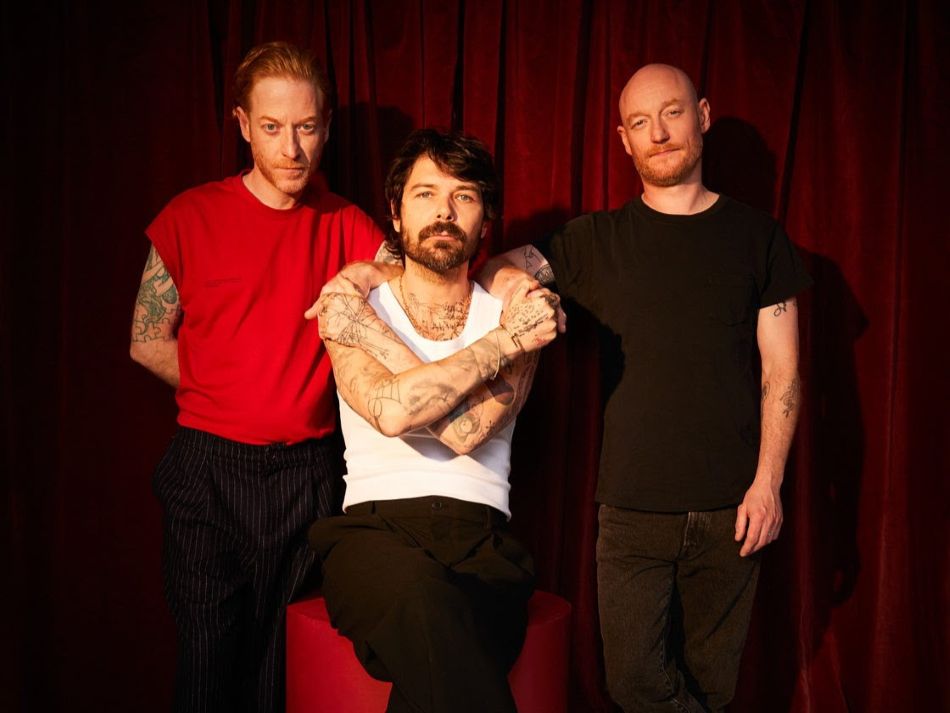
In the wake of Biffy Clyro‘s announcement of Australian tour dates for April next year, bassist James Johnston kindly took some time out to chat with us about the tour and the experience of live music.
The very exciting news, of course, is the Australian tour. We’re obviously very, very excited to have you coming back after eight years.
Oh, we can’t wait, Jen, especially as the weather turns pretty miserable over here. It’s something we’re very much looking forward to…it’s been so long since we’ve been over, so hopefully you guys are all like tightly coiled springs ready for us to come.
Well, I can only speak for myself, but I couldn’t possibly be more tightly coiled with anticipation, so yes, very excited. I did see on the pre-sale that there was some teasing about New Zealand as well. Is New Zealand on the radar?
Fingers crossed. Fingers crossed. I don’t know if this is an exclusive, but we’re working really hard to make that happen. It feels like such a long way to come. It would be a shame not to go across New Zealand as well, but we’re really hopeful. We’re hopeful we can make it happen.
You can’t possibly intensify the rivalry between Australia and New Zealand, so it would be a community service if you could, so we could both have you. Your big tour cycle starts, I think, in December, but you’ve done some live shows since the album release. How have you found the material to play live?
It’s been amazing, Jen. It’s been absolutely amazing. It feels like the songs are really vital. You just feel totally alive when you play them. I think, as a band, you always feel that your new songs are the most exciting to play, but somehow, this time around, it’s just elevated everything that we do. It feels like all the old songs have got another shot in the arm, another boost of energy, and it just feels like the whole thing has just got a bit more energy about it, so we’re really buzzing. We can’t wait for people to learn the words, and they can sing along with us. That’s always a really big part of songs becoming live, but so far, so good, Jen. Everything’s going really well.
You’ve obviously been playing together as a band for a long time and have toured a lot. What, to you, makes a particularly good Biffy gig?
Good question. There are so many different things. Usually, it’s a connection with the audience, to be honest. Those sorts of nights where everyone just really forgets about life and forgets about having to walk the dog or pick the kids up from work or any of those things, and people just really let their hair down and go for it and have a slightly out-of-body experience, if that doesn’t sound too bold. I know when we have a really great show, you come off stage and you feel like you weren’t even touching the ground.
You were almost kind of elevated, levitating the whole time. When I say out of body, it becomes just a part of you, but it’s like you’re not even thinking. It’s just that you end up in some kind of magical world. I know that sounds a little bit over the top, but it’s been our life for 30 years now, and that’s how it feels when you have a great show. It’s like nothing, nothing can touch you, and it’s just the most amazing feeling.
Are there any of your gigs that remain unforgettable for you?
They stick their head above the parapet now and again for different reasons, and we’ve been so fortunate over the years. I think about the first time we played at a national festival here in Scotland. It was called T in the Park, and it’s no longer with us, but it was a big festival for decades, and the first time we got to play on one of the big stages during the afternoon, we came out and we played there before in the smaller stages, but suddenly we’re on this big stage with a sea of people and all these Scotland flags were coming up, and there was the odd shout of “Mon the Biff”. It was the first time we’d felt kind of accepted, if you like, if that’s not too bold to say. It felt like we were in front of our own people and that the audience was really on our side, from being perennial underdogs, and I suppose in some ways we still are, but it was quite a turning point for us to just feel really welcomed, and it felt like we belonged there. I think that’s the moment we’ll always hold on to.
Interestingly, you mentioned T in the Park. The only festival I’ve ever been to in the UK was T in the Park in 2014, which you headlined when it was out in Perthshire. I have to say that being in a sea of Scots with you guys headlining as the sun had gone down (although I’ve never seen so many sunburned ginger people in my life, just kind of glowing like glow sticks), that was one of those sort of transcendent moments, I guess, for me as a gig goer. I can fully appreciate what you’re talking about with that festival in particular, with the connection. I was wondering if you’re conscious as a musician that there are people in the audience who are having sort of bucket list moments or a kind of life-affirming or life-changing moment?
Not directly, not at the time, it’s not something that I think about as that would be a bit much to carry, you know? Now that you ask and I reflect on it, yes, yeah, you can see people have come together and you can see the reaction in the audience, you can see people look into each other’s eyes and nothing to do with us, you know, it’s just something between two audience members or whatever it is, and that’s really nice. I don’t take that lightly. That is always something we try to strive for as a band, which is to create these moments that are life-affirming or important moments in your life, so it’s really nice to think about that. It’s not something I tend to think about too often because it would just drive me mental.
Yeah, well, you’ve got enough to focus on, I think, to be performing.
Exactly, I think that would be a bit much of a burden.
Are there any gigs in your life that you’ve been to as a fan that are one of those moments that you will never forget?
There’ve been plenty; the first one that comes to mind is one of the first shows I ever went to, which was Rancid at the Barrowlands here in Glasgow. Now the Barrowlands itself is a really famous venue, it’s grimy, it’s rough, it’s dirty, but it’s got a real soul to it, and I was a young 14-year-old lad, curly hair, and there’s all these big dudes with leather jackets and studs and mohicans and wallet chains and all the kind of things that made them seem intimidating to me as a young lad. I was scared, I was really scared, Jen, but as soon as I fell over, as soon as someone fell over, somebody picked you up, and then we’re all roaring together having a great time. It was suddenly this communal atmosphere where, “oh, these guys weren’t scary, you know, they were just dressed a certain way”, you know? It was just part of growing up, but it really left its mark on me at that point, in many ways, not just the music, but also just not to judge people too much by the way they look. There was something about the energy and the music, and the appearance of Rancid at that age that left quite a big memory on me.
That’s a great memory. Is there anybody that you can’t see now that you would love to have seen live?
I think the obvious answer would be Nirvana, considering we had tickets to go and see them before Kurt Cobain’s untimely end. They were a band that really, like many of my generation, made us pick up guitars; they were the ones that sort of unlocked the door, if you like, and made us feel like we scruffy little lads from Ayrshire could look like those scruffy little lads from Washington State. There was something about them that opened the door and became the keystone, if you like, to our kind of musical experience, so yeah, to go and see Nirvana back in the day, that would be, that would just be like a dream come true, really.
Talking about life-affirming or bucket list moments, I was thinking about my own experience, and I realised that out of my top five memorable gigs, four of them are Biffy gigs.
Wow.
I was trying to analyse it, and I think it’s that my relationship with Biffy is one of catharsis. I think I have different relationships with different bands for different reasons, which I think is fairly normal, but I read somebody saying, I don’t know whether it was criticising or not, but they were talking about how they couldn’t understand why people were getting emotional at Biffy Clyro gigs. It was an interesting perspective, because perhaps they just want to have a great time, right? Yet for someone like myself, who’s very sensitive, Biffy’s music is something that unlocks a degree of reserve. I feel like I’ve operated on a level of sustained reserve all my life, and then suddenly I’m in a moment where I can feel all my cells release. I think that’s my relationship with Biffy, and why it’s such an emotional one. I wondered if there are any bands, obviously Nirvana was one that you’re talking about when you were younger, but if there are any bands or musicians that, whether you seek it out or don’t, give you the same sort of emotional release?
Yeah. First of all, that’s nice to hear, Jen. That is really nice of you to share that. I think if you have a band that’s open emotionally, it
allows you to be open. I think that’s probably the transaction that’s going on there. Simon is being so honest with his lyrics and so open about emotional and difficult subjects, and I think it allows the listener and, dare I say, friends to open up a little bit. I mean, all I can think about now is all the songs that make me cry, and for some reason, the human soul needs that as well. Sometimes you just want to put on those songs and sit and have a cry. Listen, there’s nothing wrong with that. I think Elliot Smith was one of those artists for me; he was always a morose sort of fella, and, you know, it was always emotional music. Henceforth, it made me emotional, but then, when Elliot Smith took his life, I just couldn’t listen to it anymore. It’s a real shame. I really wish I could go back to it and listen to it more, but it almost unlocks too much of a feeling. It’s almost too much to carry. Maybe that’s what I’ll do after we hang up. I’ll sit and listen and have a cry. But it’s part of the human condition. You know, there are all types of emotions in there, and sometimes you need to unlock them a little bit. That’s so nice of you to share your Biffy experience. That’s really nice to hear.
One of the ones I just want to share with you very quickly was the Barrowlands gig that you did online during the pandemic, when you played Celebration of Endings all the way through.
That was a good one. I can say that without being too bashful. I think that was a really good night. We really enjoyed that one.
Being in the middle of the pandemic and being locked down, not knowing if we’re going to ever see live music again and all that sort of stuff, and I was actually watching with a very dear friend of mine from England. She was in England watching, me in Melbourne, and we were chatting together as we watched. We had our own little community at that moment, even though we weren’t gigging in the flesh. Every time I see anything from that gig, I’m like, “Oh, my God”, you know, it takes me back very quickly to that emotion, and my friendship with her.
That’s really sweet. It was an incredible, incredible feeling to do it. It showed you the power of music. I know that sounds hippy dippy, but at that moment when we’re all locked down and struggling and so many thoughts are going around your head, it was just so nice to get back together. We’re really, really, really proud of that one, actually. If that’s not a sin.
I don’t think it’s a sin, and I would worship at that church any time.
Biffy Clyro return to Australia in April 2026. General ticket sale starts at 10:00 am local, on Friday, 14 November here.
Don’t miss them on the Futique Tour:
The Forum, Melbourne – Tuesday, 7 April
Roundhouse, Sydney – Wednesday, 8 April
The Tivoli, Brisbane – Thursday, 9 April
Photo credit: Eva Pentel
