

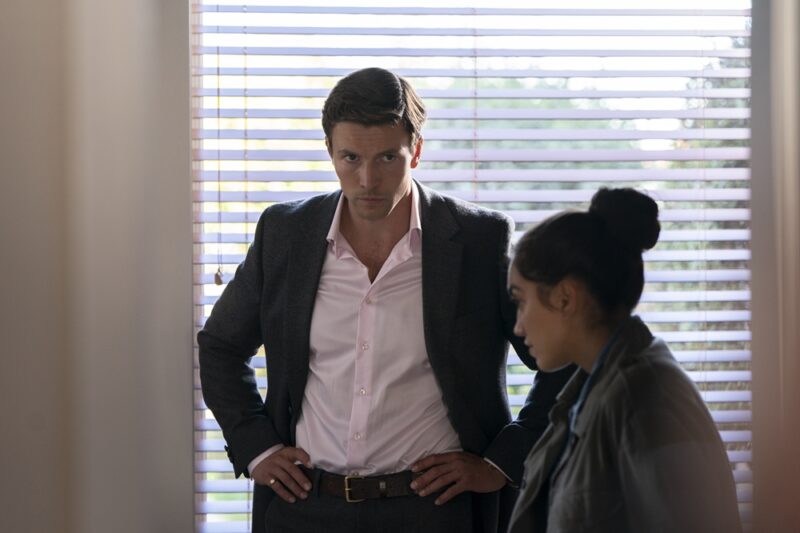
A fresh take on Elizabeth George’s Inspector Lynley novel series, Lynley follows the weekly adventure of a mismatched crime solving duo – an aristocratic police detective (Leo Suter’s Lynley) and maverick sergeant from a working class background (Sofia Barclay’s Havers). Together, the opposing duo become a formidable team, bonded by their desire to see justice done, while the series tackles issues around personality, gender and class.
As the series premieres in BritBox Australia, The AU Review’s Peter Gray spoke with both Leo Suter and Sofia Barclay about their roles on the show. Here, Leo Suter discusses the personal injections of himself into the characterization of Lynley and how the show’s view on class and gender bled into his own.
Lynley has that classic crime-duo thing to it. There’s that mix of tension and tenderness between both you and your on-screen partner, Sofia Barclay. What was your first impression of her take on her character? And how did that shape the rhythm and the chemistry on screen for you?
As you say, so much of this show hinges on the relationship between Lynley and Havers (Sofia’s character). It was so nice to be playing opposite someone like Sophia, who is so warm and generous and kind-hearted. That as a context for going into work means that you can play around with ideas really quite comfortably. Immediately we had a really good connection that allowed us to, I think, click as a duo. It’s scripted early on that there is this animosity between them, and actually the audition scenes they used for us when we were doing our chemistry test was that first scene in the car. That’s where some of the real jabbing comes in from Havers, poking fun at Lynley’s private education and Oxbridge background. As well, the other scene they used in the audition was the pub scene, which is another moment where Havers really is trying to unpick Lynley and ask, “What are you doing here? Who are You?” Those scenes were in the forefront of my mind, so I knew that Havers was going to have a bone to pick with Lynley.
With all that jabbing, we know that Lynley is born into privilege. How do you avoid playing him as a polished archetype? Because we need to know he’s a likeable character, and that’s not always the easiest thing to do when everything’s been handed to him.
When Havers is throwing all those jabs and comments, it’s really important that Lynley doesn’t rise to it. If he started jabbing back, I think people wouldn’t like him. So it was important not to rise to Havers’ quips and keep that as a trump card you only want to play rarely. In terms of just humanizing him? There’s so much of the production design that helps. For example, Lynley’s house, we see he lives in this beautiful modern house on the coast. It’s a beautiful house, but it actually looks kind of lonely. His fridge is empty. Like, all he’s got in there is some tortilla chips, hummus and old salsa, which I did have to eat (laughs). I think that helps tell the story of someone who has so much privilege, but he’s so committed to his job. Fundamentally, this is a guy who has turned his back on being an aristocrat and is, instead, really singularly focused on his career and getting justice for the right people.
And the show dives into class divides and gender politics. But it’s also about empathy. Was there a moment for you where you personally felt seen or confused by your character’s worldview at all?
That’s such a great question. I would spin off that slightly, and say that when Lynley discovers a body in the third episode, it’s quite moving. Each episode has its own flavour, but in that third episode, Lynley and Havers get really close to this tight knit community where a family have lost their son. Lynley discovers the body, and he takes the parents to the morgue to identify the child, and those were very surprisingly impactful moments. We have such a brilliant ensemble cast for each episode, and watching them truthfully portray what that would be like was really powerful.
And I guess another part of your question, there was crossovers between (Lynley and I). I went to Oxford, and they needed photos of Lynley at Oxford for his “harkening back to his (school) days”, and I submitted quite a few photos, hoping that I might get a few of my mates on the telly (laughs). I don’t think any of them did, but there is a photo of me having just passed my exams, drinking a cider, wearing a sombrero and holding a balloon. So that is a moment of Lynley and Leo crossing over, which is quite satisfying for me when I see it on screen.
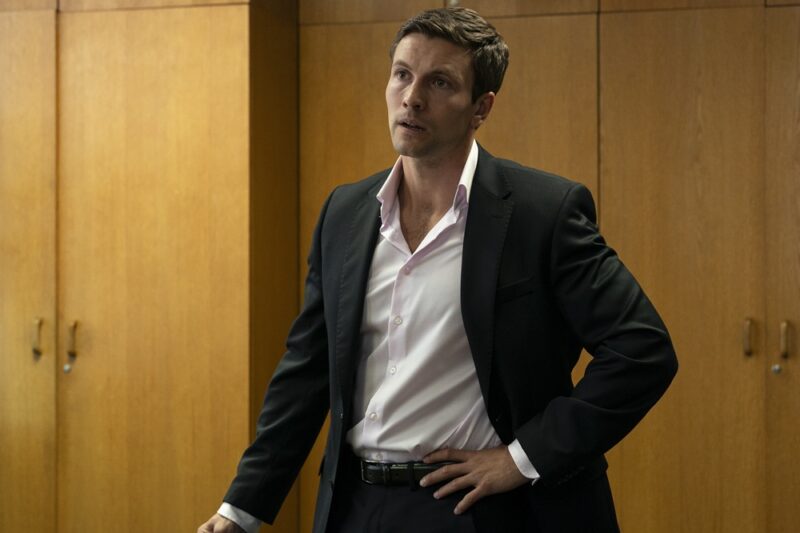
Do you find playing someone who’s always in control hard at all? Is there a satisfying element to being someone who’s so sure of themselves?
I don’t know if Lynley is always so sure of himself. He can get frustrated and annoyed, and there are some wonderful argumentative scenes with Danny Mays as Inspector Nies, who rubs Lynley the wrong way. The two of us are like hammering tongs at each other. I think with any character, it wouldn’t be fun to always be totally in control. There’s ups and downs and moments of happiness, sadness, anger…Whatever character I am playing, I always look for those moments of contrast, because those are what bring an audience in and help them fall in love with the character and root for them in their lows.
The idea of justice in the show is slippery, we’ll say. Probably the best way to put it. Do you find that justice means something specific to Lynley? And has that meaning changed for you as the series unfolds as well?
That is a great, great question. One of the things about the justice of a detective show is that, yes, we’ll always find the murderer. There’s satisfaction in solving the crime, but justice is a longer process than that. It’s not just about identification. For each episode, for the perpetrators and what happens afterwards, in terms of justice being done, I feel like you need longer to really reflect on each individual circumstance. In terms of my own thoughts on justice, I think Lynley thinks more deeply about it than I do. I certainly have a great respect for the character of Lynley and of Havers, and of their focus and believing in the righteousness of what they’re doing. And also the sacrifices that they, as characters, make to pursue what they’re doing. I think they are very noble and admirable people.
This series interrogates how much of who we are is chosen versus inherited. Did that make you reflect on that question personally?
Yeah, I think you summarized it very neatly there. It’s very much a British thing. It’s about the British class system and how pervasive and deeply rooted it is as well. Did it make me reflect on that? Yes, it brings to the fore and reminds one of Britain’s great eccentricities – the class system. That’s undeniable, and, these days, is quite subtle. Lynley and Havers really expose it by throwing these two chalk and cheese characters together. Yeah, it does one make reflect on class in Britain, for sure.
The first episode of Lynley is now available to stream on BritBox Australia, with each episode releasing weekly.
