

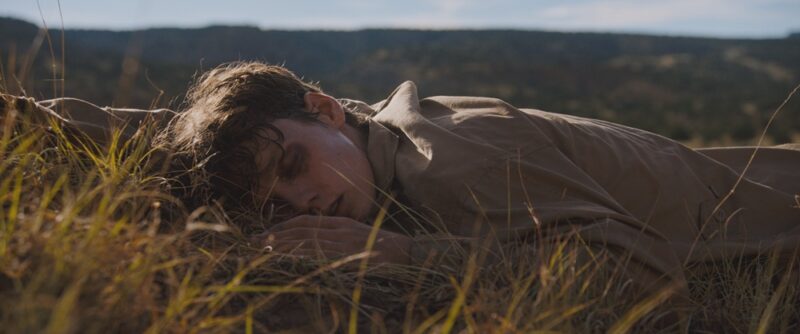
In a time when conversion therapy is once again in discussion as to whether or not such a practice will be allowed to be constitutionalized once more, a film like Spencer King‘s The Wilderness feels even more topical. Whilst King’s film isn’t exactly detailing the same notion as conversion therapy, it’s still bringing awareness to an under-reported practice that is seen as a treatment option for adolescents who are battling substance abuse, behavioral disorders, and mental health issues.
There’s a danger to how these programs – so often shrouded in secrecy – weaponise abuse, and King’s heartbreaking drama looks to bring an awareness to these practices, packaging the film in an almost coming-of-age temperament, primarily focusing on Ed (Hunter Doohan), a troubled young man fighting drug addiction, who is abducted from his home and forced into the unforgiving wilderness of the Utah plains; all under the guise of assisting him, of course.
The camp leader, James (Sam Jaeger), keeps a manipulative eye over Ed, informing the confused lad that he isn’t to speak to another at the camp until he has forged his own fire in the vast wilderness surrounding – a rule that has a long-standing within the camp. It doesn’t take Ed long to realise that he is very much on his own in this situation, and it’s through this horrific understanding that he forms a bond with the other young men who are all similarly fighting their own demons; Lamar Johnson‘s Miles being the most predominant he befriends.
Whilst there’s a certain “thriller” mentality to The Wilderness, King’s film is more an exploratory drama about cyclical abuse and hoping to overcome such. Through flashbacks we learn that Ed’s passion is surfing, and that he and his late father – also battling dug addiction – often fueled each other’s habitual mindframes. Despite this, what King’s script successfully projects is that Ed is a good kid, really, and it’s his inherent virtue that makes so much of the film as emotionally charged – and devastating – as it is; as much as his mother betrays him by sending him to the camp, she does it for his own good, unaware of just what exactly she’s sending him into.
Adhering to a slow burn, The Wilderness isn’t a particularly pleasant film. There’s a brutal sense of irony in that the beautiful landscape of the film masks the emotional, psychological and, in some cases, physical torture these young men are experiencing. But King’s film has been designed to open its audience’s eyes to such hardship – to break open a way of thinking that deserves evaluating – and the fact that it’s all coming from a personal place for the filmmaker makes it an experience all the more resonant.
In a time where original films and their personal connection to the storyteller feel lost in a haze of franchises and sequels, King bringing out such a work of art incorporating his own trauma makes The Wilderness all the more special – in spite of the anguish it causes.


FOUR STARS (OUT OF FIVE)
The Wilderness is now screening in select theatres in the United States.
