

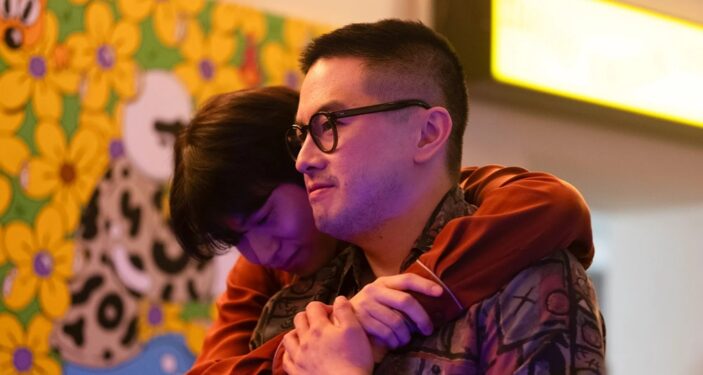
Directed by a then-rising Ang Lee, 1993’s The Wedding Banquet‘s tackling of themes around queerness, immigration and cultural identity marked something of a silent rebellion in cinema. It was a film that paved the way for furthered LGBTQIA+ stories to be told, and in Andrew Ahn‘s reimagining, Lee’s original story is expanded upon, allowing a thematic entrance for both millennials and Gen Z audiences to see their own experiences reflected.
Taking the basis of Lee’s original – which concerned a gay Taiwanese immigrant who marries a mainland Chinese woman to both placate his parents and secure her a green card, only for their plan to backfire when his parents arrive to plane his wedding banquet, hiding his gay partner in the process – Ahn’s The Wedding Banquet shifts its players and their motivations enough for his and James Schamus‘s script to develop its own personality and widen the original scope.
Here, there’s two queer couples at the centre, Angela (Kelly Marie Tran) and Lee (Lily Gladstone), and Min (Han Gi-chan) and Chris (Bowen Yang), with Min positioned as the character needing a green card, as his student visa is about to expire. Angela and Lee are trying to have a baby through IVF, and it’s evident that this process is causing serious stress, not just because they haven’t been successful, but also because Angela’s mother, May Chen (Joan Chen), is showing more interest in the sperm donor’s Yale degree and cardiology career than the fact that Angela is trying to have a child.
An art student and sketch artist, respectively, Min and Chris live lovingly in the guest house of Angela and Lee’s inherited home, with the quartet forming their own chaotic, inclusive found family energy. It’s beautiful and relatable, but with Ahn’s film still adhering to a dramatic mentality, this energy will be challenged when Min’s grandmother, Ja-Young (Youn Yuh-jung), informs the mostly placid young chap that he’ll be forced to return to Korea if he doesn’t take over the family business. There’s an expectation that he’ll honour his family’s legacy and discard his own career aspirations – something that many Asian viewers are sure to find comparable – but he’s been rejecting such for so long that he isn’t about to submit to familial pressure now, and in wanting to stay in the U.S he proposes to Chris.
Min genuinely loves Chris, and he expresses how he doesn’t even care that he’ll be cut off from the family fortune if he comes out as gay, but Chris doesn’t want to be responsible for such a disownment. As well, in Min proposing marriage, Chris views it as a plea for a green card, thus commencing something of a downfall in their relationship. Both upset and frustrated with their situations – Angela even starts to suggest that she and Lee not continue trying to get pregnant – an unlikely solution is formed, which is something that sounds more fool proof than it actually is. Min and Angela will get married, which allows Min to stay in the country, and with his wealth he can fund their IVF journey.
As risible as this plotting could be, Ahn never loses the emotionality at its core. Both relationships prove of equal importance, and the individual chemistry shared between Tran, Gladstone, Yang and Gi-chan allow their characters to play off any given partner, strengthening the film in the process. As much as there is a joyousness to the film and the relationships we witness on screen though, The Wedding Banquet is a far more dramatic affair than some may be expecting, given it’s being touted as a comedic feature. There’s laughs, without question, but I suggest viewers proceed with caution, as the film centering itself around generational traditions, fertility struggles and queer kinship opens itself up to a certain impassioned temperament.
The Wedding Banquet is a film that lives in both moments of tenderness and powerful exclamations. Relationships are examined across its 103 minutes, and as much as there’s still a cinematic sense of storied beats being honoured, the fact that the narrative on hand doesn’t always tie itself up in a neat manner speaks to the realism Ahn creates within the realms of a genre story.
A reimagining more than a remake, Ahn’s The Wedding Banquet is a beautiful, dramatic story that takes a more snapshot-into-life approach over the situational comedy mentality the film opens itself up to. You’ll be crying and reflecting more than you’ll expect, but when so many wedding-themed films give us fairytales and farce, a little therapeutic squalling can prove a welcome antidote.


THREE AND A HALF STARS (OUT OF FIVE)
The Wedding Banquet is now screening in Australian theatres.
