

As Australia’s only island state, Tasmania is already quite unique – but it’s not until you start navigating the winding roadways of the Tassie countryside that you realise just how different Lutruwita is from the rest of the Australian mainland. Beloved by the locals for its ancient wilderness regions, dramatic coastlines, and rich Indigenous history, Tasmania is a time capsule of life in Gondwanaland, with its towering Huon pine forests and alpine regions telling an epic tale of the Australian continent through epochs.
If you’ve already explored much of Victoria and have visited iconic regional townships like Beechworth, VIC, then you’ll also be charmed by Tassie’s hodge-podge of villages and townships, all of which have their own little quirk (i.e. Railton is the Town of Topiary, Sheffield is the Town of Murals, etc.).
And as many of the island’s natural sites and attractions are still largely untouched, Tasmania is also one of Australia’s most iconic road trip destinations, with the island’s diminutive size comparative to other states also being a great fit for 2-3 week-long road trip itineraries. You can basically see all of Tassie in just under a month if you know where you want to go.
So here are the stops you should definitely prioritise adding to your Tassie road trip itinerary.
Bay of Fires – Sun, Sand, & Wildlife Spotting
A picturesque conservation area on Tasmania’s northeast coast, Bay of Fires boasts white sands, vivid orange granite boulders, and crystal clear waters that allow for peak visibility for those looking to do a little snorkelling or ocean kayaking, and any other watersports and adrenalin-fuelling activities that are covered under your domestic travel insurance!
If you’re just looking for a casual swimspot though, be warned that the coastline is actually quite expansive. With campsites and accommodation scattered throughout the region, you can basically set up a homebase at your favourite beach. Binnalong Bay is a crowd favourite, but Ansons Bay further north is also a good fit for travellers looking to avoid beach crowds.
At Ansons Bay, you can also book multi-day walking tours of the area, which are ideal for being able to access and explore some of the region’s most isolated attractions, including the Mount William National Park and all its Indigenous sites, and other historic man-made attractions like the Eddystone Point Lighthouse.
Freycinet – Nature with a Touch of Luxury
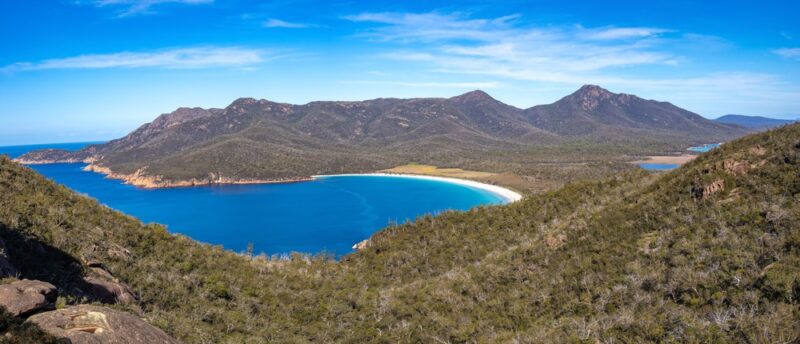
Further south down the eastern coast lies Freycinet and Dolphin Sands, Tasmania’s equivalent to Victoria’s own Wilsons Promontory. With some drop-dead gorgeous hiking trails leading to fantastic lookout points like the Wineglass Bay trail and shorter but still breathtaking Sleepy Bay track. The Wineglass Bay Lookout is an absolute must-experience, allowing you to witness firsthand the postcard-worthy view of the iconic bay with its genuine wineglass-shaped shoreline and aquamarine waters.
Of course, some big days of hiking call for a little evening pampering, and Freycinet delivers here as well. With luxury accommodations like the Saffire Freycinet as well as fine-dining options all over Freycinet and Dolphin Sands, you can explore the lush coastal landscapes during the day and recover with some great food, spa treatments, a rejuvenating shower, and plush bedding every night to make sure you’re fresh-faced and ready for more adventure tomorrow.
Cradle Mountain – Iconic Alpine Views
Trading in coastal views for mountaintops now, a trip to Cradle Mountain in the heart of Tasmania is always sure to delight. With a variety of walking trails that will take you either directly to the Cradle Mountain summit or to a range of lesser but more accessible vantage points around the Dove Lake circuit, Cradle Mountain offers enriching alpine hiking experiences for travellers of all ages and fitness levels. And for the particularly adventurous at heart, there’s also the multi-day Overland Track that spans roughly 65km total from Cradle Mountain to the northern shores of Lake St Clair.
Even if you don’t climb the mountain, still witnessing the iconic cradling peak from across the horizon is an experience all on its own. But if you do happen to make it to the summit, you can expect some otherworldly views of the Tasmanian wilderness, Dove Lake and Crater Lake, as well as the surrounding countryside blanketed in Tassie’s signature winter fogs and mists.
Tasmanian Wilderness – A UNESCO World Heritage Site
Speaking of the Tasmanian wilderness, did you know that it was actually recognised as a UNESCO World Heritage Site back in 1982? Spanning approximately 15800 square kilometres which includes Cradle Mountain and surrounding alpine territory, the Tasmanian Wilderness World Heritage Area is actually one of the largest conservation areas in Australia. The area also accounts for around 25% of Tasmania’s total land mass – yes you read that right: 25% of Tassie belongs entirely to the trees!
If you’re wondering at this point how exactly you’re supposed to explore an area of land that immense, let us tell you that there are few different adventure pathways available to you here. For starters, Cradle Mountain, Mount Roland, and other alpine attractions are situated within the Tassie Wilderness on its northern side. On the western side, there’s also options to travel to Strahan and Queenstown to embark on some guided river cruises, helicopter tours, and other guided tours. The river cruise from Strahan will take you around Macquarie Harbour, with stops at the old Sarah Island prison encampment, as well as a quick trip up the Gordon River into the heart of the untouched wilderness areas, where you can get seriously up close and personal with some towering Huon pine trees that are endemic to the area.
Hobart – Art, Food, & Culture
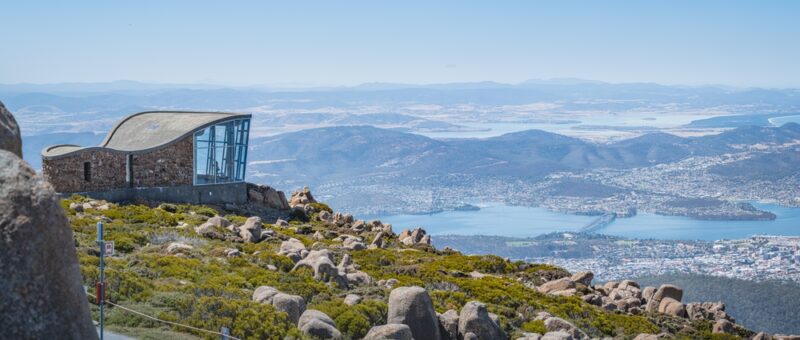
After all this time in the countryside and wilderness, it’s time to enjoy some of the treats and delights of Hobart, Tasmania’s state capital city. Nestled on the cliffs of Tassie’s southeastern coast, Hobart is a city of many contradictions. It simultaneously feels quaint and regional whilst still boasting a towering city skyline with a great variety of cultural attractions, including the ethereal MONA (Museum of Old & New Art).
There are so many things to do in and around Hobart for all types of travellers, however. Art and theatre fans can take a trip to MONA in the day and then catch a show at the Theatre Royal in the heart of the city, which also happens to be Australia’s oldest continually operating theatre after having opened its doors back in 1837.
For foodies, Hobart also offers a coffee scene that rivals the Melbourne CBD (if we’re allowed to say that!). With iconic bakeries like Jackman and McRoss, Daci & Daci, and cafes like Erda, Island Espresso, Imago, and the quintessential Hobart Coffee Roasters, there are oodles of great brunch spots to enjoy during your stay.
And if you’re keen to do a little sightseeing in and around the city, there are perfect vantage points on offer around Mount Wellington, plus beautiful sights surrounding Huonville, Cygnet, and other townships further west, and of course, the gorgeous Richmond Bridge in Richmond, which is yet another Heritage Site and Australia’s oldest stone bridge, having been built by convicts in 1825.
Bruny Island – A Unique Island Getaway
As far as Tassie destinations go, there’s none quite as unique as Bruny Island. Just a quick ferry ride from Kettering, southwest of Hobart, Bruny Island is a fascinating geographical landmark in its own right, with the island separated into two distinct sections that are connected by an incredibly narrow isthmus that the locals lovingly refer to as ‘The Neck’.
Measuring at just 10-15 metres long at its narrowest point, The Neck offers fantastic 360 degree views of Simpsons Bay on one side and the open Tasman Sea on the other. From the Truganini Lookout, you can also clearly see the changing of the tides on either side of the island at different times during the day.
Bruny Island is also a great destination for lovers of all things flora and fauna, with the island being home to unique elusive species like Tasmanian pademelon and the white wallaby. Bruny Island is also a preferred breeding ground for migratory short-tailed shearwater or muttonbirds. These fascinating native Australian birds build their nests at ground level and return to Bruny Island during the summer months to lay their eggs across the full length of The Neck. You can actually head out to The Neck during dusk hours to watch them soar through the air and find their nests at ground level – just be warned that they do in fact torpedo down to the ground, and many tourists are hit every season. Headwear is recommended!
Experience Tassie this Winter – Map out your Itinerary Today
From the island’s alpine regions to its many coastal settings, historical landmarks, and uniquely small-town attractions, Tasmania is undeniably a bucket list destination for millions of Australian mainlanders as well as international tourists alike.
If you’re ever so lucky to have a good 2-3 weeks on the island, then be sure to grab yourself a rental car (or take your own ride over on the ferry from Geelong, VIC to Devonport, TAS!), and load your GPS up with some of the top stops we’ve outlined above.
