

Nelson, the third of six children, was the most intellectually ambitious of the Rockefeller family, whose staggering influence was best put to use as patrons of the arts.
Although his legacy isn’t without its spots, the former US Vice President was less concerned with expanding industrial wealth than he was with using it to shape institutions and systems. His ambition was that of a cultural globalist; his legacy in the arts speaks volumes, echoing from some of the most iconic corners of Manhattan. not only deepening the connection between city and state, but intentionally blurring racial lines in the industry and championing respect for Indigenous art.
Along with his mother, Abby, Nelson Rockefeller was instrumental in the Museum of Modern Art and its expansion throughout the 20th century. His attention helped turn MoMA into the global centre of modernism, cementing a profile that’s now largely responsible for the way the world talks about New York as a bastion for the arts.
Writer Francine du Plessix Gray once famously described Nelson as “this restless, robust, kinetic cosmoplite” – requisite traits for such a profound supporter of the arts as a total and all-encompassing industry of human creativity. It was Nelson whose vision papered New York City with a worldly arts scene, embracing Parisian avant-garde movements alongside growing New York’s abstract expressionist movement and stitching that with North American and Central American folk art, African and Southeast Asian sculptural art, Japanese prints and ceramics, and 18th-century European porcelain.
Nelson was the first to jump on slow-marching movements and help them find their rhythm, whether it was pitching Andy Warhol’s distinction as Pop Art or tasking Jean-Michel Frank, arguably the greatest interior designer of the 20th century, with decorating a Manhattan apartment (a 30-room apartment occupying the top three floors of 810 Fifth Avenue).
His endless curiosity and passion gave New York City an artistic outreach that was, and still is, virtually unmatched across the world. Another one of du Plessix Gray’s very apt descriptions of Nelson: “the highest man in public office to be a champion of the avant-garde.”
While society isn’t exactly celebrating those with untold wealth these days, it’s safe to say that Nelson’s discernment has had an overwhelmingly positive impact on New York and the central role it plays in the arts. A year after he took office as the 49th Governor of New York, Nelson backed the formation of the New York State Council on the Arts and, through it, helped diversify art in terms of location, style and purpose.
While he was forging connections with modern masters like Pablo Picasso and Joan Miro, Nelson was also showcasing works from Jackson Pollock, Frank Stella, Willem de Kooning and Ellsworth Kelly. Yes, even Warhol. At the time, these names were little more than specks in the art world.
At one of MoMA’s many showings of Nelson’s private collections, the former Governor quoted English writer Cyril Connolly: “Art is a religion… collecting is a form of prayer.”
How Nelson Rockefeller transformed The Met
In the 1950s, Nelson and his son, Michael, founded the Museum of Primitive Art (MPA) to exclusively showcase non-Western art that spans across Africa, Oceania and the Americas, positioning objects as high art to move away from ethnocentric views on the arts.
Recasting non-Western art as masterpieces on the same level as European art was unheard of at the time. And while the industry still has problems with fixing European lenses on Indigenous art, the Museum of Primitive Art, which was located in a remodelled townhouse across the street from Nelson’s mother’s MoMA, represents a moment when the Western world began looking at art through a much more progressive lens.
Even if the process of acquisition depends heavily on Western capitalism’s colonial gaze.
The MPA arrived at a time when Indigenous art was treated like an afterthought, seen more as tools for anthropologists than art produced by human creativity. You’d be more likely to find African sculptures next to dinosaur fossils at a natural history museum, examined for their primitive purposes without any discussion on aesthetic beauty and symbolism.
Nelson seemed to think of building a worldly art collection as essential to understanding the industry as a whole. He conceived of such a collection as an “encyclopedia of man’s creative achievement” and went on to donate 3,500 pieces from the MPA to The Met in 1969, just five years before the Museum of Primitive Art was closed.
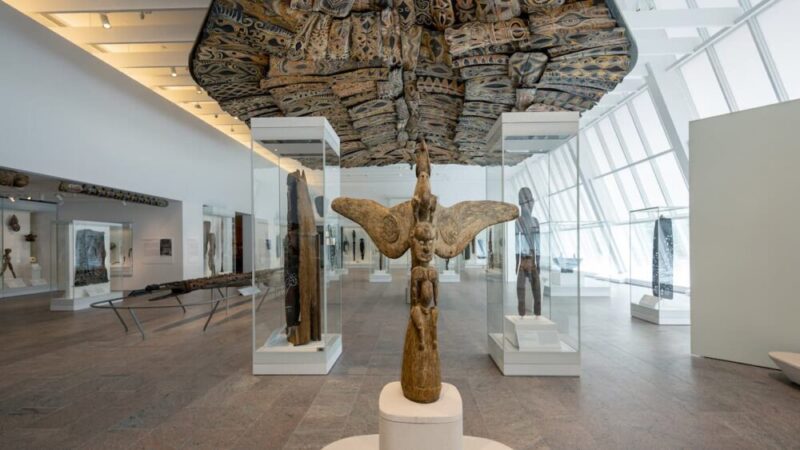
Many of those pieces now sit in The Met’s Michael C. Rockefeller Wing, which last year was reconceived as part of a $70 million project, expanding the wing’s footprint to 40,000 square feet and elevating the displays of art from Africa, Oceania and the ancient Americas. These pieces, some so large they wouldn’t fit into a photo, now better align with Nelson’s desire to see Indigenous art considered on the same level as European art.
In fact, the new wing is now The Met’s most impressive moment. WHY Architecture has designed large light-filled spaces where objects can now be arranged to emphasise cultural relationships and histories, using curation and presentation as important contextual information. Interiors are now brighter and maximise views of Central Park, better connecting this section of the museum with the natural world that informs many of these works.
Nelson Rockefeller’s secret New York State gallery is a lesson in legacy
Nelson had a penchant for embedding art into architecture. One of his most notable contributions to art as a civic necessity is the Empire State Plaza in Albany, where his fascination with the tactile, sensuous qualities of sculpture is integral to the governmental complex. Modern art isn’t just for private collections, but public life.
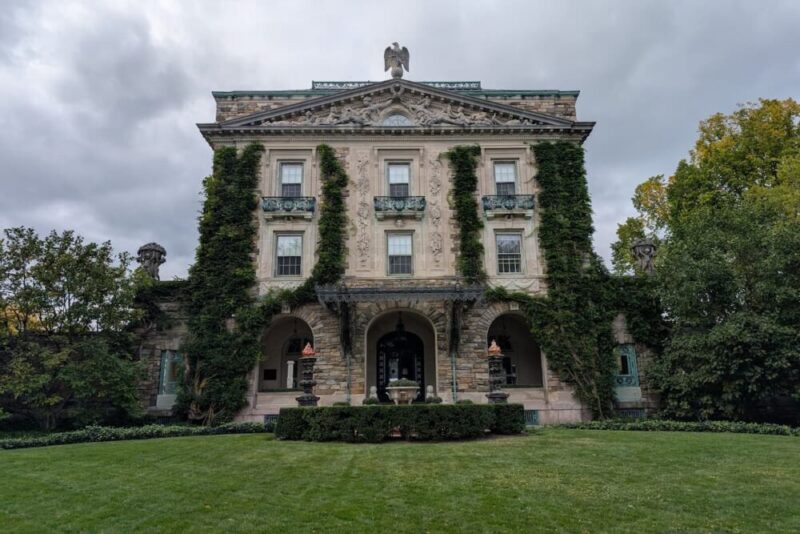
And yet some of Nelson’s most impressive acquisitions aren’t found at any one public institution. They are buried underneath Kykuit, John D. Rockefeller’s impressive Neoclassical mansion in Pocantico Hills, about a 50-minute drive from New York City, just inland from Sleepy Hollow and Tarrytown.
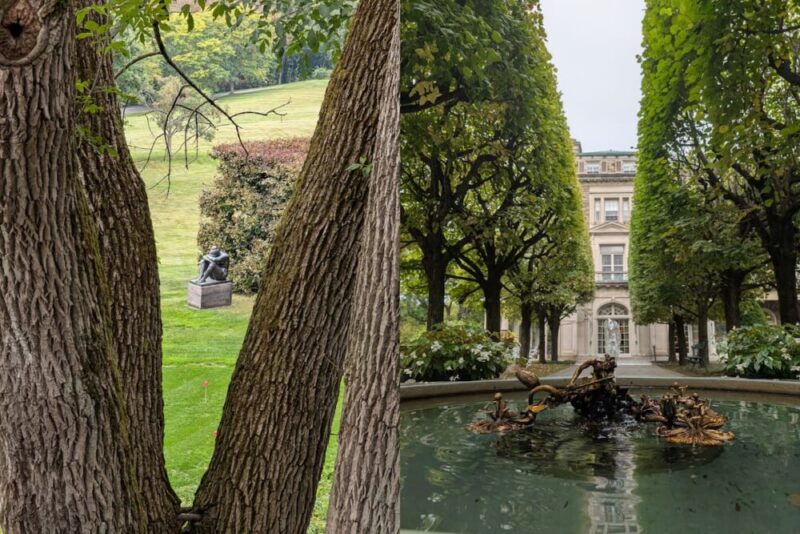
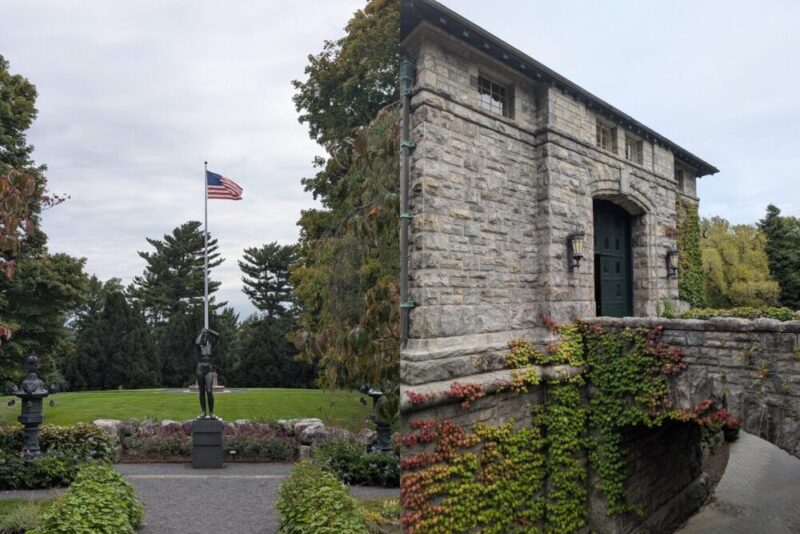
Taking a tour of this historic 40-room, four-storey stone villa is one of the most popular things to do in New York State. Yet, unlike The Met or MoMa, the historic home isn’t exactly on the way to, or from, anything. Intention is the only way you’ll find your way up to this unforgettable location, framed by terraced gardens and best known for its elegant interior design.
But while the home’s stately aesthetic does wonders for the imagination, no visit is complete without a look into the basement.
In the 1960s, Nelson commissioned architect Wallace Harrison to reshape the long, narrow subterranean space into a purpose-built art gallery that speaks to the collector’s specific curatorial whims. Eventually, this narrow space, which is long and petite, a bit like the underground space in Denmark’s Louisiana Museum of Modern Art, started housing large-scale sculptures and commissioned installations.
Unlike some of the other mansions in New York State, this estate doesn’t build wasn’t built almost entirely by arrogance and social competition. There’s a strong conviction that sits behind this family’s legacy, and while oil may have been a reason for their generational wealth, philanthropy was a major pursuit that distinguishes this home from many others.
And so the art Nelson hides down in his secret gallery isn’t overly concerned with power and moral righteousness. Here you’ll find rare masterworks from the likes of Alexander Calder, Andy Warhol, Henry Moore, David Smith and Louis Nevelson. Photos aren’t allowed, especially since the gallery leads to a room unlike anything I’ve seen before.
Preceding the end of the gallery, a wide space of colour and abstraction, is a letter from Pablo Picasso, permitting Nelson Rockefeller to turn 18 of his masterworks into large-scale tapestries. The gallery displays the results: impressive, wonderful recreations of famous Picasso paintings as enormous tapestries, some of which were delicately woven in collaboration with the artist, to ensure authenticity in colour and texture.
Shifting these masterworks, including the anti-war Guernica, from oil on canvas to wool and silk fundamentally changes their visual impact. Here, Picasso’s works are monumental and draw attention to more details, making these far more than just copies but great textural achievements that transform the geometry of Picasso’s most notable works.
Picasso’s tapestries are epic and rare
New York State hosts many secrets, and many of those secrets are stuffed into mansions dotted all over this great pastoral land. Hyde Park’s Hogwarts-like Culinary Institute of America, which will greatly change the way you think about food, and the worldly Untermyer Gardens in Yonkers are two of my favourites, but it’s this hidden underground gallery that’s the first thing I think of when I think of Upstate New York.
Why? Simply because it feels like a forgotten part of art history. Both as an important comment on authorship, authenticity and reproduction, and an illuminating view of Pablo Picasso’s cubism.
And so next time you’re walking around MoMA staring at Les Demoiselles d’Avignon for the fifth time, just know that there’s a much more peaceful way to appreciate the Spanish painter’s most important works, sitting just under an hour from the urban sprawl.
Chris Singh explored as a guest of I Love NY.
