

Tokyo’s visual supremacy is born from contrast. Plenty of pockets around the city blend Edo-period Japan and 21st-century Japan in an effortless, almost disorientating way, speaking a distinguished visual language that echoes across the entire city.
There are many unique things about Tokyo; this is definitive.
I’ve been to this incredible city around ten times throughout my career, and am always taken away by its many gorgeous parks. My first time, in 2010, took me over to Hamarikyu Gardens and – along with Inokishira Park in Kichijoji – it’s become one of my favourite places in the city.
The parks themselves are crafted and planted with intention, reflecting a prescient understanding of what people need in a big city. Sydney uses beaches for that. New York City, like Tokyo, uses parks. These breaks of perfectly preserved nature are so existentially important to big cities that I couldn’t even imagine what people would be like without them.
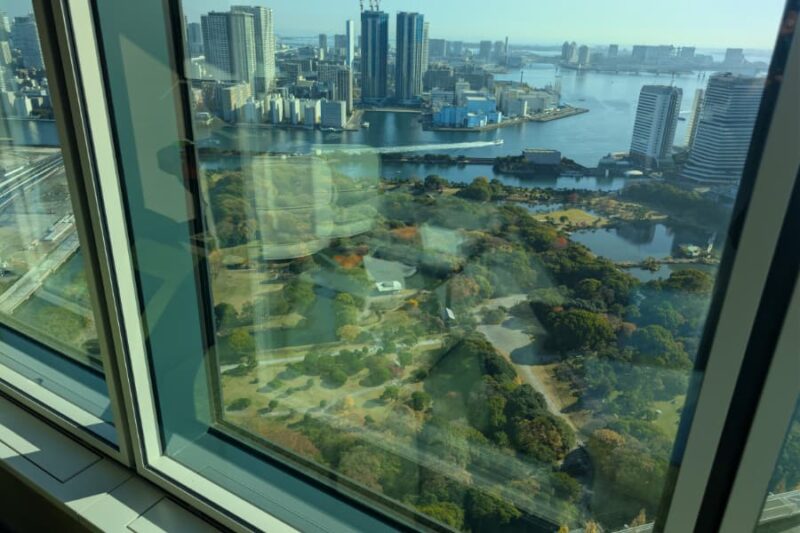
Hamarikyu is the perfect example. Quiet, contemplative, restorative and communal: all the good things a city park needs to be, cradled in the centre of business-minded Shiodome and its glass skyscrapers. Beyond the park is the glistening waters of Tokyo Bay, a wide channel that’s constantly active throughout the day.
This is a part of Tokyo that has always meant a lot to me because Hamarikyu Gardens is where I decided to pursue travel writing.
Whenever I land in Tokyo, I love to visit a stationery store – Traveler’s Factory – and buy a nice leather book and a good flowy pen. I sit in parks, bars, restaurants, coffee shops, dog cafes and wherever else my feet take me. Then I write. I love to see what kind of words this endlessly inspiring city bleeds out of me. It’s helped me become a better traveller, a more thoughtful person, and continually reinforces my undying love for this city, its people, its culture, its music and its hospitality.
That habit started in this green space, which gets its temporal distortion from the aforementioned contrast. Those skyscrapers, beautiful in their own way, cannot wrestle the calm that washes over me when I enter the former Tokugawa shogun estate, slowly circling the tidal pond and its remarkably intact wooden teahouse. Few places in Tokyo illustrate the city’s evolution from Edo-period Japan to one of the world’s great modern capitals so effortlessly.
And so when I found out that one of Tokyo’s most lauded luxury hotels completely looks over the gardens with an almost bird’s-eye view, I knew I needed to stay there one day. Conrad Tokyo does just that, offering outsized, immaculate and well-sized rooms with large glass windows that fully take in Hamarikyu Gardens, as well as the vast Tokyo Bay.
It’s a view worth the premium.
Location
Much like another one of my favourite hotels in Tokyo, IHG’s The Strings, Conrad Tokyo is perfectly pitched as an upscale base in a worker’s playground. Yet unlike the much louder Shinagawa, which is most convenient for anyone catching a Shinkansen out of town, Shiodome can feel like a bit of a ghost town when everyone is in their offices. Plus, it has a strong grip on its natural surroundings.
As above, Hamarikyu Gardens and Tokyo Bay are in full view from the hotel. That’s why rooms on this side of the hotel would fetch a premium.
Aside from the surrounding beauty, Shiodome isn’t a destination neighbourhood in the same way as Ginza, Shibuya or Asakusa. But it is quietly convenient. You’re only a 10-minute walk from the rowdy salaryman bars of Shimbashi, which also means you’re quite close to Ginza as well. Head down the escalator, walk through a cavernous underground mall, and you’ll also get to both the Toei Oedo Line (which is good for Shinjuku, Ueno and Roppongi) and the Yurikamome Line (which crosses the Rainbow Bridge to Odaiba).
An underground walkway connects the hotel to Shimbashi Station, opening up the JR Yamanote, Tokaido and Keihin-Tohoku lines, along with the Tokyo Metro Ginza Line and the Toei Asakusa Line.
The hotel entrance itself isn’t the easiest find, obscured amongst the area’s sterile business centres. Privacy is key here, and guests enter a small room with an elegant bright red sculpture in the middle. As with most mixed-use buildings in Tokyo, the entrance is just a pre-reception space; the enormous sky lobby is on level 28.
Design
Many of Tokyo’s higher-end luxury hotels are in mixed-use buildings, including two of my other favourites, The Four Seasons Tokyo at Otemachi, located in the 39-storey Otemachi One Tower, and the spacious Shangri-La Tokyo, occupying the top 11 floors of the 37-storey Marunouchi Trust Tower Building.
The designers of Conrad Tokyo have done much better to distinguish the guest rooms from all the office workers. Look up at the building from the centre of the garden, and you can see that the office portion has an orderly grid-like structure, while the hotel guest rooms have big glass walls and clean horizontal lines.
One of Conrad Tokyo’s greatest design strengths is that it deliberately compresses and expands space. You enter through a relatively understated ground-floor entrance, ascend to the 28th floor, and emerge into a double-height lobby framed by floor-to-ceiling windows overlooking Hamarikyu Gardens. It’s a classic architectural device; Frank Lloyd Wright would often make use of the compression-release dynamic in his spaces. After all, the famous architect’s inspiration was largely driven by Japan’s vocabulary.
The hotel opened in 2005, but it looks like it hasn’t aged a day. The gorgeous wooden details across the communal spaces look like they were just refreshed, and the polished floors, which lead to several different restaurants, are squeaky clean. The entire property has aged well because it’s avoided trend-driven luxury, maintaining a distinctly Japanese sense of restraint.
But of course, it’s always got that sense of wabi-sabi, the central Japanese philosophy of never being perfect but always improving. I find that the luxury hotels I am familiar with in Tokyo all have this one thing in common: a desire to, almost intentionally, avoid the “perfect” label.
Timber, stone and soft lighting help the hotel feel calm rather than performative. It’s a confident hotel. Almost every major public space engages deftly with the skyline, the gardens and Tokyo Bay, sustaining a sense of place so guests are always distinctly aware that you can only get this view at Conrad Tokyo.
Rooms
Skyline views are overrated. If Hamarikyu Gardens is the reason to book Conrad Tokyo, then landing in the right room is important.
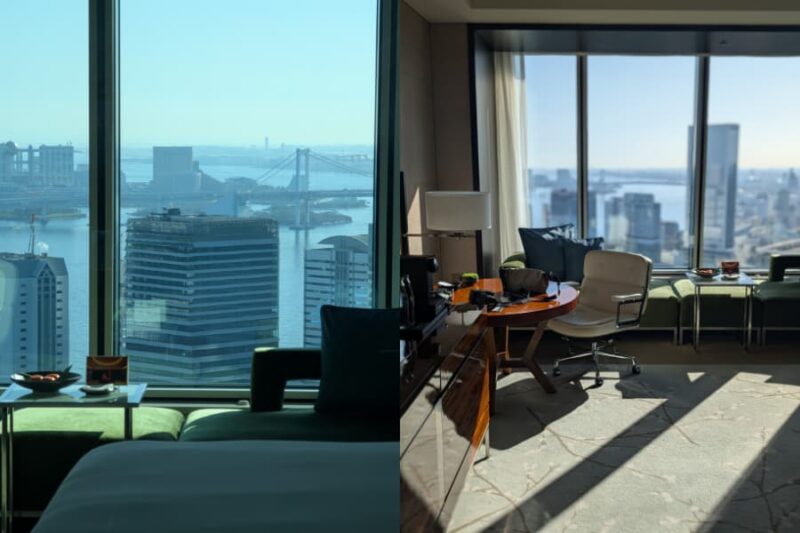
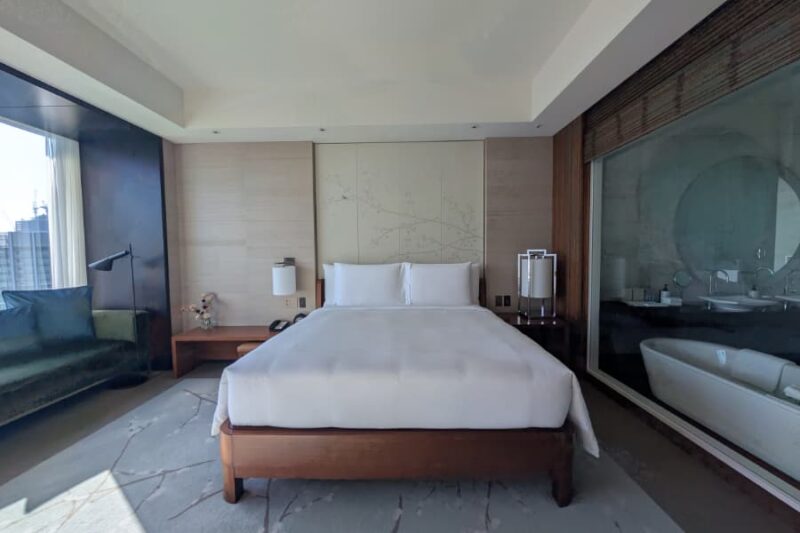
At 48 square metres, my King Executive Bay View Room is exceptionally spacious for Tokyo. Again, that seamless story of Japanese design comes into play with warm timber accents, soft neutral tones and crisp, clean lines. Everything has been considered towards a state of calm, enhanced by the stimulating, dynamic view that changes as light bounces off Tokyo Bay.
Waking up and watching the ships cross the sun-stroked waters with the gardens in the foreground – bliss. It’s actually the view I imagined.
The bathroom follows the same philosophy. A deep freestanding bathtub sits beside expansive windows, inviting long soaks overlooking Hamarikyu Gardens and Tokyo Bay. It’s one of those rare hotel features that never feels like a gimmick. Instead, it reinforces the hotel’s greatest strength: continually connecting guests with the surrounding landscape.
Comfort is unquestionable, and the turn-down service is second-to-none. But it really is all about that calming vista, which stands in stark contrast to the busier side of Tokyo. Japanese culture values stillness, so I understand why Conrad Tokyo is still held up as one of the city’s preeminent luxury stays.
Food & Drink
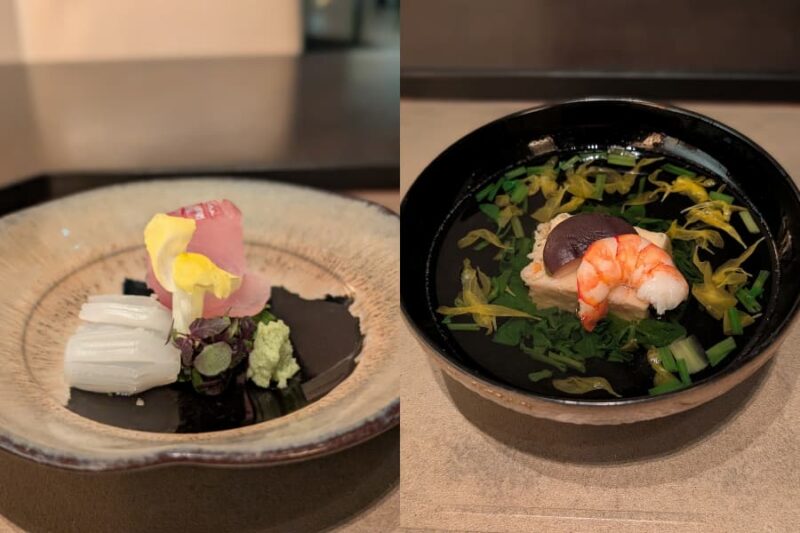
Almost all classic luxury hotels in Tokyo would have a restaurant for kaiseki, sushi and maybe even teppanyaki, and another that serves technique-forward cuisines like Italian or French. Or they opt for the familiar, rich flavours of China. Conrad Tokyo favours both, with its Chinese restaurant, China Blue, a perennial award winner, and a Michelin-starred French restaurant, Collage, that’s consistently well-reviewed.
The more traditional of the three is Kazahana, fitting that “Japanese restaurant” bill perfectly with a set kaiseki course that changes far too often to name any standouts. The quality is clear though; provenance is taken seriously, service is exacting without the stuffiness, and those views tie everything together. Smartly, most tables are set to maximise the glow from surrounding skyscrapers.
The aforementioned TwentyEight Bar & Lounge completes the picture with live jazz and large panoramic windows. Conrad Tokyo’s geometric interiors work hard to make this feel like a standalone venue, and it works incredibly well. The bar is in the middle, facing the view, and surrounded by all types of lounge seating, while the ambience is built steadily throughout the night with jazz that seems to start louder and get softer throughout the evening. A late-night premium Wagyu sando is exactly what I need on my second night just before I return to the room.
There’s an all-day dining restaurant as well. Cerise. I didn’t eat dinner here, but that’s where you’ll be for the extensive continental breakfast, which is spread across several stations and is consistently a stand-out. But I’ve never been disappointed for breakfast at any high-end Japanese hotel.
Guests with Executive Lounge access can also enjoy breakfast, afternoon tea and evening cocktails in a more intimate setting overlooking Hamarikyu Gardens.
Amenities
Small trees are planted around a 25-metre indoor swimming pool that’s open daily from 6 am to 10 pm (but is strictly adults-only between 6 am-9 am and 7 pm-10 pm). Plenty of natural light hits the water by day, and while it’s quite narrow, there’s more than enough room for several guests to use it at once.
Not that many do. Granted, I’ve never been to a hotel pool (outside of somewhere like Miami or Los Angeles) that is completely swamped with hotel guests. Instead, the quiet is contemplative, with the pool framed by a different angle to Tokyo’s skyline than you’d get in Ginza or Marunouchi.
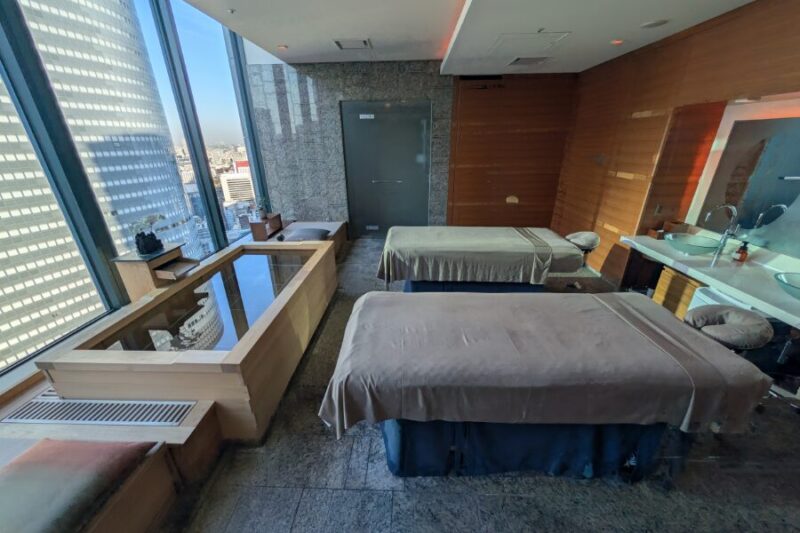
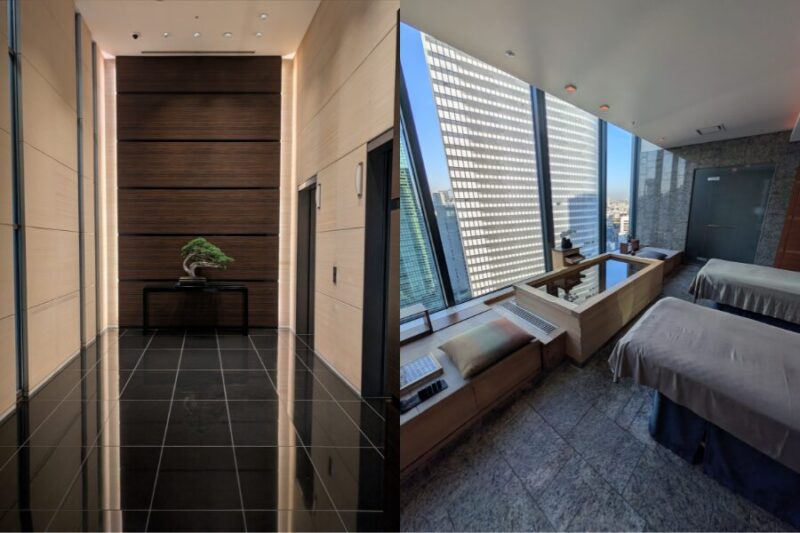
A 24-hour gym sits with plenty of space and what looks like a recent refresh. The modern equipment is varied and ticks off all types of exercise. Not far away is the award-winning Mizuki Spa, where lavish treatment rooms feature Japanese cypress baths bathed in natural light. I’ve always found Japanese spas, unsurprisingly, more nurturing and softer than the trend-chasing wellness facilities elsewhere. This one keeps it classic, with weighted blankets to relax after treatments and warm whirlpools next to a sauna.
Service
As expected, service is empathetic and attentive. Mizuki Spa is the best example of this, with the gentle staff perfectly aligned with what you’d expect from top-tier Japanese hospitality. Elsewhere, efficiency is a source of pride, and it’s clear staff have been trained (and re-trained) constantly to ensure perfection without the rigidity. Nothing ever comes across as performative, and lately that’s what I – and a lot of guests – have been wanting.
Loyalty Program
Conrad Tokyo is part of the Hilton Honours loyalty program, which is one of the most extensive hotel loyalty programs in the world. Hilton Honours starts from Bronze and reaches all the way up to Diamond Reserve, with tiered membership perks in between.
Benefits include a guaranteed Hilton Honours discount rate, digital check-in and room key, points towards free nights (with redemptions starting from 5,000 points per night), space-available room upgrades, daily dining credit, milestone bonuses and more.
More information about Hilton’s loyalty program can be found at hilton.com.
Verdict
High expectations are rarely met in the hospitality industry nowadays, but Conrad Tokyo is an easy exception. The hotel’s strong sense of identity has a lot to do with it. This property is far removed from fleeting trends because it was built with intention from the start. There’s a timeless elegance that can’t be beat, and it’s got a lot to do with those gardens below.
That said, a night at Conrad Tokyo doesn’t come cheap. Seasonality is strong in Tokyo so rates will vary, but you’re going to be paying at least $650 for a night here, and that price hikes a lot in peak season. The biggest question for those without a great deal of disposable income is whether or not spending two nights at Conrad Tokyo is worth the splurge.
I would say it is. I’m starting to see a trend amongst millennial travellers: they typically opt for mid-range accommodation for most of their trip and splurge on one or two higher-end properties towards the end. If that’s you, Conrad Tokyo should definitely be in that “treat yourself” category, especially if you’ve just spent a week admiring the skyline of Shinjuku and want to end your Tokyo adventure on a more contemplative note.

FIVE STARS (OUT OF FIVE)
Conrad Tokyo
Address: 1 Chome-9-1 Higashishinbashi, Minato City, Tokyo 105-7337
Contact: +81 3-6388-8000
The author stayed as a guest of Hilton.
