

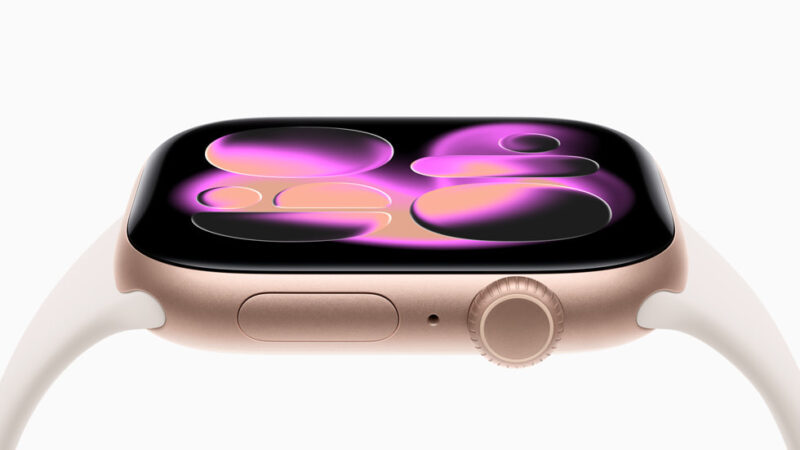
I just spent 75 days travelling around the United States, moving between cities with an iPhone in my pocket that increasingly stayed there. That was largely because of the Apple Watch.
Apple released the 11th generation of their multi-award-winning smartwatch at the usual time last year, and rather than write-up a review – it’s an iterative update, but a meaningful one: better sleep tracking, significantly longer battery life, more efficient heart health notifications – I figured I’d write about something that I’ve felt about the Apple Watch for a few years now.
As someone who constantly travels for work, I feel like having a fully functional smartwatch (I’ve tested a few – Apple is hands down the best) is as essential as a reliable suitcase and a Credit Card these days. It’s a non-negotiable for anyone who’s constantly dealing with the chaos of constant movement, simply because it’s one of the few tech devices that still undeniably improves your life rather than takes away from it. There’s virtually no downside to having a smartwatch, aside from the “do I charge it overnight, or wear it overnight” dilemma.
These little wrist computers are also increasingly important parts of one of modern life’s essential questions – how in the hell are we going to reverse phone addiction?
Travel smart
The advantages of having a computer strapped to your wrist become obvious when you’re travelling. I noticed it most when I was in a hurry. If a train was coming, I could check the time without breaking stride or digging around for my phone.
Getting around an unfamiliar city also became easier. Directions were sitting on my wrist when I needed them, while paying for public transport was often just a tap away.
These are small conveniences, and I’ve been using some version of them on Apple Watches for years. Yet over 75 days in the United States, I became much more aware of how often the Watch was smoothing out my day.
Travel tends to expose these little points of friction. You’re constantly thinking about where you’re supposed to be next, often while moving through a place you don’t know particularly well. Your phone solves much of that problem, although every interaction requires you to take it out and put your attention into another screen. The Apple Watch Series 11 gave me another option.
Getting my phone out of my hands
This became most obvious in New York City, where I quickly fell back into the city’s famously fast walking pace.
There were plenty of times when I needed directions but didn’t particularly want to stop. I could have pulled out my iPhone 17 Pro and stared at Maps like I’ve done countless times before, but having the next instruction on my wrist meant I could keep moving.
There’s also a safety consideration here.
One of the smartest things you can do in an unfamiliar city is move with some confidence. I’m particularly conscious of this in the United States, where I’ve found it useful to walk as if I belong there and avoid looking obviously lost. Constantly pulling out an expensive phone on a busy street works against that. It also takes some of your attention away from what’s happening around you.
The Apple Watch works especially well here when paired with AirPods Pro. I could hear navigation instructions without staring at a screen, then glance at my wrist when I needed more context. Most of the time, nobody around me would have any reason to know that I had no idea where I was going.
That’s useful in a practical sense, but it also makes exploring a city more enjoyable. Instead of walking around with my face pointed towards a phone, I was looking at New York.
Public transport reinforces the same point. When Apple Pay is supported, tapping through a station with the Watch feels almost comically easy. This becomes even more useful when you’re carrying luggage and don’t have a free hand waiting to grab your phone. After a while, you stop thinking about the individual interactions. You just keep moving.

New York will destroy your step count
I also walk far more when I’m travelling than I ever seem to at home.
New York takes this to another level. A subway ride might get you most of the way somewhere, but there’s almost always more walking waiting at the other end. I’d look at my Apple Watch later in the day and realise I’d covered a distance that would have seemed ridiculous back home.
Keeping track of that mattered to me because I have hypertension. I’m conscious of my cardiovascular health and regular movement is something I need to take seriously, so watching my daily activity accumulate gave those numbers more relevance than they usually have at home.
The Watch is particularly good at this kind of passive monitoring because it doesn’t require much from you. I wasn’t travelling around America obsessively checking fitness statistics. Most of the time the Watch was simply recording what I was already doing, leaving me to look at the results when I actually wanted them.
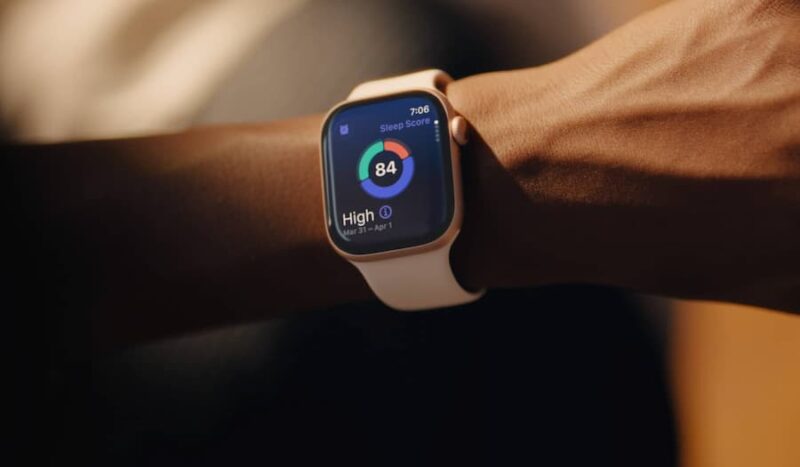
Apple continues to push further into health with Series 11. Sleep score now gives you a simpler way of understanding how well you’ve slept, while the Watch continues to gather information through its existing health sensors throughout the day.
Apple has also introduced hypertension notifications on compatible models in Australia. The feature looks for patterns that may be associated with chronic high blood pressure over 30 days. It isn’t a direct blood-pressure measurement and isn’t designed for people who have already been diagnosed with hypertension, so this isn’t something I personally rely on to manage mine.
The improved battery life on Series 11 is significant. Apple now rates it for up to 24 hours of normal use, which makes wearing it overnight much more realistic. A short charge can also get you through several more hours, something I found much easier to work around while travelling.
Apple, ironically, has the antidote to phone addiction
The health features are useful, but they’re not the main reason I’ve become so attached to the Apple Watch. I want to spend less time looking at my phone.
That’s becoming harder to dismiss as some vague digital-wellness ambition. Problematic smartphone use is now being studied seriously, particularly in relation to attention and sleep. Researchers are also examining its relationship with mental health. There are still important questions around causation, and some of the more hysterical claims about smartphones melting our brains aren’t particularly useful.
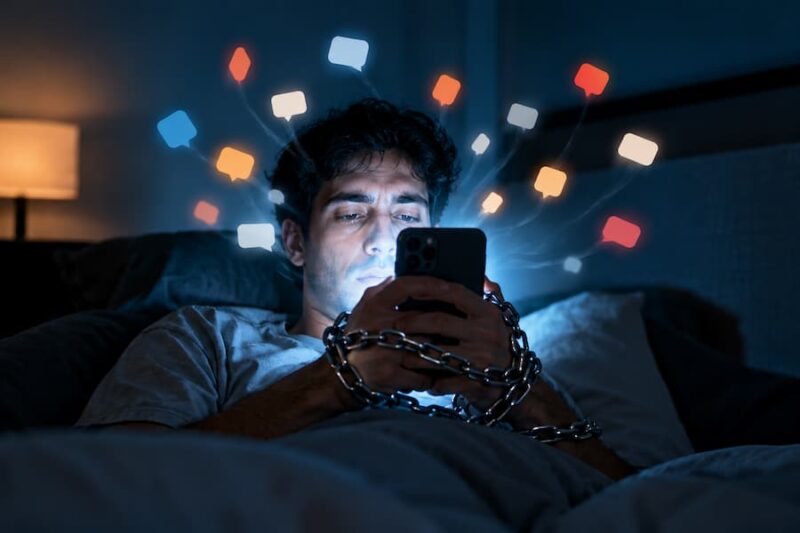
The behavioural problem is much easier to recognise. I can take my phone out because I genuinely need to check something and find myself somewhere completely unrelated a few minutes later. Maybe a notification caught my attention. Sometimes opening one app simply reminds me that another exists. The original reason I reached for the phone has already disappeared.
Travel makes me much more conscious of this because attention is one of the things I’ve travelled for. If I’ve flown halfway around the world to experience New York, I don’t want to spend an unnecessary amount of that time staring at the same rectangle I stare at back in Sydney.
Yet travelling makes your phone incredibly important. You need Maps. Your bookings are on it. Messages become more important when you’re away from home, particularly if plans change. So telling people to simply put their phones away doesn’t solve much.
This is where I’ve found the Apple Watch increasingly valuable. It puts a layer between me and the far more distracting device sitting in my pocket.
A message can reach my wrist without requiring me to open anything else. If I need directions, I can see where I’m going and move on. Checking the time remains exactly what checking the time should be. There isn’t much opportunity to fall down a digital rabbit hole on a screen this small, and that’s never been more important.
Nice little tech devices like Brick are making waves in the industry because they introduce friction between you and your screen time. It’s reverse engineering UX principles. Instead of removing friction to make doomscrolling an inevitability, Brick is bringing that friction back to keep our addictions from consumsing us. I haven’t used a Brick yet – I’ve been meaning to – but the Apple Watch works with similar principles. It streamlines the essentials from your phone so you aren’t tempted to pick it up, open social media like a well-trained zombie, and start overloading your amygdala with rage bait. That’s existential at this point.
The existential value of the Apple Watch
When Apple introduced the original Apple Watch in 2014, it was called the company’s “most personal device ever.” More than a decade later, I think the philosophy behind the product has become clearer.
Apple has spent years making the Watch capable enough to handle interactions that once required an iPhone. At the same time, the physical limitations of wearing a tiny screen on your wrist prevent it from becoming a replacement for everything your phone can do. I’ve come to see that limitation as one of the best things about it.
I don’t want to watch YouTube on my Apple Watch. I’ve never felt an urge to sit there scrolling through social media on it either. The Watch handles the information that matters at that particular moment, and then I lower my wrist. Series 11 doesn’t radically alter that relationship. Apple has improved the durability of the glass on the aluminium models, and the longer battery life is welcome. watchOS 26 continues refining the experience without changing what makes the product useful in the first place.
There are technology products that become more useful as they demand more of our attention. The Apple Watch has spent years moving in another direction, and that’s why I think it represents some of the best work Apple is doing right now. The iPhone is extraordinarily good at absorbing you. That’s partly because it has become capable of doing almost anything. The Watch takes some of the most useful parts of that ecosystem and puts them somewhere less consuming.
I felt the difference constantly while travelling. Sometimes it was tapping through a station when I was already running late. Other times I was walking through Manhattan with directions coming through my AirPods while my phone stayed safely out of sight. Over 75 days, those moments added up.
The Apple Watch Series 11 didn’t change the way I travel through some spectacular new feature. It simply made travelling feel more seamless while helping me spend less time staring at my phone. Given where our relationship with screens appears to be heading, that’s become one of the most valuable things I can ask of technology.
If you’re an iPhone user, I really think the Airpods and Apple Watch are non-negotiables at this point. I wasn’t the kind of fanboy to say something like this two years ago, but this past generation has really shown me that the “accessories” have moved from being additional parts of the Apple ecosystem, to the parts that just might save the day.
The author was loaned an Apple Watch Series 11 for this feature.
