

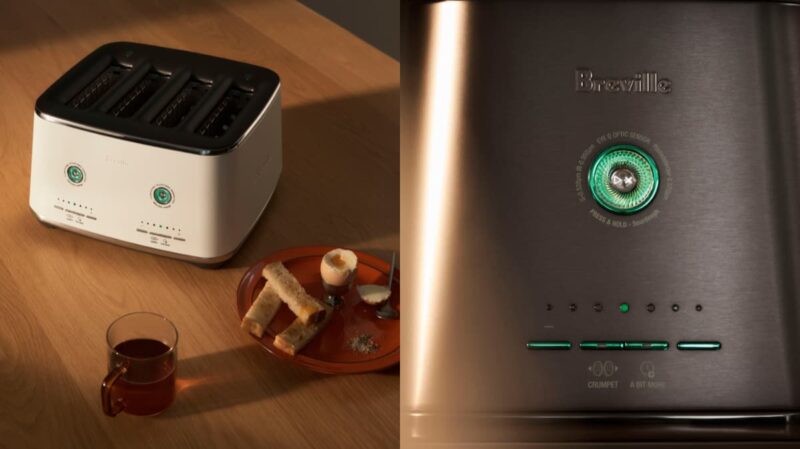
Breville’s latest home appliance is something the brand, best known for its superb coffee machines and category-leading microwaves, has never done before.
“In fact, no other company has done this before,” says Tom Groundes-Peace, Senior Global Category Manager & Head of Research at Breville. However, this gave them a slight advantage; Breville could thoroughly test the product to ensure it was top-notch for consumer release.
“We had to try and fail, a lot!”
The product he refers to is a toaster. Yes, a toaster. A toaster that has gestated for a decade and is, apparently, even more complex than some deep-sea technology.
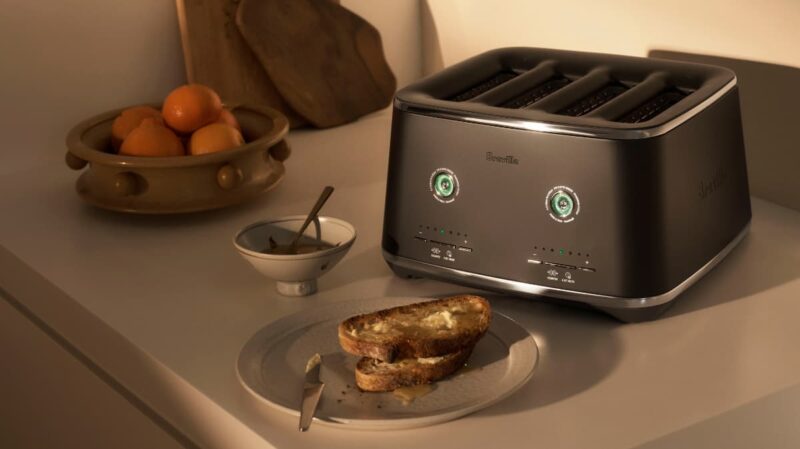
Wait a minute, how can a toaster be this complicated?
This isn’t a meme. It’s a futuristic toaster that can self-monitor so that it’s not functioning on time, as a traditional toaster does, but by colour and texture.
Specifically, that’s the Eye Q Auto Toaster, launched in the Australian market by the innovative kitchen brand to revolutionise a home appliance that’s been kept fairly consistent for more than 100 years.
Breville’s research and development team, led by Australian engineers, have found a way to set a new premium benchmark for the home. The Eye Q allows users to select the perfect shade of toast by colour instead of time, with specialised optic sensors inside the toaster constantly monitoring each slice up to 10 times per second. The toasting stops when the chosen colour is reached, ensuring perfect results every time.
This was made to address a common frustration. Anyone who doesn’t just throw the toast in and hope for the best is usually left guessing what settings are best for different types of bread. And we all know that re-toasting or throwing away over-toasted pieces is a common frustration, even with the most premium models.
This is because, to date, no brand has found a way to toast to a colour instead of time.
A ten-year development process was necessary, not just to perfect Breville’s new patent-protected Eye Q Optic Sensor technology, but also to keep the cost reasonable.
“If we released this five years ago, it would have been way too big, too heavy, too slow to toast, and too expensive,” Groundes-Peace told The AU Review.
A company called Sensability have been developing sensors and algorithms for years and helped with Breville’s Eye Q Optic Sensors. That’s the main technology that sits behind this toaster and separates it from quite literally every single toaster that has come before it.
“These [sensors] were literally [the subject of] a PhD thesis when we started with a little breadboard model [or prototype] that showed a lot of promise,” said Tom when we asked him about the development process.
“It’s taken a team of electrical, mechanical and software engineers, plus a mathematician and a scientist, years to turn that promise into something reliable, durable and manufacturable.”
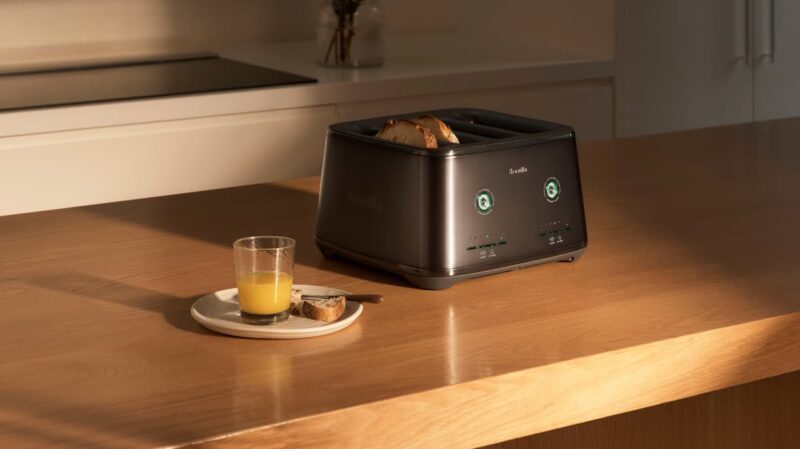
It’s all about the sensors
I’ve been testing the Eye Q out for a few weeks now. I’ll be publishing a full Eye Q review soon. For now, you should know a bit about the magic that makes it all work. And why it’s worth investing over $400 to get one.
There are two major reasons why the Eye Q took so long to develop. First, Tom assures me that had the Eye Q been released five years ago, it would be much more expensive than $469. Keeping the cost reasonable and tipping the technology towards a sustainable price point was one reason we had to wait so long (for something we didn’t know we were waiting for in the first place).
The second has to do with the sensor package. Sensability has developed the Eye Q Optic Sensors to monitor the colour change of any kind of bread up to 10 times per second using dual wavelength green and infrared LEDs. The toaster simply stops as soon as the desired shade is reached, elevating the bread from the chamber in one smooth motion.
I personally love watching the bread slide down into the toaster and slide back up when ready. This isn’t spring-loaded like a traditional toaster; the entire experience feels appropriately futuristic when the bread is raised and lowered by a whisper-quiet motor.
“The main challenge was to get a sensor package that is reliable at detecting browning while also being cost-effective,” Tom told me.
“[It also needed to] withstand the hostile environment inside a toaster [high heat, smoke etc].”
This required Sensability and Breville to tune the sensor package to read the right shades across a range of bread types, and to get the algorithm to the point where it can detect browning across all these breads. That was tricky as the many different types of bread have different colour profiles and moisture contents. Then you have other things to consider like raisins, seeds and the occasional hole.
The Eye Q addresses all of these issues. There is a special mode for sourdough that recalibrates the sensors towards thicker crusts and denser interiors, while also considering longer browning times, so you can get consistent results without getting burnt sourdough.
“We know that Sourdough is a super popular bread type, and so we created a unique mode for it,” said Tom.
“Most toasters find Sourdough hard to toast due to the quirks of crusty edges and dense centres. The Sourdough algorithm is tuned to stop toasting just a little earlier than our standard toasting mode, to reduce the chance of burnt crusts”.
If you’re toasting raisin toast, for example, the sensors will pay attention to the caramelisation of the various raisins that are flecked across the surface. There’s also a crumpet mode and Breville’s signature ‘A Bit More’ button, just in case you feel like your toast could use an extra 30 seconds.
Breville clearly isn’t taking any chances here. The amount of time, care and tech that has gone into the Eye Q easily makes it one of the most fascinating pieces of home tech to launch this year. And it’s unlikely we’ll ever be seeing such a substantial leap in the toaster category as this.
As mentioned, I’ll have a review live in the coming days. Obviously, testing this thing requires a bit more of my carb allowance than I initially thought.
Breville’s Eye Q toaster is available now as a 2-slice ($469) or 4-slice ($629) model. You can get more information from the official Breville website.
