

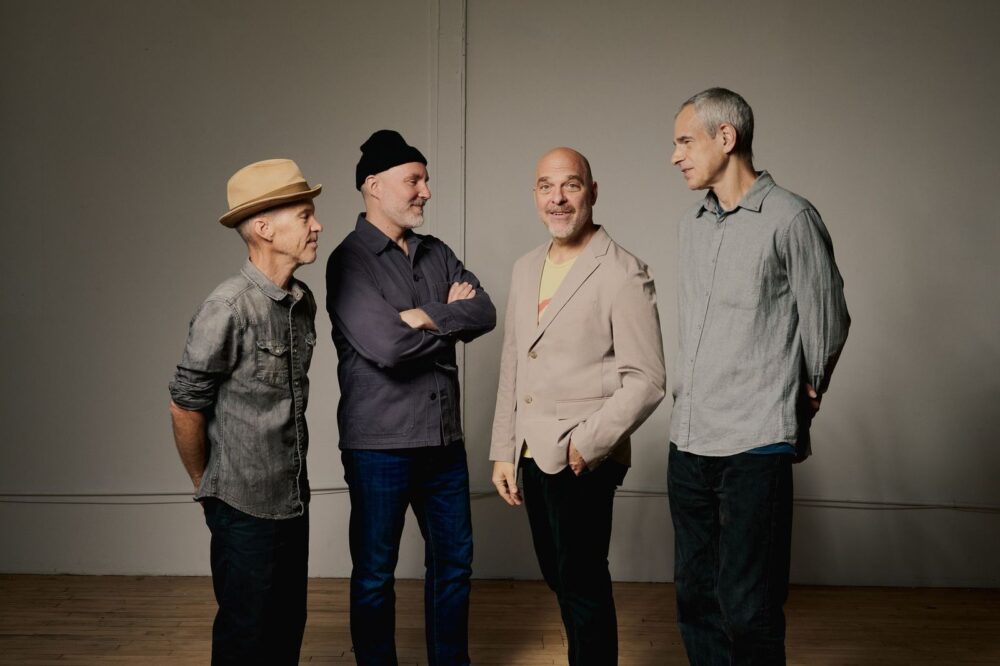
American jazz band The Bad Plus, initially a trio and now a quartet, are bringing their 26-year career to a close. Before they do, they’ll return to Australia in October as part of their farewell tour. We spoke to founding member Reid Anderson about the tour, the band’s evolution and what comes next.
You must have been going through a lot of Complex Emotions over the year with your final tour.
Yeah, it turns out it was a very aptly titled album. It’s one of those things where I really don’t know how I’m going to feel on the last show. I anticipate it’s going to be quite a heavy experience, but you can’t have that heavy experience every night for a year. So, in one sense, we’re just trying to enjoy the moment and put on good shows.
As a bass player, is that probably the worst instrument you can pick to travel with?
Oh, for sure. I don’t even travel with my bass and haven’t travelled with it for years. I wouldn’t recommend it. I’m jealous of people who get to carry their own instrument. There are various solutions. Some bass players play with these travel basses, but they don’t really sound that good. Some have necks that come off, and I just can’t deal with that, so I just play whatever they give me. If I get a playable instrument, I can make it work, and these days they’re almost always playable. Every once in a while, you’re handed a dog of an instrument, and then you see if there’s something else available, or you just have to make do.
You’ve been playing for over 20 years and changed from a three-piece to a quartet. How did that affect your dynamic of what you were doing?
Well, the obvious switch from we were a piano, bass and drums trio up until that point, and just having guitar and saxophone, obviously that changes the perspective a bit. But for us, it was a pretty easy decision because we had had all those years with piano and it just felt like it was time to make another kind of statement. So, in a sense your approach doesn’t really change because the goal is just to make the band sound great and to make everybody sound great. So that’s what we always try to do, no matter what the instrumentation is.
One of the interesting things I saw is you do a lot of covers and quite different covers to what I would expect, like Radiohead, Queen, Black Sabbath. How do you choose which ones you’re going to do?
Well, we did some covers in the early days, and we don’t do them anymore. In fact, we haven’t played covers for years. It was something that got a lot of attention when we first started doing it. I think because we did it differently. You know, it was relatively novel when we started doing it for a quote unquote jazz group to do such a thing. But we enjoyed the challenge of finding a way to bring that music into what we do. Also, just the dialogue with contemporary music and music that we grew up with or that’s around now.
It felt like part of the jazz tradition that had kind of left after a certain period, but it was great. It was always a small part of what we did. We play original music, but it had a big impact, and it was great because audiences would really stay engaged with the music, even though we were taking it to some very avant-garde places.
“Smells Like Teen Spirit” is one that pops up on the search engine, and it just changes the whole perspective of what the song’s about.
Yeah, exactly. That’s the point. Not to change the perspective but give it a just look at it from another perspective.
So, you’ll be in Japan and Australia in October with GODTET supporting you in Sydney. How did you come about picking them as a support act?
Well, I’d like to say that we searched through a number of different Australian bands and came up with them. I’m sure they’re fantastic, but to be honest, I’ve never heard them before. I think the promoter probably lined them up. But I look forward to hearing them.
I’ve seen them before, and they are really good. I think they’ll fit the vibe of what you’re doing really well. Then you’re in Melbourne and Perth for jazz festivals as well. Do you get a chance to check out other bands and things when you’re at these festivals?
Sometimes it depends, you know, on a lot of different factors. But you know, we’re there to do our thing, and if there’s anything else, it’s a cherry on top.
So, what will audiences get from the band? What are you planning?
Well, maybe some people who come to the show will know who we are. For those who don’t, we’re a band. We’ve been together for maybe 27 years, and we’ve written a lot of music, and there’s a body of work out there. If anybody wants to come to the show prepared, they can do a little homework, but I think we’ve created a personal sound. We’ve written music that we feel very proud of, and it’s not an anonymous jazz experience. We always bring a very intense but also inclusive energy to the shows. So, I hope that people will come away with that impression.
So, after 27 years, what’s the plan? Will you still be making music, or just in a different format, or with different people?
Yeah, new beginnings, I guess. None of us plan on quitting music, so we’ll all pursue other projects and musical interests and see where it takes us.
Have you had any particular highlights over the years, like something that’s really stuck with you?
Well, one thing that comes to mind is just seeing it become something from this band that myself and Dave King and Ethan Iverson started in 2000. We committed to it, we believed in what we were doing, in our music, and in creating a group sound. Here we are, 27 years later, and we’ve been able to sustain it. We’ve made a mark on the world as such as it is. I’d say that’s quite something. Not everybody gets to do that.
It must be very satisfying to spend that many years doing something that you love and making a living from it.
Yeah, it’s wonderful. It’s an incredible privilege, and also as a musician, it’s a great feeling to take the stage and really know the music. Like the truth is, in a lot of jazz, different players, whoever’s available, and it’s just a different energy. It’s fun to have that kind of fundamental confidence in what you’re doing.
I imagine that the live experience would be more intense and more ethereal, because you’re able to improvise on the night, depending on the audience reaction and the band’s reaction.
Yeah, sure. I mean, this music is meant to be live music. We’re looking forward to being in Australia. It’s always been a highlight to go to Australia, as unfortunately we can’t do it all the time. But we’re very happy to do these shows on the final tour.
The Bad Plus Farewell Tour
Plus guests: GODTET
Thursday 22 October
Approximately 2.5 hours including interval
Tickets from $65+BF are available HERE
City Recital Hall – 2 Angel Place, Sydney NSW 2000, Australia
Header image credit: Evelyn Freja
