

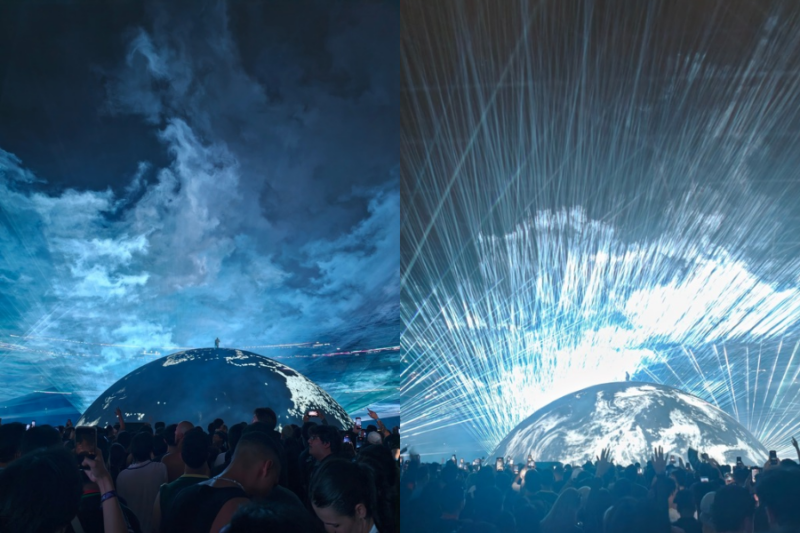
Ye (formerly known as Kanye West) brought the full production of his now infamous comeback show to Jakarta’s Gelora Bung Karno Main Stadium, giving the Indonesian capital one of the largest concerts in the city’s history. And while the show’s spectacular visuals confirmed West’s lofty ambitions, glaring sound issues marred most of the night, holding it back from what would have otherwise been a fantastic show.
Bringing Ye to Jakarta
Promoters Raw Vision Collective and Senyawa Entertainment worked a miracle to not only bring Ye to Jakarta, but lock this in as the beleaguered artist’s only show in Southeast Asia and Oceania. There was a lot riding on it as a result. Around 20,500 tickets were purchased from overseas, with Australians leading international ticket sales, followed by countries like Singapore, Malaysia and New Zealand.
Buzz about Jakarta’s growing event profile only grew louder, with the city completely getting behind Ye’s comeback show in the hopes that this was just the beginning for Indonesia’s share of the increasingly lucrative destination events market.
That could still very much be the case. In terms of pre-show logistics, things couldn’t have been smoother. While Jakarta’s famously nightmarish traffic didn’t suddenly improve for the day, getting in and out of the stadium was seamless; there were plenty of fan zones, food and photo opps around the stage, and gates opened on time.
I even managed to book a Grab back to my hotel on the first try, within five minutes of walking out of the venue. Earlier this year, I was in Philadelphia for Roots Picnic. It took me two hours after the event finished before I could get an Uber, and I had to walk 30 minutes to the pick-up point.
Good Kid, Bad Rhythmicity
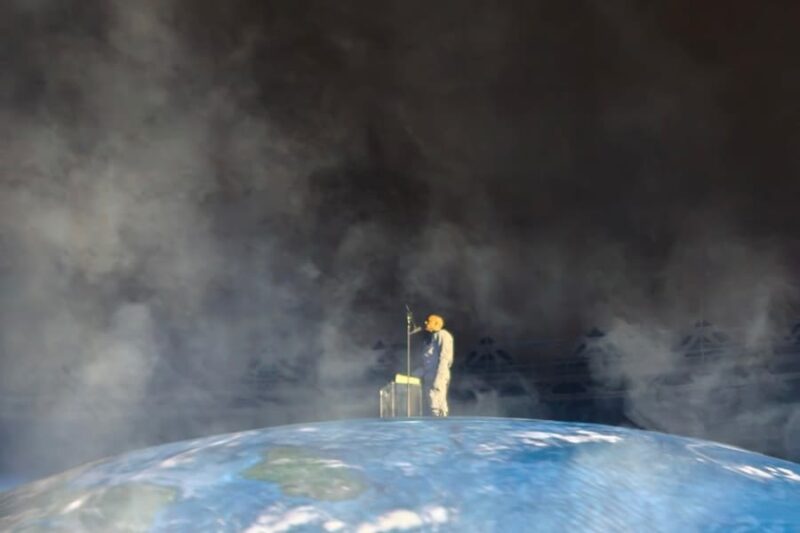
Even Kanye didn’t slump, like big-name rappers are wont to do. The show was scheduled to start at 9pm. Kanye emerged atop his incredible 360-degree dome shortly after, rising to a snippet of ‘Dark Fantasy’ which quickly bled into ‘Waves’ and ‘KING’.
But the sound team? They slumped. They slumped big time. In fact, I’ve never heard sound this bad at a concert.
Allow me to demonstrate.
Open up a new tab and go to YouTube. Bring up your favourite song. Now, open another tab, and do the same. Punch in your favourite song. And, just for the sake of it, open a third tab and do the same. Assuming you’ve hit play on all of them, they should each run around 3-4 seconds behind the other.
Doesn’t sound good, does it? You’ve got that familiar song. The sound you love so, so much. But hearing it thrice, overlaid and out-of-sync, is kind of unbearable, isn’t it?
Instead of the natural reverb of an indoor stadium concert, which typically widens the soundstage and adds richness, there was a distinct echo all throughout the outdoor show, from ‘KING’ right up until the closing moments of ‘Runaway’, never letting up and spoiling every moment of the two-and-a-bit-hour concert. There was not a single second where the echo didn’t become a serious issue, weighing down everything from the cinematic highs of ‘POWER’ to Andre Troutman’s excellent solo on “All The Love”.
Granted, complaints online have been few and far between and seem to be specific to those standing in General Admission (“Festival”). It seems like the seats were too far back for this to be an issue. But I can only review a concert from my perspective.
How was Ye’s show in Jakarta?
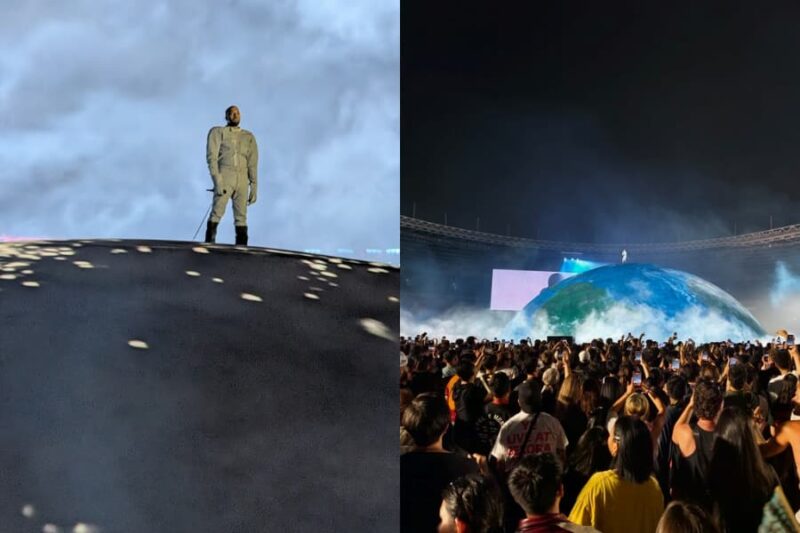
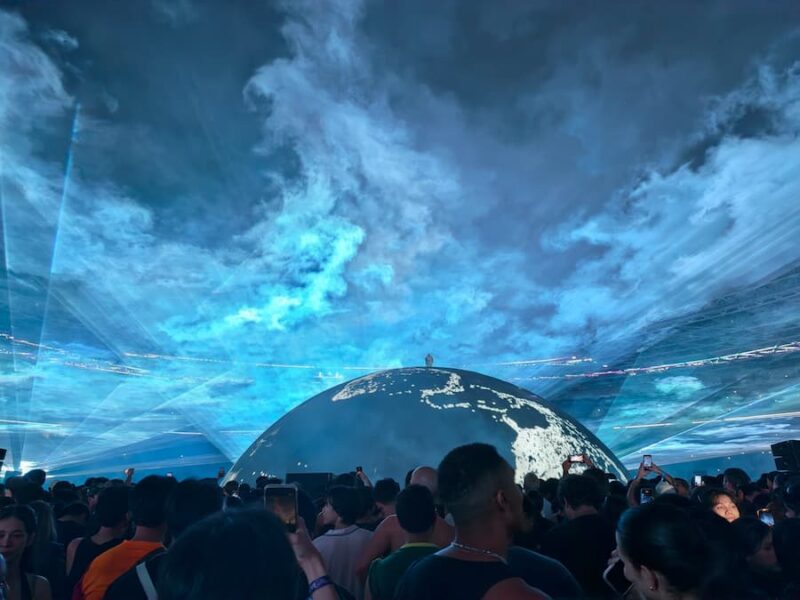
Sound issues aside, this is a spectacle worth the price of admission. The now-famous globe isn’t as large as you’d think, but it towers above the crowd, propped in the centre of the Gelora Bung Karno Main Stadium.
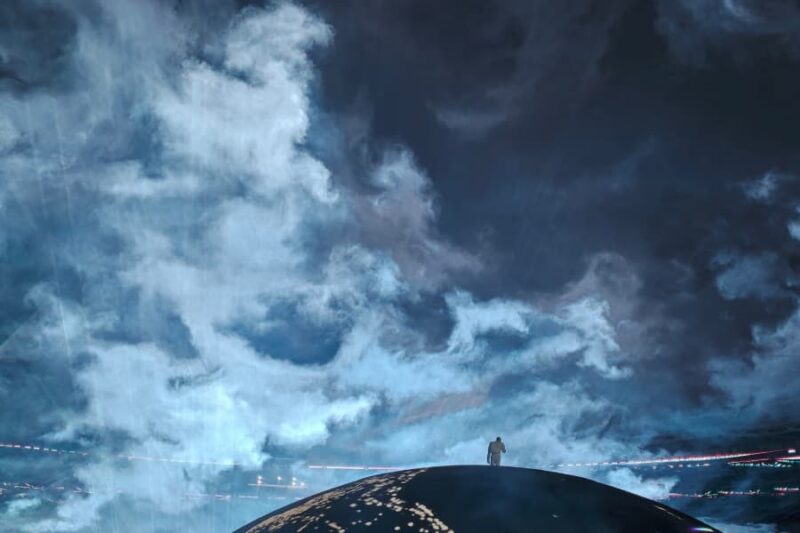
Ye and creative director Austin Taylor debuted the spherical inflatable structure in Los Angeles, and it’s been flooding social media ever since, upping the ante over West’s previous stage designs with a high-lumen external projection mapping project creating the impression of a spinning planet Earth. Ye stands on top and near the centre at all times, tethered to the structure as swirling clouds, overlapping laser beams and dense displays of pyrotechnics are timed to the artist’s discography.
Irrespective of how you feel about Ye’s public-facing behaviour over the past decade, it’s hard to deny just how impressive this stage design is.
But from the outset it’s clear that visuals aren’t enough to carry the night. A new opening sequence of ‘Dark Fantasy’ and ‘Waves’ sounds much too muddled with the aforementioned echo bouncing off the stadium walls. In fact, I don’t even realise ‘Waves’ is playing until the very last notes.
To his credit, West doesn’t rely on the quickened medley-style that often bogs down performances from big-name rappers. Standout BULLY cuts like “Father”, “King” and “All the Love” are given room to breathe, each bringing a different vibe to the energetic crowd. Classics like “Stronger” and “Flashing Lights” are reworked and updated to align with the show’s visuals, the former being the more impressive of the two with the “Earth” spinning double-time to match the song’s energy.
But as the show drags on, it becomes harder and harder to ignore the sound issues.
“They’ll notice and fix it soon”, I tell myself. But I’m just trying to deal with my own disappointment at coming this far and paying this much, only to have the night spoiled by sound issues. Again, there’s no single moment where the echo doesn’t become an issue.
I look around and see concern on other faces, assuring me that I’m not, in fact, having a stroke.
By the time ‘Black Skinhead’ comes on, it’s clear that this issue isn’t going away. The best way forward is just to enjoy it for what it is. The pure adrenaline of Yeezus’ showpiece puts the issues to the side, and the floor turns into one large circle pit, spiking the energy and keeping it high for the rest of the show. ‘Father’ does much of the same, while ‘All the Love’ has the pit replacing barging shoulders with linking arms; groups of strangers all swaying together and screaming the triumphant hook.
It turns out chaos is the key to an enjoyable night. Vocal-driven songs, like “Bound 2” and “Heartless”, are let down by the echo, while beat-driven songs, such as “Blood on the Leaves” and “Fade”, are highlights purely because everyone’s having too much fun to care too much about sound quality. But for me, forever the chin-stroking critic, even a comeback concert I would gladly pay over $1,000 to see (and probably would again) can still be a crashing disappointment for reasons out of the artist’s control.
Ye himself seems to put on an excellent performance considering his lack of mobility. I’ve got the Oppo Find X10 Pro with me so I can zoom in real close without really losing any quality. There’s no lazy lip-syncing here. He isn’t missing a step when it comes to the lyrics, never glazing over an opportunity to hype the crowd up while still rhyming over each of these beats with the conviction that’s so core to his way of being.
Comparing this to his Chicago concerts would be unfair, given the sheer amount of surprise guests that popped out onto the globe with him. In Jakarta, Ye is all by himself. But he clearly thrives here, evidenced by how much fun he appears to be having with his Akai MPC drum machine while taking us through the signature hit “Runaway” – the set closer and an easy highlight, heightened by an enormous explosion of pyro when the beat flips into that iconic drum loop.
Over thirty songs spoiled by an echo would seem like a colossal disappointment given the hype surrounding Ye’s only concert in the region. But I don’t really see that at all online. People are grateful that they finally got the comeback they never thought would happen, written in such a large format that matches not only Ye’s ego, but his achievements as well.


THREE STARS (OUT OF FIVE)
The genius of Kanye West’s stage design
I don’t think this is talked about nearly enough, but Ye’s creativity is so immense that he’s been bending entire industries to his whim since The College Dropout. In my opinion, a core reason why West creates the way he does is how he was treated at the start of his career.
As his ex-wife Kim Kardashian said in a recent interview, Ye is obsessed with finding out how to take something typically seen as “uncool” and make it “cool”. Controlling the cultural zeitgeist is his ultimate goal.
Ye always wanted to be a rapper. He was just never that good at it. Before the high-fashion, the pink polos, and even the Gold Digger-era Shutter Shades, West would always be seen on stage wearing a tiny backpack. Historically, this has been a symbol for what they call backpack rap, once a pejorative for hip hop that’s seen as a bit “too” left-field, nerdy and intellectual.
That may seem silly nowadays, when “backpack rap” is deeply admired for its authenticity and insight, but this was at a time when gangster rap had gone mainstream. Outside of niche circles, people weren’t listening to Mos Def and The Pharcyde. They were listening to 50 Cent, who managed to find a way to twist modern mafioso rap with clever pop sensibilities.
Kanye did the same with backpack rap. He took something once considered nerdy and “weaker” and used his knack for pop music to make it “cool”. He’s since done the same with Christian rap and gumboots.
Kanye himself was deemed uncool because he wasn’t as lyrically gifted as some of his peers. Constantly having a lot to say often got in the way of his career, and the succinctness required for top-tier emceeing took a long time to develop. But in terms of production, Kanye West was damn near untouchable. From completely transforming the images of Chicago legends Common and Twista, to giving JAY-Z his best album since Reasonable Doubt, he was unstoppable.
But it seems he always felt like he was at a standstill; gatekept from the lyricist lounge that was dominated by his “big brother”. He was constantly told that you can’t be great at producing and equally great at rapping. And that’s a theme that’s followed him around his entire career, a dictum he’s constantly sought to challenge: you can only be good at one thing.
And so becoming very successful at producing, rapping and being a fashion designer became his obsession. Particularly being a black man, given that black men are constantly pigeonholed into either sports or music and rarely ever considered multi-hyphenates.
Despite his success, that underdog mentality has constantly shaped and reshaped Ye as an artist.
And so when he became a pariah, lost his fortune, friends and family, and was essentially considered dead in the water, it appears Ye only became stronger in his convictions. Unfortunately, those convictions were filtered through incredibly poor mental health and drug addiction, trapping him in a vicious cycle of rage and shame.
Which leads me to his stage design and why it matters beyond its visual impact. Now that he’s an independent artist, he had to find a way to maintain the cinematic scale his tours are known for while also keeping costs low. And so instead of expensive LED panels and weighty technology, he solved a massive engineering issue with a lightweight textile dome and visual trickery.
Ye’s stage design looks like it would have cost a fortune, but that’s unlikely. To cut engineering costs and avoid heavy LED cabinets, Ye uses a soft fabric shell brought to life by high-lumen projection mapping. The impression is that Ye is standing on top of the world, with swirling smoke seemingly ignited by lasers and strobe lighting. This not only floods social media algorithms with the optics of Ye’s comeback tour, but it also widens the margins and keeps overheads from blowing out, which, for an independent artist, would be a nightmare.
I wanted to love this show
There are several reasons why I’m a “Kanye West apologist”. I wouldn’t really refer to myself that way, though.
I’ve worked with people who were stuck in untreated psychosis before. I’ve studied Psychology extensively, and I don’t just say I’m a mental health advocate for the sake of it. To apply intention to Kanye West’s behaviour under a very obvious framework of bipolar mania (I’d say schizoaffective, but I’m not his doctor) is not only wildly ignorant and graceless, but it’s also callous and adds to the stigma of symptom-shaming that prevents sufferers from seeking early intervention.
But Chris, bipolar doesn’t make you racist!
People in psychosis can think they are royalty, or clones, or celebrities. But for reasons that have more to do with moral absolutism than established neuroscientific knowledge, the condition, characterised by disordered thinking, cannot “make” you say or do offensive things.
Every section of the DSM that deals in psychotic disorders (two of the most common being schizophrenia and schizoaffective disorder) doesn’t say much of anything about the contents of someone’s delusions, because any honest person who has studied these illnesses would tell you that they are highly individualised. And so I find it confusing when people focus on the contents of very obvious delusions, rather than the fact of them being delusions in the first place.
It is intellectually inconsistent, or innocently ignorant, to claim Kanye West was acting with clear-minded and malicious intent when he made those offensive tweets, or made wild public statements such as wearing certain T-Shirts and saying outlandish things in interviews, while at the same time acknowledging the lack of culpability surrounding other high-profile cases of psychosis. To continue to call him a “nazi” and defer to his delusions as proof is just plain obnoxious.
In light of the high-profile Lindsay Clancy case, and an apparent agreement amongst netizens that someone in a severe state of psychosis is not clear-minded enough, or even conscious of their own condition (known as anosognosia), to act with intent, the continued demonisation of Kanye West seems borderline cruel. At best, it speaks to an obsessive need for people to shame others to atone for their own sense of inferiority.
“But we have to make sure he sees consequences!!”
It’s that classic stereotype of a community needing a villain in order to conceive of themselves as heroes.
And so, unlike Anthony Fantano or Pitchfork, I don’t base my assessment of Kanye West’s music on my unwillingness to read up on psychosis, my trollish desire to ragebait his fans, or his supposed political beliefs. I base it on his art, impact and originality – all three still intact, and very much outstripping just about everyone else in the industry.
Ye Jakarta Set List
- Dark Fantasy/Waves
- KING
- Father Stretch My Hands, Pt 1
- Ni**as in Paris
- Mercy
- Praise God
- Black Skinhead
- On Sight
- Blood on the Leaves
- CARNIVAL
- Power
- Bound 2
- Fade
- Heartless
- ALL THE LOVE
- BEAUTY AND THE BEAST
- I CAN’T WAIT (Lauryn Hill version)
- FATHER
- EVERYBODY
- Famous
- Run This Town
- American Boy
- Jesus Walks
- All Falls Down
- Through the Wire
- Gold Digger
- Touch the Sky
- Good Life
- All of the Lights
- Flashing Lights
- Homecoming
- Stronger
- Ghost Town
- Moon
- Runaway/Mama’s Favorite
All photos taken by Chris Singh with the Oppo Find X10 Pro.
