
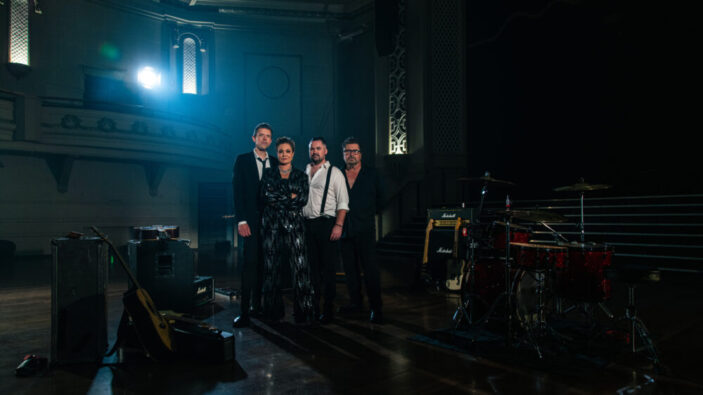
The Superjesus burst onto the Australian rock scene in the late 90s, fronted by the powerhouse vocals and captivating stage presence of Sarah McLeod. Debut EP, Eight Step Rail, quickly gained traction, followed by the critically acclaimed debut album Sumo, cementing their place as a force to be reckoned with. Known for their blend of grunge-inspired riffs and melodic sensibilities, The Superjesus quickly became a staple on Australian radio and festival circuits, earning a loyal following and numerous awards.
After a hiatus, The Superjesus triumphantly returned, proving their enduring appeal and musical relevance. With McLeod at the helm, the band continues to deliver electrifying performances and release new music that stays true to their signature sound while exploring new sonic territories. They have recently released a self-titled album, The Superjesus and are hitting the road to take the album to the fans, old and new.
We spoke to McLeod to discuss the band’s incredible journey, the challenges and triumphs of navigating the music industry, and what the future holds for The Superjesus.
I’ve been listening to The Superjesus for many years, and “Gravity” is on my favourites Spotify playlist. We never skip so it comes up like two or three times a week, my teenage daughter sings with me!
Don’t skip it. No skipping! That’s lovely to hear, thank you!
I’m interested in how you came to music. Were you a kid that could sing before you could talk or did you grow into it as you grew up?
I used to sing to all my sisters friends whenever she would have parties and have friends over, but my sister used to hate it! I would see her friends arrive and go, “Oh, great. I’m gonna go get my recorder, or I’ll sing for you” and Leah would be like, No but all the friends would be “yeah! Do it!”
To be fair, no person in their right mind is going to be psyched about a recorder, so it may not have been about your singing at all!
That’s where I went wrong! I used to always sing in the car and then someone would turn the radio on. It was kind of like this little rebellion thing I had, because it would always feel like every time I tried to sing, I’d get told, “No, don’t do that”. All my school friends. they weren’t really musical. No one played an instrument, nobody was in a band. I went to an all-girls school, and there was just music class and nothing else going on.
It was when we finished year 12, myself and three girlfriends went to Bali and they pushed me up on stage with the Balinese band. I played one song and everyone started cheering and giving me free beer. And I was like, alright. I played another one, and then I ended up playing with them all night, and then the whole trip that I was in Bali. I came home and quit uni and started going to see bands, until I found some musicians that I connected with and hustled some members of other bands to put together my own band.
It clearly was the right combination because 20 odd years later and you still have some of those original members with you.
It was an evolution—definitely an evolution. The band started out as a cover band, and over time, the original members were slowly replaced, bit by bit. At one point, we were called Fallen Down Monster. We kept changing members, just kind of reshuffling, and then one day we thought, ‘Why don’t we start writing our own songs?’ So we did. Then we thought, ‘Let’s change the name to Hell’s Kitchen.’ And later, again, we decided, ‘Let’s change it to The Superjesus.’ So even though the name and the people changed, it was always the same band at its core—just evolving, mixing things up as we went.
That’s where great music comes from, if something feels different, you go with it, you change it. It’s better than being rigid. Some bands kind of cut off their own potential by not being open to change.
Yeah, I’m glad you said that, because one of the most important things about being in a band is staying fluid with the plans. I have to really drive this home sometimes, because the others will get an idea in their heads, like, ‘This is what we’re doing,’ and then I’ll come in and go, ‘Quick—this opportunity just came up. It means we have to cancel everything and change direction completely, but if we do, we get to do this.’ And we’ve got, like, an hour to make the call. The others are like, ‘Oh my god, okay, wait, let us think,’ and I’m just going, ‘We’ve gotta go now. Be brave, guys.’
It’s like—you’ve gotta be on that cog, and when you see another cog coming around, you’ve all got to jump together. If you hesitate and say, ‘But that wasn’t the plan,’ you miss it. And then you’re stuck going around on the same cog until the next chance comes up. And who knows how long that’ll take?”
That kind of fluid, instinctive approach something has carried over into your solo career as well? You’ve done a really varied mix of things, it feels like you’re someone who goes, ‘That feels right—I’m going to do that now.’ Would you say that’s true?
Absolutely—and honestly, I’ve managed to build a 30-year career without ever really making solid plans. I usually have a rough idea, just enough so I don’t get anxious about having nothing on the horizon. Like, I’ll look ahead and go, ‘Oh, we’re not doing anything in that half of the year—what should we do?’ And then, inevitably, the phone rings, a tour pops up, or something starts to unfold.
Things tend to fall into place, as long as you’re out there, letting people know this is what you do and that you’re open to opportunities. I think it’s actually better that way, because you end up catching waves you wouldn’t have caught if you weren’t already standing on the beach.
I was in the car listening to Triple M a few years ago, and they were doing one of those cross-genre segments where they get an artist to perform something totally outside their usual style. And they had you do “Empire State of Mind” by Alicia Keys. It was so good but oh my god, that song has so many words! I thought they’d really given you a bigger challenge than some others I’d heard.
Yeah, it was a really hard song to sing and I remember thinking; it’s a rap but I’m not a rapper. I wanted to make it more melodic. I actually used another song as inspiration… I think the artist was M.I.A., and the song was “Paper Planes.” You know, the one that goes, “All I wanna do is (gunshots) and take your money.”
The way she rapped it wasn’t like a traditional rap, it had this kind of melodic, rhythmic vibe to it. And I thought, okay, I don’t want to rap like Jay-Z, because that’s just not me, but I can find something to hang my hat on. I kind of followed her trip, added a bit of melody, put some chords behind it, and suddenly it felt like something I could actually own, something believable that I’d do.
Congratulations on being named as the Chair of Australian Women in Music. From when you were starting out to now, do you feel like there’s been real progress and forward movement or are there still some unfair struggles that you think haven’t really gone away?
There’s still an unbelievable lack of a level playing field, especially in rock and roll. Dance music is a different story. I work in that space too, and it’s much more progressive. They actually have quotas, like how many female artists should be played on the radio, how many should be booked for festivals. But in rock? It’s just a free-for-all shitfight. There are no quotas, no real structure, nothing helping to balance things out.
I’m across all of this now as part of my role as the Chair. I’ll be rallying the government to try and get some quotas in place, because it’s time we do something to help level the playing field, at least a little.
Where could take that new role to invigorate the industry for women? When I think about Hall of Famer women in Australian music, I think Chrissy, Suzi and you and there just seems to be a big barrier for new female artists to make it to that enduring list.
It’s a hard struggle. There are so many incredible female-fronted bands out there, but they’re just not breaking through to that next level—because they’re not getting the same opportunities. That’s what I want to change. I’m ready to smash down some doors, walk in with a big hatchet, and try to widen the path for the next generation.
My sister said something the other night that really stuck with me. We were talking about all this, and she said, ‘Never pull the ladder up from behind you.’ I thought—God, I love that. You work your ass off to reach a certain point, and it’s not enough to just sit there and go, ‘Cool, I made it.’ You’ve got to turn around and say, ‘Alright, come on—here’s how I did it, now how do we bring everyone else along too?’ Never pull the ladder up behind you.
You have self-published your latest album The Superjesus – is that a result of the industry being difficult to swim in or just you deciding to take control?
Putting music out through a record label is a very different situation these days compared to how it used to be. If you can get a record deal—great. But even then, most labels outsource a lot of the tasks involved in a rollout. That’s actually why I started my own label to put out The Superjesus record. I had to sit down and go, ‘Okay, what would a label be doing for us?’ And it was things like: we need a publicist, we need an aggregator to get the music onto Spotify, we need digital publicity, print publicity, marketing, a radio plugger—all these moving parts.
If you can be bothered doing all that yourself, or if you have the right people around you, then great. But the truth is, it’s really hard to make money in music these days, because you can’t sell records anymore. So if you do get a deal, often what little money you make from live shows ends up going to the label. That’s why I think record companies might eventually become obsolete—because more and more artists are learning how to do it themselves. It’s a lot of work, but it gives you more control.
The digital revolution has also changed the music business in many ways with social media either allowing artists or for some, burdening artists with this channel direct to the audience that needs to be fed.
It’s shifted massively in terms of how you connect with people. Now it’s all about authenticity and engagement. When we first started out, it was the opposite, it was about being cool and aloof. There was this mystique: ‘Wow, they’re rock stars, we don’t know anything about them.’ That’s all gone. Now, you have to be constantly present, in people’s faces, asking for support. Like, ‘Can you vote for us for this?’ ‘Can you listen to the album?’ ‘Can you buy tickets?’
That kind of direct engagement still feels a bit cringey to me. I’m not used to it but I’ve heard so many big artists talk about the same thing. It is awkward, but it’s the norm now. That’s the landscape. It’s a massive DIY situation, and everyone’s just learning how to navigate it in real time.
It’s not coming across as cringy, I can assure you of that. You feel a little bit like the Australian Adele. You’ve got this amazing, strong, beautiful rock voice and then when you’re talking to you’ve got a warm, Aussie accent that everybody can feel comfortable around. Your social media is a bit cheeky and fun but then this incredible voice on the opposite side of it.
That’s very nice of you to say, thanks. I love Adele and you’re right she is so approachable when she’s talking.
I often ask people: when did you feel like you made it but with you, I get the impression you get feeling every time you get a warm reception from your fans, and every time something is successful and people love it. I feel like you lead with gratitude feeling all the time. Does that resonate with you?
I do—because honestly, there’s not really one single pivotal moment, apart from maybe when we first started and got signed. Sure, that was huge. But the road is long, and so is the career. I kind of see it like a game of snakes and ladders. One minute something amazing happens and you’re like, ‘Unreal!’ And then, a couple of weeks later, you find out you didn’t get the tour, or the grant fell through, or a show gets cancelled.
It’s this constant rollercoaster—so I always gather the team and say, ‘Alright, no worries. We’re still good. Let’s go again.’ And we just keep climbing. Up a ladder, down a snake, and back up again.
That’s why I always say: we have to celebrate the tiny triumphs along the way. Because those little wins—they build something. They build momentum, they build your spirit, they fuel your creativity. No matter how small they seem, they matter. Each one is just as important as the next. And if you don’t stop to acknowledge them, you’ll miss the magic that keeps you going.
The new album that that you’ve just released, The Superjesus, why is this the one that is the one that gets the self-titled mantle?
We really believe that the band we have now—the lineup, the chemistry—it’s the strongest it’s ever been. And we feel that the songs on this record are the most personal and in-the-pocket we’ve ever written. They truly reflect who we are and where we’re at right now.
I used to think self-titled albums were a bit of a cop-out—like, ‘Oh, we couldn’t come up with a title.’ But when we got to this one, we were going back and forth, trying to find something that felt right. And then Ruddy, our bass player, said, ‘Let’s just make it self-titled.’ At first, I was totally against it. I thought, ‘The Superjesus? It’s confusing. It’s boring.’ But the more I sat with it, the more I realised—it’s actually bold. It says more than any other title could. It’s a statement. (Guitarist Chris Rudd) Ruddy had to massage me into it—I was definitely dragging the chain—but in the end, he was right.
This album just feels so close to home. We made a conscious effort to keep one foot in the sound we had in the ’90s, but also to evolve. We’ve all grown as songwriters, and that made coming back together after all these years feel exciting. Everyone brought their own journey to the table.
Ruddy’s a great example—he’s become an incredible producer. A few years ago, he could barely turn on a computer, and now he’s got this full studio and is making amazing music. I’m so proud of him.
For me, going solo meant doing a lot of dance music, and when I came back to the band, I told Ruddy I wanted to bring in some of those influences—but make them work within a rock and roll context. Some of the songs on this record actually started as top lines I wrote for club tracks that never got finished. I took the vocal ideas and built rock songs underneath them. There’s definitely value in dance rhythms—as long as we keep the instrumentation heavy and raw.
We even flirted a little with funk—not full-on funk (I hate that word!), but just a tiny bit of groove. Because we’ve always had this strong, gritty rock foundation, and I wanted to add just a hint of something that moves. I kept using INXS as the model. I said to the guys, ‘Look at INXS—they were a rock band with big hooks and danceable grooves. That’s the energy we should tap into. Let’s find that balance—stay heavy, but let it breathe and move a bit.
I think a huge part of The Superjesus sound comes down to your signature vocals. There’s something about the way your voice sits over the music, ,it instantly brings that familiar vibe, no matter what the instrumentation is doing. So even when you’re bringing in those new influences, whether it’s dance beats or different grooves, it still feels grounded. There’s this common thread that pulls it all together when you’re all in the room.
That’s exactly what we’re hoping for, and I reckon it’s there—you can still hear The Superjesus in it, even with the melting pot of influences once everything comes together in production. Even songs like Gangbusters, which is miles away from where we’d usually go. I honestly didn’t think the band would go for it, because I only wrote it for fun.
I was watching a doco on Nile Rodgers [American singer / songwriter], and he was breaking down how to build funky grooves, and I thought, right, I’m going to give that a crack. So I followed everything he said to do, step by step, and ended up with Gangbusters. The verses originally had this super funky, almost porno-music vibe—again, I hate funk, but I just wanted to try it as an exercise.
Then I brought it to the band and said, ‘Okay, ignore the funky porn music for a sec—what if we strip that back and keep this Edge of Seventeen-style chicka-chicka-chicka thing going?’ That gave it a bit more of a rock edge, and to my surprise, they were into it.
Sometimes, you’ve got to go out on a limb, but if you’ve still got those core elements that tie it together, it’s always going to sound like us in the end.
So you’re about to go out on tour with the with the album, do you prepare for it differently now than perhaps you would have a few years ago?
Well, for this tour, we’re boldly going to play the entire new album from start to finish—plus a full set of greatest hits. It’s a massive show, and it’s something we’ve never done before. Normally, you’d only throw in a few new singles, because let’s be honest, most people just want to hear the old favourites. That’s just how it goes.
But we love this album so much, we’re treating it like it’s already one of those iconic 20-year anniversary records that you play in full. We’ve just released it, but it already feels that special to us. So we’re going to play the whole thing, beginning to end, and then hit the crowd with all the classics afterwards.
We don’t care how long we have to stay on stage—we’re ready to go big with it. We’re putting a lot of prep in, and we’re pulling together a really solid, proper show. It’s going to be huge.
People usually do that kind of thing for album anniversaries, but I don’t think anyone really does it with a brand new record. Most people would be like, what the hell are you doing? No one wants to hear an entire new album live but I feel confident about this one. I’m putting it all on red. I honestly reckon if people sit with the record long enough, they’ll really connect with it and they’ll want to hear something fresh.
And we’re still playing the old stuff too, so no one’s really missing out.
So now that the album’s out and you’ve got the tour on the horizon, feels like it’s all fresh and new. What would you like to do next? Where would you like to take it next to continue the growth and get everybody along for the journey?
Great question! I keep saying this to the guys, living in this country, we just go around in circles. We do a tour, we loop around, and we’re pretty much playing to the same crowd every time.
We have to start branching out and doing more international touring. At the moment, we’re putting together a New Zealand run, and after that I’m going to start looking into what we can do in Europe—just so we can keep playing. We want to play all the time.
We can’t just wrap an Aussie tour and say, “Right, that’s done,” and then sit around waiting for the next round. In the past, that’s what we’ve done, tour here, then go quiet until the interest builds again. But now, we’re really trying to shift that mindset and see how far we can take it.

The Superjesus self-titled album is out now – grab a copy HERE!
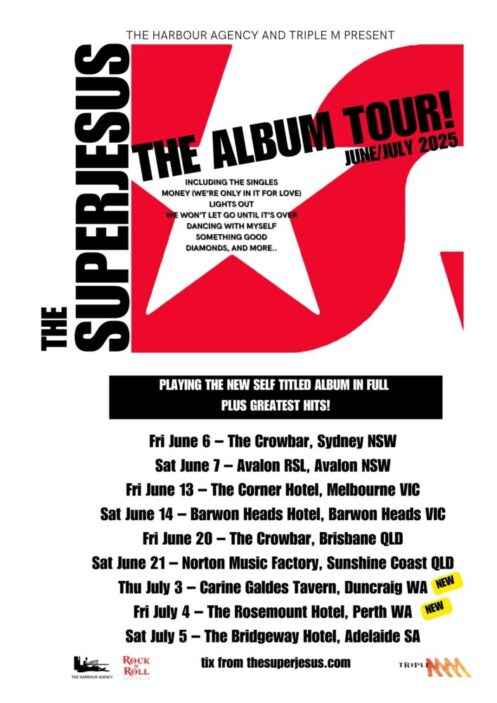
THE SUPERJESUS – THE ALBUM TOUR
Friday June 6 The Crowbar, Sydney
Saturday June 7 Avalon RSL, Avalon
Friday June 13 The Corner Hotel, Melbourne
Saturday June 14 Barwon Heads Hotel, Barwon Heads
Friday June 20 The Crowbar, Brisbane
Saturday June 21 Norton Music Factory, Sunshine Coast
Thursday July 3 Carine Galdes Tavern, Duncraig
Friday July 4 The Rosemount Hotel, Perth
Saturday July 5 The Bridgeway, Adelaide
Tickets on sale now – head to thesuperjesus.com
Header photo credit: Liam Somerville
