

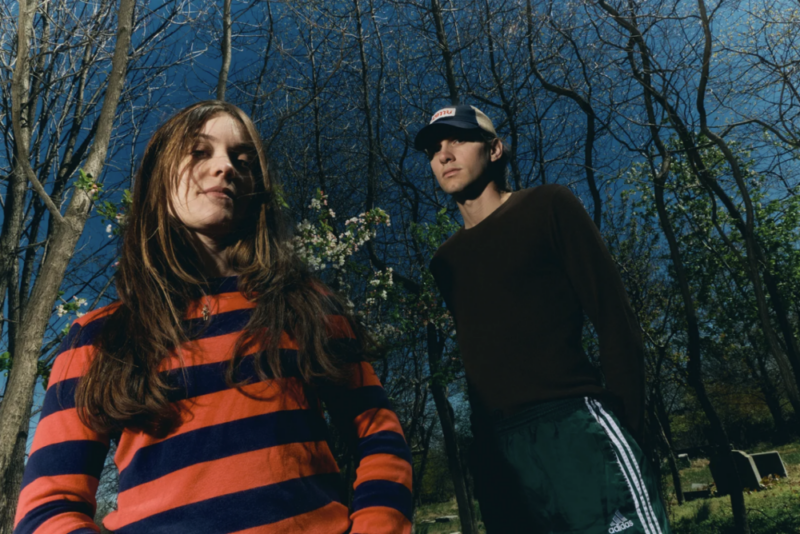
Good luck finding @ on the internet.
In an age where discoverability, search engine optimisation and carefully curated online identities are practically prerequisites for musical success, Philadelphia duo @ (yes, just the symbol) have managed to make themselves almost impressively difficult to Google.
Behind the spectacularly unsearchable moniker are Victoria Rose and Stone Filipczak, a beekeeper and self-taught computer programmer respectively, who perform under the name @ (pronounced “at”). Their shared love of experimental music brought them together through the American DIY scene. Their musical partnership initially developed remotely, with the two exchanging compositions and building upon each other’s ideas without ever sharing a recording studio, or even singing together in the same room.
It’s an appropriately unconventional origin story for a band whose music seems determined to challenge just about every convention available to it.
Following their 2021 debut Mind Palace Music, the pair signed with the legendary independent label 4AD. Their sophomore effort, Autosmile, offering eleven tracks of peculiar, often beautiful and occasionally bewildering psychedelic folk.
And if you’re approaching this one expecting a collection of straightforward acoustic ballads, you might want to read the warning label first.
There’s something fascinating about the musical world @ have constructed. Acoustic guitars twist and turn over unexpected chord changes, fragile vocals float over elaborate instrumental arrangements, and conventional song structures are frequently abandoned in favour of something altogether stranger.
It’s an approach that I can appreciate enormously in theory. In practice, however, I found myself admiring Autosmile more often than I was actually enjoying it.
Opening track “Bird” is a particularly good introduction to this strange dichotomy.
Beginning with an ominous, almost Eastern-sounding acoustic guitar figure, the song establishes a peculiar atmosphere through its chromatic melodies, hushed vocals and dramatic pauses. It’s theatrical and immediately intriguing, before suddenly giving way to a remarkably conventional, and remarkably enjoyable, pop chorus.
The melody accompanying the refrain of “run away, stake a claim” is an absolute earworm, providing a moment of melodic clarity amidst the more unusual musical surroundings.
Then, just as quickly, the song retreats into its earlier eccentricities.
There’s something undeniably clever about the juxtaposition, and I suspect that contrast is precisely the point. But I couldn’t help wishing the chorus would stick around a little longer. Whether that says more about my own musical preferences than the band’s creative intentions is another question entirely.
“Love In The Dark” follows a similar trajectory, opening with the rough, intimate sound of an acoustic guitar before fuzzy electric textures begin cutting through the arrangement. Rose’s delicate vocals lend the track a wonderfully vulnerable quality, while unexpected chord changes and strange production flourishes continually threaten to pull the song in another direction.
There are reversed sounds and curious little instrumental details scattered throughout, particularly as the arrangement builds towards its peak. Once again, however, it’s the more immediate melodic passages that make the strongest impression. What’s particularly interesting is how effortlessly @ appear capable of writing these moments. Their pop sensibilities are clearly well developed, but rather than allowing them to dominate, the duo seem more interested in dismantling and reassembling the surrounding musical architecture.
Fortunately, “I Know You Are (But What Am I Thinking)” strikes a balance that works considerably better for my ears.
Opening with the peculiar metallic sounds of guitar strings being plucked and manipulated, the track gradually blossoms into a wonderfully whimsical folk number. The ascending and descending movements of the guitar are particularly enjoyable, while the vocal melodies possess a playful, almost theatrical grandeur.
It’s one of the more straightforward compositions on the album, relatively speaking, and one of my favourites. There’s still plenty of musical invention, but the experimentation feels more closely connected to the song itself. Rather than drawing attention away from the melody, the unusual instrumental flourishes seem to enrich it.
“Earthly Love” continues this welcome stretch with one of the record’s most beautiful arrangements.
A delicately picked acoustic guitar introduces the song, accompanied by the intimate sounds of a performer clearing their throat before Rose’s lovely, understated vocals emerge. It’s a wonderfully human opening, and one that immediately establishes a sense of closeness. From there, the instrumentation gradually expands into something almost storybook-like. Strings and flutes weave around the guitar, while spacious vocal harmonies give the recording a remarkable sense of depth.
Whimsy is perhaps the best word for it.
The production is particularly impressive here, with the various elements occupying their own spaces while contributing to a cohesive whole. It’s the kind of recording that rewards a good pair of headphones, revealing little details that might otherwise disappear into the background. Indeed, regardless of how successfully the songwriting connects, the production throughout Autosmile is consistently fascinating.
Much of the record was assembled using decidedly modest home-recording equipment, including an old microphone that Rose reportedly props up in a coffee mug. Yet the resulting sound is often remarkably lush, balancing the rough edges of its DIY origins with arrangements that can feel almost orchestral. There’s something wonderfully democratic about that approach to making music. The sophistication comes not from expensive equipment or immaculate studio conditions, but from imagination, patience and a willingness to experiment.
“Your Dog” offers another helping of the duo’s peculiar musical personality, with papery, thwacking percussion, playful acoustic guitars and Filipczak’s distinctive vocal delivery. Little instrumental flourishes appear and disappear almost as quickly as they’re introduced, ensuring that even the quieter passages rarely feel static. By the album’s middle stretch, I found my enthusiasm beginning to wane.
The sprawling “I’m Not In Pain” certainly doesn’t suffer from a shortage of ambition. Opening with a lovely cello passage and intricate guitar interplay, the five-minute composition gradually unfolds into something resembling a miniature theatrical production. Instruments enter and retreat, melodies change direction, and the arrangement moves through a succession of curious interludes. It’s an impressive piece of musical construction, with the various instrumental exchanges offering plenty to admire. But it’s also representative of the album’s occasionally exhausting nature. There’s so much happening that I sometimes found myself appreciating individual moments more than the songs containing them.
“Punish My Mind” introduces another collection of unexpected sounds, including monkey calls. The elaborate harmonies and acoustic arrangements continue to demonstrate the duo’s musical inventiveness, while “Judgement Farmer” further highlights their remarkable ability to extract seemingly endless textures from the humble acoustic guitar.
If nothing else, Autosmile is a compelling reminder of just how versatile that instrument can be.
The album’s title track, “Autosmile”, is another high point.
Stretching towards seven minutes, the composition begins with beautifully intricate fingerpicked guitar and an exposed vocal performance that feels almost painfully intimate. There’s a nakedness to the delivery that is particularly affecting, especially when contrasted with the increasingly elaborate musical passages that follow. It’s one of the album’s most ambitious pieces.
Perhaps unsurprisingly, I found myself most drawn to the moments where its experimental tendencies gave way to recognisable folk songwriting. The extended arrangement allows the duo to explore a broad musical landscape, but it’s the comparatively simple melodic passages that provide the strongest emotional anchor.
And perhaps that’s precisely what makes them interesting. There’s little doubt that Autosmile is the work of two enormously talented and imaginative musicians. The guitar playing is frequently exceptional, the arrangements are inventive, and the vocal performances possess a distinctive, fragile charm.
More importantly, the album has an identity that is entirely its own. But originality and enjoyment aren’t necessarily the same thing.
For all its impressive musical craftsmanship, Autosmile is a record I found easier to appreciate than to love. The moments of conventional melodic beauty frequently left me wanting more, while the more experimental passages sometimes felt like elaborate diversions from songs I might otherwise have connected with.
That’s not necessarily a failure on the band’s part. In fact, listeners with a greater appetite for psychedelic folk, unconventional structures and theatrical musical experimentation may well find considerably more to embrace here. And I’d much rather hear musicians pursue their own peculiar creative instincts than watch them sand away every interesting edge in pursuit of accessibility.
Still, eleven tracks is a substantial amount of time to spend in a musical world that doesn’t always feel particularly welcoming. Autosmile is an ambitious, beautifully arranged and frequently fascinating record. It’s also an acquired taste, and one that never quite won me over completely. Perhaps the greatest compliment I can offer @ is that, even when their music isn’t particularly to my liking, I’m never left questioning whether they know exactly what they’re doing.
I just wish I enjoyed it as much as I admired it.


THREE STARS (OUT OF FIVE)
Autosmile is out Friday October 16. Find @ HERE
Header image credit: Ingmar Chen
