

You’ve probably killed minotaurs in a whole bunch of games. Pretty standard enemy, right? Well, the team at Artificer are switching that little fact up with this new release. Now, instead of you hunting a terrible monster through its den, you’re the monster doing the hunting.
And there are a lot of unprepared adventurers for you to kill.
In Minos, you play as the legendary Minotaur, sentenced to the ever-changing Labyrinth and plagued by heroes who want nothing more than to slay this terrible beast. To avoid the myth playing out as it’s supposed to, you’ll need to leverage the shifting strength of the Labyrinth and create a deadly maze, bristling with traps and where a monster hides in the shadows. You’ll never leave this place alive, so why should they?
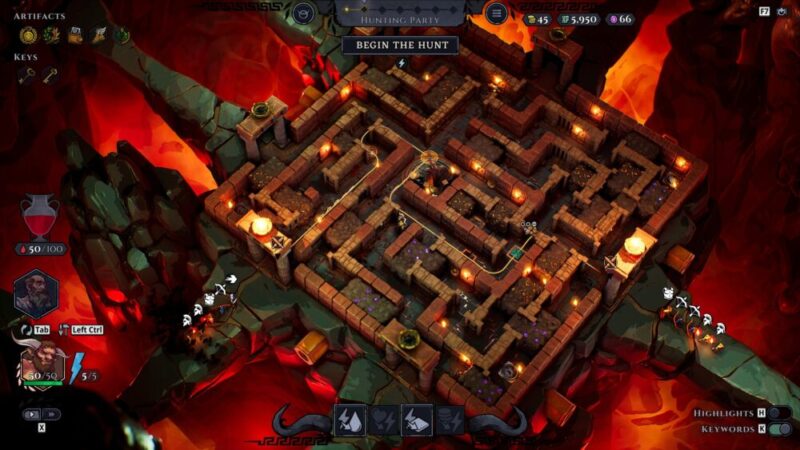
Sometimes, all I want to do is set up a crafty little trick, then watch a 3d model of a person die a horrible and painful death while I practice my evil cackle. If you feel the same way, Minos will perfectly satisfy that desire with its complex trap-designing mechanics.
Killing the ‘Rogue’ in ‘Roguelike’
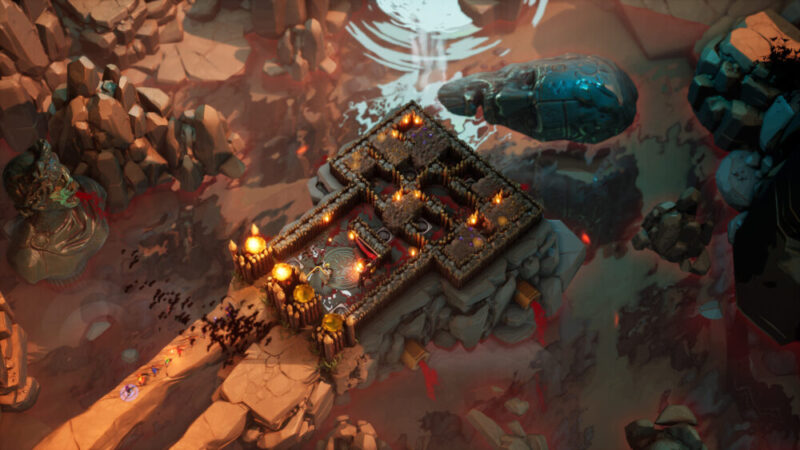
As you might imagine, becoming the famed Minotaur is a path just as winding as the Labyrinth you tread, and just as deadly to boot. Defending yourself is not enough, either – to truly understand your surroundings and borrow its strength, you’ll need to descend ever deeper into this strange place.
The game is separated into rest levels, where you can heal, learn new traps and decide which challenge is next on the docket, and said challenges. It’s there you will learn to become the Minotaur – with some help from Daedalus, the man who created the Labyrinth. Adventurers will come in waves, seeking first your den and then you, and if you want to avoid getting chopped up into little bits, you’ll need to stop them by sculpting a winding maze and filling it with various vicious traps.
Spill enough blood, and you’ll be able to spill more, with new traps and temporary boons.
With each level you complete, you’ll be able to choose from a random group of traps, plus a more limited choice of other upgrades and game-changing artifacts, as well as which level type you’ll be facing next. The further you sink, the harder the challenges will get. As you face new enemies, new obstacles and a few new surprises, you’ll just have to hope your traps (and your wits) are enough to beat them.
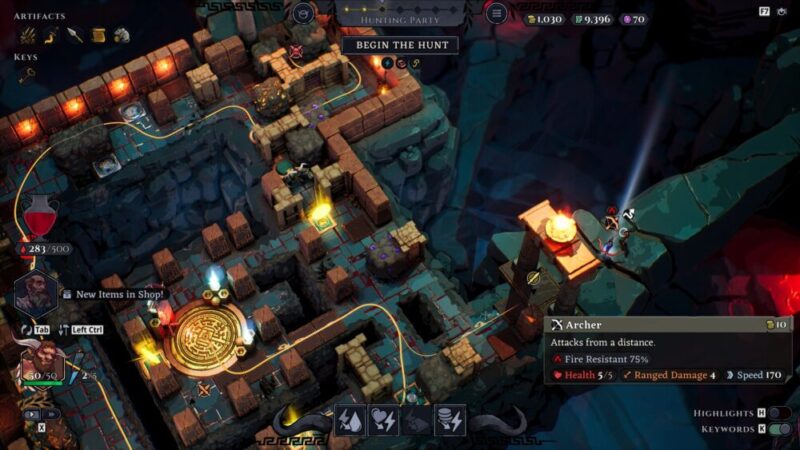
They won’t always be. Luckily, or perhaps unluckily, there is no escaping the Labyrinth for you. Each time you die, you’ll be sent right back to the first level, to start all over again. The arsenal of traps you spent so long building up is gone now, as are most of the riches you could have used to buy new ones. You probably won’t find them again, not in quite the same way. Death wipes the slate clean, and with each new run, you can experiment with new devices, discovering new strategies based on what modifiers you find and levels you are tunnelled into.
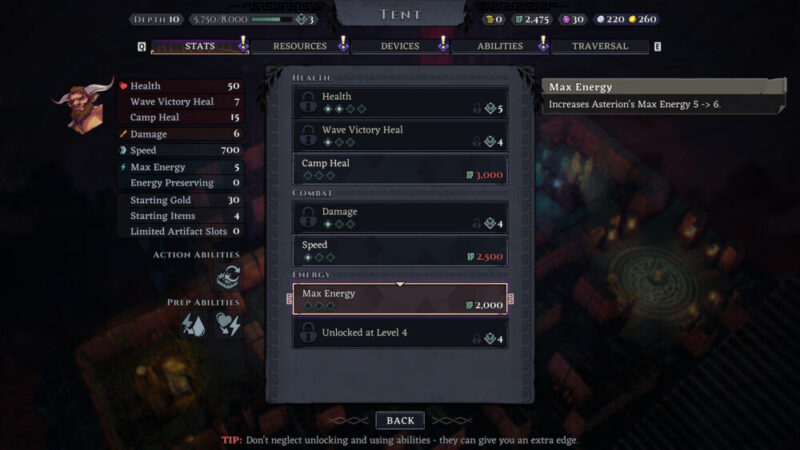
Strictly speaking, this repeating journey is not a roguelike, but a roguelite – meaning the constant death is a little less brutal than it seems. On later runs, you will have not just a greater understanding of the game’s mechanics (of which there is a lot to understand), but also more tangible holdovers. The Minotaur will gain experience just as you do, leading to permanent upgrades.
And there are a lot of upgrades – from more health and speed to the ability to rearm traps, eat rats, or chuck gold as a distraction. It’s a pretty hefty skill tree. You can even unlock shortcuts to the lower levels, though descending too quickly comes at the risk of leaving you unprepared for the tougher enemies that dwell in the darkness.
This makes for a more forgiving experience. Even when you completely stuff things up or get really unlucky (the former being more common, in my experience), you’re still making progress. Experimentation is key to this game, especially if you want to survive until the bottom of the Labyrinth. This slightly more relaxed approach means you can take a little more time, have fun trying out new traps and combos and artifacts, and play it risky with the knowledge that all those precious upgrades won’t completely disappear.
Unfortunately, there is one thing that is easily lost – your time. Levels can get lengthy, meaning the time spent on any one run can really add up. Even once you’ve unlocked shortcuts and with a fast-forward button in place for speedier adventurer death, cautious players can find themselves spending a lot of time waiting to get back to where they were seemingly a moment ago. While not an insurmountable issue, it makes you a little less likely to say ‘just one more run’.
Automating Adventurer Death
Luckily, there’s plenty to dive into on these long runs. There’s a wealth of traps to check out, meaning there’s also a ton of strategies resulting from them. Do you want to start sniping enemies with ballistas at a distance, or wind them down long corridors filled with spike traps? Want to link traps with cleverly placed pressure plates, or lure individuals down a dark corridor, only to burst from a hidden door?
Artifacts and the synergies between traps encourage you to try something new and stick to it. There’s always something unexpected to find, with part of the fun stemming from figuring out all these hidden little mechanics and unknown tools.
The balance between letting you figure things out for yourself and completely abandoning you isn’t always perfectly struck, however. There are times when something that should be clear isn’t, or isn’t explained quite enough. It’s mostly a minor point, rather than a game-breaking issue, but it does cause friction.
In addition, while there is a good amount of variation (but not so much that the in-depth trap mechanics remain the shining centre of every level), it doesn’t always come through until the later parts of a run. This can leave earlier segments feeling same-y and repetitive.
For the most part, the mechanics are incredibly fun to play with – there’s a lot of depth to dive into, but even splashing around in the shallows is a great time. There are just a few instances where it could do with a little more polish.
Making a Myth Magnificent
Yes, the satisfaction of setting up a clever trap and watching it go off without a hitch is what makes this game so much fun. But that satisfaction doesn’t just come from the in-depth mechanics. It wouldn’t hit nearly as hard as it does if it weren’t for the artistic design of the game.
For the most part, the art in Minos is understated to let the gameplay shine, but that does not mean it is underdeveloped. The adventurers who come to kill you are simply designed, but they explode and ragdoll amusingly. The mazes have enough details to be visually engaging without being distracting. The sound design is clear and concise, so you can tell exactly which trap is activating at any given moment without being overwhelmed. If you zoom in, you can even hear the hum of the mechanisms.
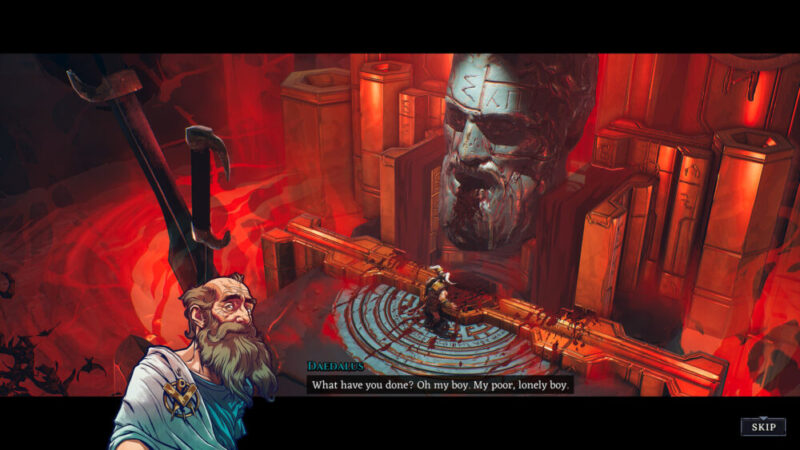
The music – which adds to the game’s tense moments – takes a similar approach, as does the story. It’s relatively simple, providing a throughline and goals without overstaying its welcome.
It adds up to make the game feel atmospheric, as you sneak behind the backs of wary adventurers and rearm traps, veering between victorious confidence and uncertainty, hoping you’ve crunched the numbers correctly.
Another noteworthy element is the abundance of customisation options in the menu (including visual elements like the killcam and gore level, plus functional tools like auto-rotate for certain traps). It’s a killing experience perfectly catered to you!
Final Thoughts
Minos is, in many ways, a simple game of defence. But underneath the surface lies a complex and lively network, with a lot of fun to be had. It is simple, not out of limitations, but to draw focus to the important parts.
And the important parts – engineering the perfect maze and watching a whole bunch of guys explode into a cloud of viscera and ragdolling limbs – really deserve that focus.
It’s strategic enough to feel engaging, challenging enough to feel satisfying, and forgiving enough to make you want to never stop playing.


FOUR STARS (OUT OF FIVE)
Highlights: Engaging gameplay with a good level of complexity; An abundance of hidden features and interactions
Lowlights: Doesn’t consistently explain complicated elements, simplistic story
Developer: Artificer
Publisher: Devolver Digital
Platforms: Windows PC
Available: Now
Review conducted on PC with a code provided by the publisher.
Featured header image also provided by the publisher.
