

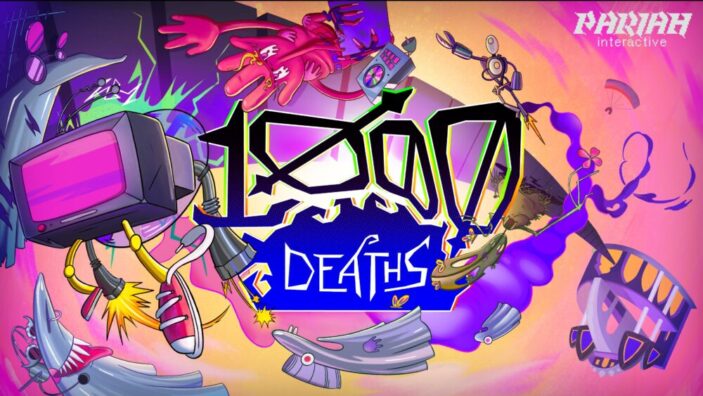
1000 Deaths is one of those games where it only takes one glance to know if it’s your thing or not, something you’ve probably already worked out from the header on this article. Bright, bold, weird and proud of it, it is a game that is everything it sets out to be. And just what would that be?
It’s a story which attempts to answer a vastly complex, yet relatable, question – what would my life be like if I had made a different choice? If I had gone to the big city instead of staying in my hometown, struck out on my own instead of working with a friend, or confessed to my teen crush instead of keeping it a secret? It’s a question you can never truly answer all of, and yet it’s one that 1000 Deaths explores with great enthusiasm by taking the player through the lives of four strange beings.
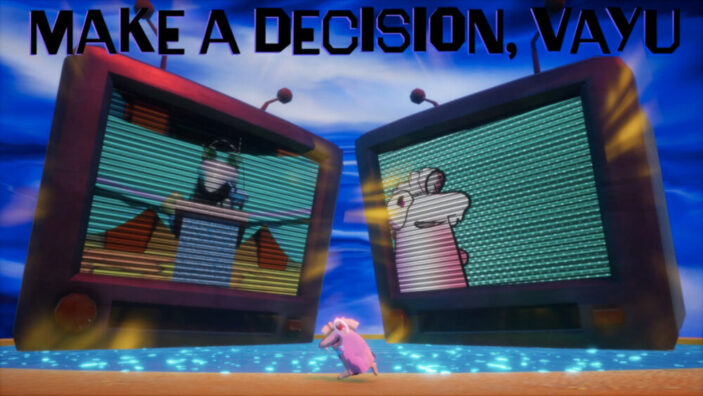
At important junctions, you are asked to make a choice that could utterly change the life (or death) of these characters, a choice that must be made through nail-biting, physics-bending, utterly surreal platforming gauntlets where death comes easily.
Though I won’t deny it has its flaws, there’s also no denying that 1000 Deaths is delectably difficult. Like the best 3D platformers, the strangely satisfying blend of frustration and fun is its cornerstone, as you puzzle through its tough-as-nails challenges.
Dying a Few Hundred Deaths
1000 Deaths is a game of two worlds, where you move seamlessly between the real world and the strange and dangerous structures of a person’s psyche to unravel the course of their lives. Short cutscenes and gameplay segments – where you are given free reign to explore a character’s life as it is now – end with the character pressured to make a choice that will forever effect them. In their uncertainty, you step in – quite literally.
Inside the minds of the 4 main characters is a hub where a series of platforming challenges await, and you must complete them to make a choice and drive their life onward. But of course, life is a series of choices, and for each of the characters you are asked to choose again and again, observing the changes each choice brings through more cutscenes and shorter levels set in the real world, until your series of branching paths grows into a tree.
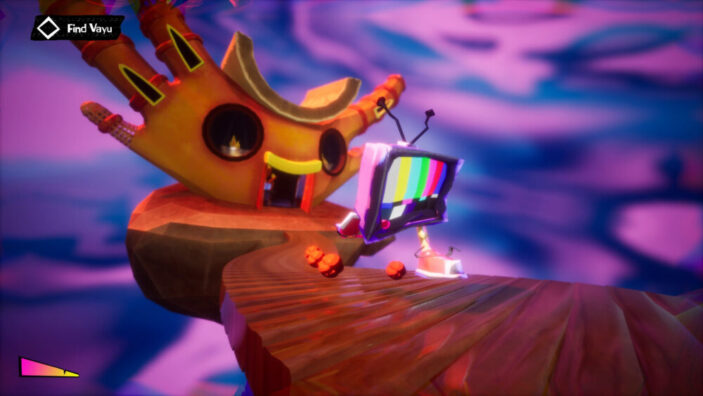
As befits a game themed around dying a lot – and in different ways – these platforming challenges can get treacherous, and after a brief tutorial you’re thrust right in the deep end and left to sink or swim. Probably the former.
In the style of classic 3D platformers and their challenge sections, the levels are deadly obstacle courses, fairly short but jam-packed with danger, pitting you against both stage hazards and the ever-present peril of falling off the platforms into an endless, colourful abyss.
These dangers include some of the classics we’ve come to expect from 3D platformers – such as moving platforms and fast-moving hazards with shifting patterns – but also has a number of new surprises and elements you may not expect.
Many of these hazardous elements are found only in certain branches of the story, fixed to the life and decisions of a certain character, which serves to make each new choice feel fresh – and remind you just whose life you’re playing with here.
That’s also not to mention the game’s signature mechanic: the ability to shift gravity when you turn a corner just right, changing some levels into puzzles where your goal is to align yourself to step through a door which was, just a moment ago, stuck to the ceiling. It’s just a little inventive, a few twists on a classic formula.
In these challenge levels death can come quick, but so does life – resetting takes only a moment, and with each course being relatively short, the first time you complete one is a thrilling 1-2 minute experience.
It’s that short yet intense level design, where trying again and again and again until you finally beat it for good is a choice you can’t resist, that is emblematic of good 3d platformers.
Unfortunately, another thing that is emblematic of 3d platformers is perspective and camera issues. While for the most part, 1000 Deaths is tidily made, with failure due to your own lack of skill rather than an issue with the game itself, it’s not entirely free of gameplay frustrations which just feel unfair or unreasonable instead of difficult.
While on most levels the camera, at worst, functions just fine, there are one or two levels where it becomes a hindrance. In one particularly egregious example, the environment of a late-game level can block your view of the character – turning what was supposed to be a challenge of dodging constantly-moving balls of fire into a challenge of seeing what you’re doing. The gravity shifts, while inventive, are also at times unclear or finicky.
While it’s rock-solid in most levels, there are a handful where it doesn’t act quite how you expect, slipping you off surfaces that you thought you landed on perfectly, or turning you on your side because you landed on a slight angle.
There’s also the simple fact that the game’s inventive elements simply aren’t always used to their fullest. Though the game feels like it has a lot of levels when you play through them, these challenges are carefully devised to make sure that new mechanics do not overstay their welcome or repeat too often.
It keeps the game feeling fresh and light, with each level being a completely new and unexpected experience, but it also means that there are some elements that feel under-utilised or even wholly unnecessary – chief among them being the ground pound.
Introduced late in the game, in one branch of one character’s life, this mechanic is needed to complete but a few levels. It can be entirely missed by players not looking to complete every part of the story.
Dying a Few Hundred Deaths…Faster
With such a focus on short levels which can be completed quickly with the necessary spoonful of skill, it may come as no surprise to hear that 1000 Deaths has a built-in system to track your speed run times.
Or that it has an arcade mode so you can access a challenging level all the more easily, without going back and forth between different ‘decision’ hub worlds. It’s nothing fancy – a menu of levels for you to click through, with a timer and list of target times for each level – but it is an extra helping of convenience sure to be appreciated by those looking to master the game.
Though the platforming challenges are the meat of the game, the game’s ‘real-world’ platforming segments are not to be underestimated either, despite their reduced difficulty.
Their more relaxing counterpart, they provide a chance to take a breath and engage with the game’s story while you massage some life back into your thumbs. There’s depth to them, an openness that allows you to explore the world your character has found themselves in and talk to the people around them, if only for a moment.
These segments still have their challenges, however – they’re just cut from a very different cloth. For those driven to explore, there are secret items to be found on rooftops and behind corners, and a full collection of stickers to assemble (in a menu which tells the location of the ones you’re missing for added convenience).
But if that’s not your thing, you can just head straight to your objective, and get back to the challenge levels quickly and easily. It strikes a good balance, offering you a breather without overstaying its welcome or letting you forget the challenges that are yet to come.
Why Are We Dying Like This Again?
If it wasn’t clear from the plot summary, 1000 Deaths’ title not only refers to the challenging nature of its platforming, but also to the story itself. Following a branching narrative helping a group of characters making choices that will change everything (including the game you yourself play), you may be able to see them living different lives, but they all end the same way – in death. Not all 1000 of them, it’s more like 12, but still.
As you progress through different choices, watching the changes you yourself make take effect – both on the character you control and on the other characters around them – you explore the lives and the many different facets of the four main characters, hopping from timeline to timeline to watch how they are shaped by their varied experiences.
These four characters may look strange when you first meet them, but beneath their surreal exteriors they’re just as messy and conflicted as any human. Getting to know them and help them improve – or reveling in their flaws and mistakes – is a joy. To experience it via such an unusual method, which lets you see their entirety in a way not afforded to other mediums, is an equal joy.
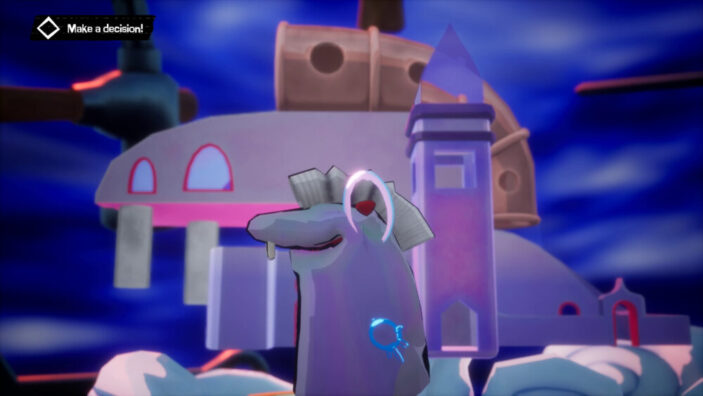
Unfortunately, I personally found that this is one of those cases where the idea is more compelling than its execution. Though the main quartet have some interesting flaws and neurosis that make them enjoyable to follow, and are different enough to make each branch feel like its own story, they aren’t quite interesting or unique enough in anything but appearance to really make them really stick in the mind.
The fact that aspects like the dialogue and story progression are fine, but nothing to write home about, doesn’t help, nor does the fact that the player character is for the most part brushed past.
In addition, while some developments and choices are unexpected and compelling, offering a true dilemma for the characters, others felt flat in comparison – especially Maxine’s, whose story included two different paths where you are asked to choose whether they form a relationship with another, specific character or not.
The repeated, similar choice felt a little stale and disappointing next to other paths, where you had to choose if a character would speak out against unfairness or say – and risk – nothing, or choose whether a character would either abandon their closest friend to pursue their dream, or compromise on their dream but maintain their friendship.
Overall, the story just felt a little uneven, a little unpolished, especially in contrast to the much more solid and well-made platforming segments. It’s fine given it’s a secondary aspect to this game, but I can’t help think that with a little more time, it could have been something more memorable.
Yes, the Game Does Look Like That; And I Love It.
It feels strange to have gotten this far through the review without talking about one of the most obvious distinctions of this game – the surreal, and at times abstract, aesthetic and chunky art-style. It’s distinctive, it’s bold and bright to the point of being almost hypnotic, it embraces all the limitations and weirdness of its 3d platformer medium with joyful abandon.
Because there are minor limitations to this game’s graphics – moments where you can see things load in just a moment too late, or clipping-related injuries. Things which probably could be edited out with enough time and work, but which in all honesty? Are a central part of the game’s aesthetic, of its identity.
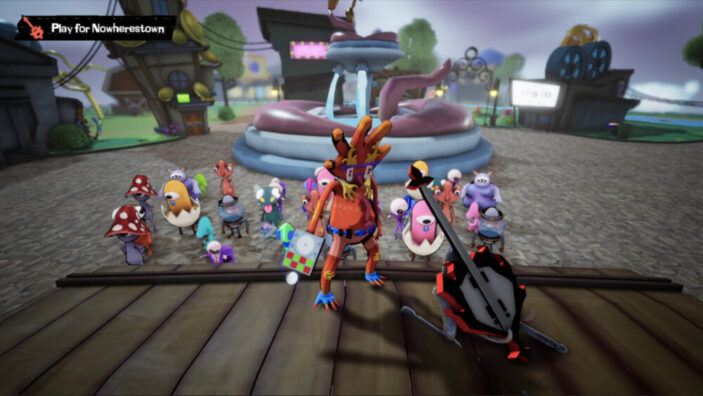
It’s that cultivated messiness, that weirdness wherever you turn, that forms a central part of the game’s charm. All the characters in this world are strange, and maybe a little ugly, but most of all they’re creative and unique, and the same goes for the adjacent-to-our-own world they inhabit.
Against the many fresh-faced AAA games always coming out, it’s always a delight to see a game that gets a little silly with it, that just feels like the creators were having a fun time making the designs. They committed to this style as well, so while it might be almost-incoherent it certainly isn’t inconsistent.
These jagged edges and quirky characters are an acquired taste, sure, but if you like that taste you’ll love this game.
Final Thoughts
1000 Deaths is an imperfect game, one which I think could be improved with just an extra layer of polish on the top. But all the same, I certainly can’t deny that I had a blast playing it, in that nail-biting, ‘aw, come on!’ way you get with all satisfying platformers.
It’s not afraid to experiment, and even when things don’t quite work out, it’s easy to forgive it. There’s plenty to love here, after all.


THREE STARS (OUT OF FIVE)
Highlights: Out-there art-style; Snappy and fresh gameplay; Built-in speed running features
Lowlights: Story could use some work; Minor camera issues
Developer: Pariah Interactive
Publisher: Pariah Interactive
Platforms: PC
Available: Now
Review conducted on PC with code provided by publisher.
Featured header image provided by Pariah Interactive.
