

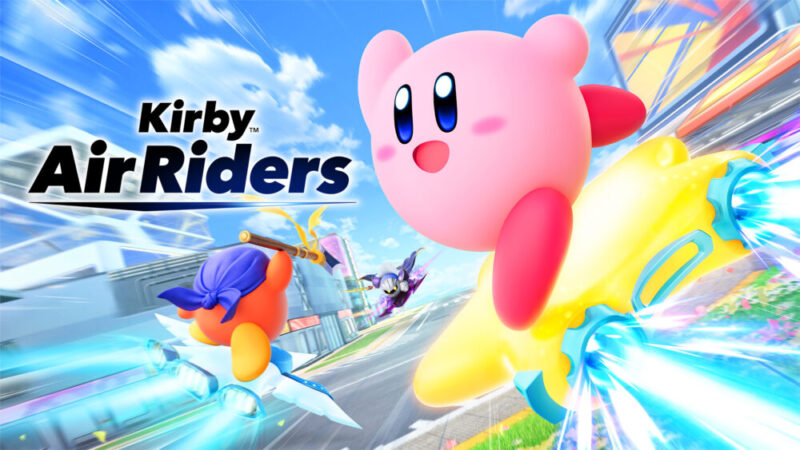
Few sequels feel as miraculous, unexpected and downright delightful as Kirby Air Riders. Reviving a niche GameCube classic and transforming it into a fully fledged Switch 2 powerhouse, Nintendo and HAL have delivered something rare: a bold, wildly creative action-racer that not only honours its cult predecessor but completely redefines what a Kirby racing game can be.
Where Kirby Air Ride hinted at greatness, Air Riders arrives at full speed with an overflowing toolbox of modes, unlockables and single-player content that makes this one of the most robust offline racing packages on the console. Yes, online play is excellent – far better than expected, frankly – but Kirby Air Riders is equally, and sometimes more, satisfying as a completely solo experience.
For a series often associated with breezy multiplayer fun, this surprise Switch 2 sequel stands tall as one of the most feature-rich, replayable single-player arcade racers in years.
A Revival With Ambition – and Personality to Spare
What surprises first is the sheer ambition. Air Riders retains the series’ signature single-button steering and delightfully floaty physics, but elevates them through modern design, Switch 2 horsepower and a meticulous sense of detail. It’s still wonderfully weird. It’s still unabashedly Kirby. But now, it feels bigger and fully realised, on a system that can support its bold ambitions.
The roster is enormous, pulling in characters from across Kirby’s history. Highlights include Bandana Waddle Dee, Lololo & Lalala and my personal favourite Chef Kawasaki. There are plenty of machines, too – more than twenty – all with unique quirks, specialities and limitations.
You don’t just switch between “fast”, “light” or “heavy”. You’ll learn the ins and outs of various machines and master their handling, find their strengths and exploit their weaknesses. It’s a system that rewards time spent alone in each mode, pushing and prodding at mechanics to understand how each ride behaves. Some take many hours to master, and some just work effortlessly.
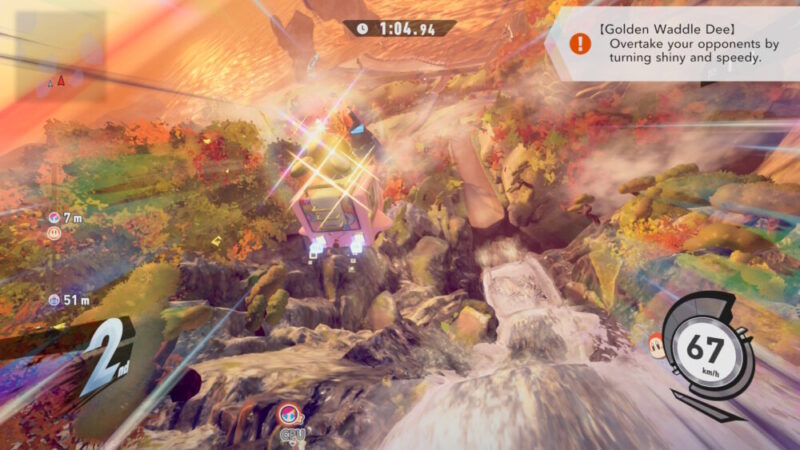
The refreshing part? Air Riders never punishes you for playing solo. In fact, its design often thrives on it. I spent over 20 hours playing in single-player mode, and the motivation to keep unlocking new tracks, characters, and modifiers kept me going. Being able to change up your gameplay modes stops it from feeling like Mario Kart World. Once you finish the bare bones “campaign”, there’s just online and a bare bones world.
Here, each track is teeming with life; it’s stacked with enemies and obstacles that make it feel lived in, a stark contrast to the plumber’s latest outing. It’s also a common issue in arcade racers that offline content often feels like an afterthought, but here, it’s the beating heart. Kirby Air Riders arguably offers more to do alone than any multiplayer-focused Nintendo title since Super Smash Bros. Ultimate.
750 Achievements That Actually Matter
The game’s achievement system is astonishing. Not throwaway challenges, but meaningful tasks that unlock new machines, new characters, alternate colours, hats and cosmetics, new music, extra tracks and dozens of mechanical tweaks.
You can attempt any achievement instantly from its checklist, and the game will auto-build the exact scenario you need. This small quality-of-life feature transforms achievement hunting from a chore into a genuinely addictive pursuit.
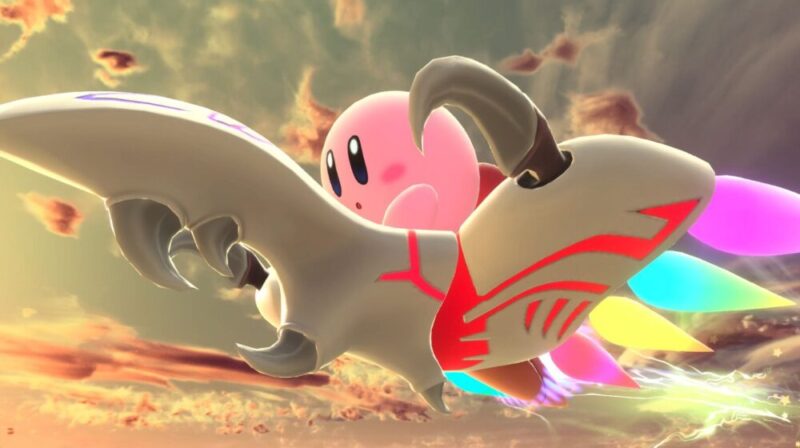
While this doesn’t translate to any kind of achievement outside of the game, the in-game pop-ups do come easily at first and then increasingly get more difficult as you progress through.
Road Trip – One of the Best Single-Player Story Modes in a Racer
The real jewel for solo fans is Road Trip, the narrative-driven campaign mode. It feels like a Smash Bros. Classic Mode meets Kirby lore meets a full single-player RPG-lite journey, all wrapped into snappy, challenge-based missions that slowly grow your machine’s power level. It’s best played in small bursts in between the other modes to build up your machine and gain more control and master each track to perfection.
Each run takes around 90 minutes, but it’s endlessly replayable thanks to branching routes, unlockables, hidden bosses, and clever remix-style challenges. It genuinely feels like HAL took the idea of a “campaign mode in a racing game” and toyed with it until it was absolutely perfect.
While its one-on-one combat trials sometimes push the simple control scheme to its limit, Road Trip’s sense of adventure, progression and rhythm more than compensate. For many players, especially those who don’t want to hop online (yes, that’s me!), this mode alone justifies the price of entry.
City Trial – Still Brilliant as a Solo Experience
While City Trial has long been considered a multiplayer favourite, Air Riders quietly becomes one of the best single-player survival racers on the console, thanks to a variety of mechanics that make it feel more like a Forza game, with your usual mechanics like seasonal weather, randomised events, rotating city geometry and plenty of secrets to find. Along these tracks, you can find rare machine parts to upgrade them; it is a collect-a-thon, but in the absolute best way.
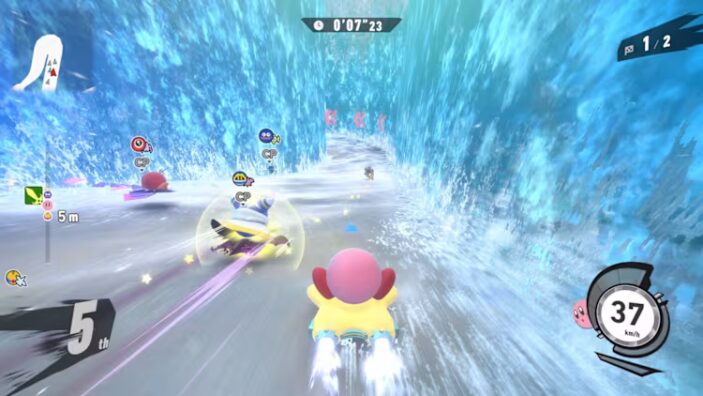
There’s so much variance and so much chaos that even a solo five-minute session becomes a little story of its own. It does get incredibly wild and chaotic, forcing you to play to its blistering pace, and generally demands a fair amount of skill.
Traditional Racing – Now With Real Depth
Air Ride mode returns with 18 courses, nine of which are new, and nine are from the original. And they’re all spectacular. Faster, tighter and more responsive than ever, these races finally feel like they demand real skill.
Offline, racing becomes a perfect playground for mastering your boost rhythm as you slide around corners, finding the sweet spot to let go. While you race along, you can use Kirby’s inhaling ability to suck up enemies that give you different abilities.
Some will give you bursts of speed, some will give you a sword, allowing you to quickly swat away racers and enemies hovering around you. Another big part of mastering your racing is learning the environmental shortcuts on each track. This can give you an advantage by combining these shortcuts with speed boosts and refining your machine-specific tactics.
This is the first Kirby Racer where solo time trials and practice runs genuinely feel rewarding. Top Ride was an addition I didn’t get to experience in the original title, so the very idea of shrinking the map and moving the camera into top-down mode made it a lot of fun.
Look the Part
What makes Air Riders so compelling is how polished it feels, be it the custom rule sets, a gorgeous machine-lab visualiser, a music library with custom track frequency settings, a character select screen so full of charm it could be from a brand-new Smash Bros.
You can feel Masahiro Sakurai’s design DNA everywhere; there’s a high floor of quality here that most arcade racers don’t even aim for. Having a master like Sakurai at the helm of this truly makes it feel special. There’s so much attention and detail that have been put into every corner of this game, you can’t help but fall in love with it.
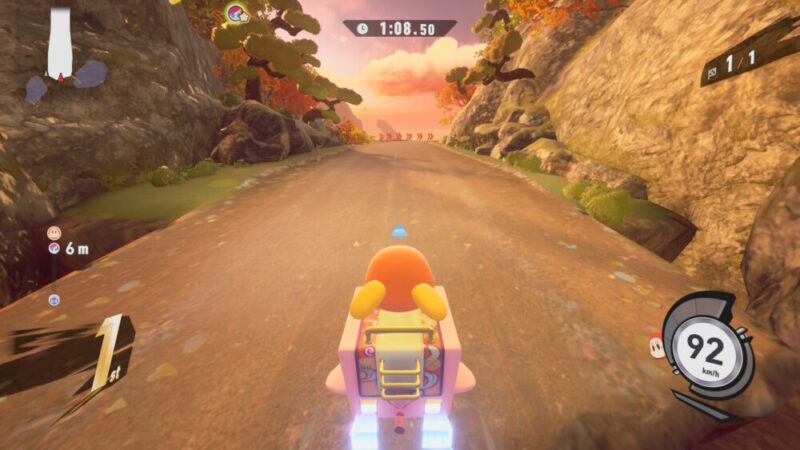
Running at a steady 60fps in both handheld and docked modes (and impressively maintaining it during chaotic four-player splitscreen), Air Riders is a technical standout.
The Switch 2 delivers smooth physics, fast load times and richly detailed environments. When you look at some of the tracks, there are ones like Mount Amberfalls – a stunning descent through glowing autumn forests, Waveflow Waters, a splashy and chaotic ride through waves and ocean rails. It’s truly a gargantuan spectacle that looks incredible on the Switch 2 screen and on your 4K TV.
While these are only two of the tracks, the truth is that not a single track misses.
Final Thoughts
Kirby Air Riders is more than a revival. It’s a statement. It’s a declaration that niche ideas, when fully realised, can produce some of the most compelling and content-rich experiences on modern hardware.
Despite a simple control scheme that occasionally hits its ceiling, the game offers endless meaningful unlocks that keep you coming back to play more. The sheer amount of single-player content is astonishing for an arcade racing game; a lot of this is down to Sakurai ensuring that this is more than just a mere Mario Kart clone.
Adding in a full-blown campaign carves out something different for this genre, supported by characters and machines that radiate a level of charm and personality that only Kirby games can deliver
Whether you ever go online or invite friends over is beside the point: Kirby Air Riders is worth playing even if you never touch multiplayer. In fact, its solo offerings are so generous that it stands as one of the most satisfying single-player arcade racers on the Switch 2.
Cut it however you want, from a joyous return to a wildly ambitious sequel. Either way, it’s simply one of Kirby’s most unexpectedly brilliant adventures yet.


FOUR AND A HALF STARS (OUT OF FIVE)
Highlights: Engaging gameplay; Solid visuals and performance; Best racer of the year
Lowlights: A little too chaotic at times, depending on the mode
Developer: Masahiro Sakurai, BANDAI NAMCO Studios, Sora Ltd., HAL Laboratory
Publisher: Nintendo
Platforms: Nintendo Switch 2
Available: Now
Review conducted on Nintendo Switch 2 with a release code provided by the publisher.
Featured header image provided by Nintendo.
