


If you’re a UFC fan, or happened to read our review of EA Sports UFC 5, then you might already know that the last instalment is the gold standard when it comes to UFC games. While I’m more of a boxing fan, UFC 5 was actually one of the few games I was still playing until this very day.
As a result, you can imagine the weight that EA Sports UFC 6 has on its shoulders. After taking a couple of years off, is UFC 6 the true contender, a worthy follow-up to its incredible predecessor? In some respects, yes. This is without a doubt the most comprehensive MMA game to date. But in other areas, some introductions to certain mechanics and systems, like the new Flow State and The Legacy mode, don’t land as well as they should.
Go With the Flow
In many respects, UFC 6 understands what it did so well the last time, and does its best to keep things nice and streamlined. Even then, while most of the controls and the reworked ground combat and grappling system still feel great, the move to the Frostbite Engine, which began with UFC 5, has only gotten better this time around. Sure, some encounters end with flying limbs bent in ways no human should endure, but for the most part, punches, kicks, and takedowns land with more force than ever.
I’ve always preferred to “stand and bang”, as it were, with a focus on striking rather than grappling. Low strikes have been switched to the L2 on PlayStation or Left Trigger on Xbox, which, for fans, can take a little getting used to as you switch up that muscle memory. You can now switch your stance by clicking the right stick, and blocking animations can change depending on your fighter’s style. These changes feel important, but rarely annoying or overbearing, and I, for one, welcome them.
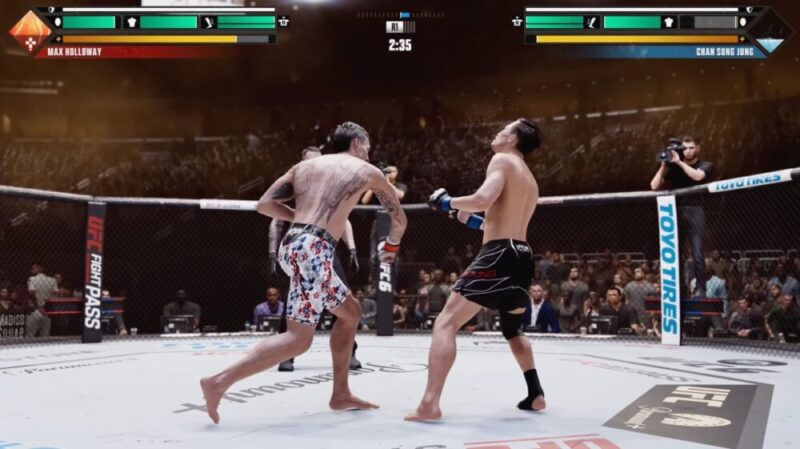
You’ll still need to manage stamina, and various body parts like the head, torso and legs, which can all be individually damaged as the fight goes on. However, I would recommend turning off the Contextual Time Dialition feature after a couple of hours. It’s a feature that slows down time during a fight and prompts you to make the correct move, be it dodging a punch or evading a takedown, but for those comfortable with the mechanics, it simply gets in the way.
The newest feature, as far as gameplay is concerned, however, is the Flow State system. Fighters will essentially build this Flow State metre by landing strikes and grappling. Once you’ve filled this metre, you can enter your Flow State by pressing down on the d-pad, which grants you heightened senses and abilities, making your strikes and grapples that much more effective and, in the right circumstances, devastating.
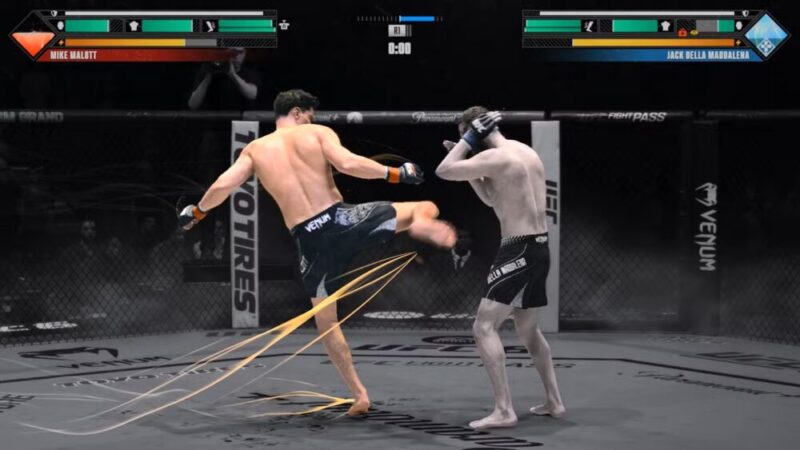
Now, make no mistake, while this mechanic has only been introduced now, the Flow State is certainly a real thing in MMA. Seeing a fighter get into their zone and hit another gear as they land the right combination, weave through a series of strikes and shoot the right takedown, all turn the tide of a bout accordingly.
The only issue with the Flow State is that, unlike real fights, in which these moments only last for a few sweet seconds, it feels incredibly overpowered in UFC 6. Once activated, the screen dims, and colour is faded to black-and-white, except for your fighter, who now stands out in colour. Your strikes leave flashes and trails of light as you absolutely unload on your opponent. Time seems to slow down slightly, and you certainly feel like you have the upper hand.
Now, on PlayStation at the very least, there’s a trophy awarded for ending a fight while in your Flow State. I got this trophy on my first attempt using this mechanic. It’s simply that overpowering.
Online fights can utilise this mechanic as well, but given its effectiveness, you only feel the need to strike and grapple as quickly and effectively as possible to get to your Flow State. One fighter has to then either run away or attack, as the fight generally depends on it. It simply ruins pacing and makes things feel way too one-sided, if that already wasn’t the case.
The Legacy
I’m a massive fan of story modes in sports games, and I still back Fight Night Champion’s Champion Mode in any situation. It’s the gold standard for stories in sports games. That being said, The Legacy is a fair crack in many respects.
The story follows two fighters from the same gym, Believe MMA, who are both gunning for a spot in the UFC. Players assume the role of Chris Carter, who, under the wing of Coach Thompson, is on his way to success. Danny Lopez sits alongside Chis, a dedicated up-and-coming fighter who also has his sights set on the same goal. For reasons I would rather not spoil, their personalities, in addition to some heated situations, cause them to clash, leaving you with a new rival as you progress through the story.

From that lens, it sounds relatively straightforward, but I’m honestly impressed with what’s here. The writing is deep, the performances believable, and I was actually rooting for Chris throughout. The Legacy is described as a prologue for the standard Career Mode, and that’s where its biggest flaw lies. It only takes around 1-2 hours to complete, and once you’re in the thick of your career, the mode doesn’t offer much out of the ordinary.
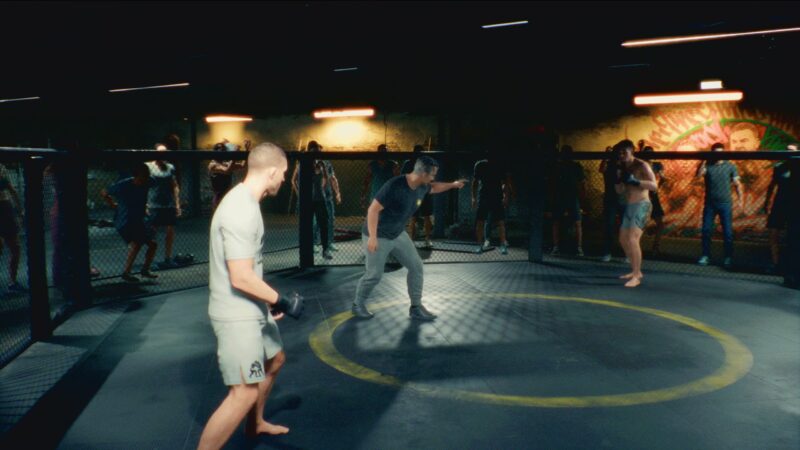
It’s not so much that The Legacy is bad, I simply wish we had more of it. While it’s entirely possible to have a dedicated career mode and story mode exist alongside each other, as Fight Night Champion has shown, there’s certainly plenty of potential left on the table.
The Fight Continues
Thankfully, the UFC Career Mode is really good. It’s essentially a deeper version of what you would have found in UFC 5, complete with a more nuanced and influential decision-making system, in addition to new workouts and fighter development. You’ll be able to create your own fighter, pick an existing one, or simply continue the career of The Legacy’s protagonist, Chris Carter.
You’ll notice this new mode is now called UFC Career Mode, and that’s basically because you’re entering the UFC off the bat. UFC 5 didn’t mess around too much, but added that extra layer of padding, which messed around with the mode’s pacing. There are now way more choices to make in between fights, with expanded dialogue options that can affect things like your fighter’s popularity, and even opportunities for titles and rivalries.
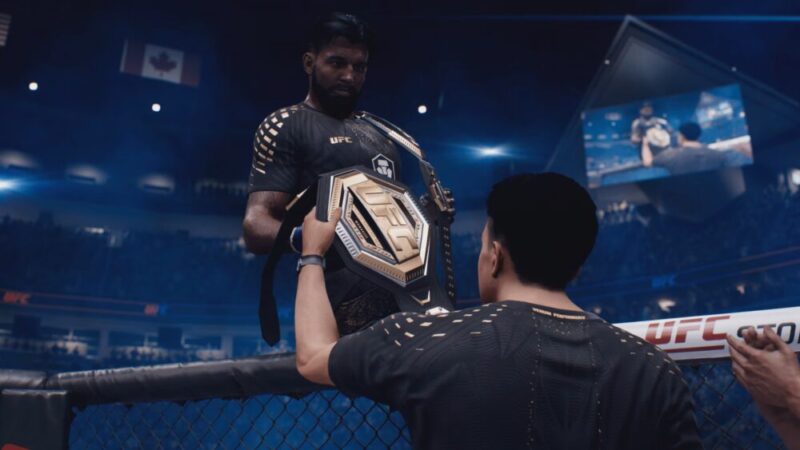
The Career Hub has also been revamped and features a stronger social media presence, even if most of it doesn’t affect your weekly schedule. Around this, and in between fights, you’ll be able to complete several training exercises and partake in certain media events, but I can’t lie, I was always pushing, though ever so slightly, to get to the main bout. You’ll also be able to earn XP and upgrade most of your fighter’s individual abilities from the ground up, including the ability to train and learn new moves as you go.
The new Hall of Legends mode is one of the most unique and inventive modes I’ve seen in ages, and it’s a great way to honour the best in the business. There are three fighters here at launch, with Max Holloway, Alex Pereira and Weili Zhang available, with EA Sports promising to add more in the future.
The mode acts like an interactive museum of sorts, where players can walk around a curated environment based on the background of each fighter, and it’s seriously impressive. I’ll admit, there’s not much in the way of actual gameplay; you’ll simply walk along various rooms and hallways with your custom fighter, but it’s in the presentation and dedication to detail that this mode truly succeeds.

Here, you’ll not only learn about the fighter, from various stats, feats and rivalries, but you’ll also learn about the person behind the fighter, including their home and upbringing. It’s a well-made experience that would only benefit from being able to jump into those exact fights and moments, similar to something like WWE 2K’s Showcase Mode.
The Gym allows you to build a team of fighters to earn various cosmetic rewards. But it’s not a roster in the traditional sense, akin to something like NBA 2K’s MyTeam. It’s simply a mode you can grind through to earn cosmetics by completing various challenges. But given this mode is so detached from everything else, there’s really no point to it unless you’re willing to put those cosmetics front and centre. I can tell you now, it’s something I forget about relatively soon.
Finally, there are plenty of other ways to continue the fight, be it competitively online or against friends at home, including the awesome Kumite mode from UFC 5, which plays out more like a traditional fighter in a really cool Bloodsport-esque setting.
Look the Part
For the most part, UFC 6 looks fantastic, complete with some incredibly accurate character models and impressive lighting for detail. Much like UFC 5, the general presentation is pretty solid, and the crowd reactions dynamically change as the fight wears on.

On the PlayStation 5 Pro, at the very least, the game runs almost flawlessly. Running in 60 FPS in 4K, there’s really not much more to write home about, but it’s all smooth and clean.
Final Thoughts
The Legacy Mode might be a little too short, The Gym Mode relatively pointless, and the Flow State mechanic utterly overpowered, but there’s still plenty to love about EA Sports UFC 6.
While those swings ultimately miss, there are still a few nice hooks and jabs from the detailed UFC Career Mode and lovingly crafted Hall of Legends Mode. It’s ultimately fun to play and packed with features, making it a solid instalment for newcomers and fans alike.


FOUR STARS (OUT OF FIVE)
Highlights: Improved combat mechanics; The Legacy is engaging for as long as it lasts; Hall of Legends is a great throwback for fans
Lowlights: Flow State feels way too overpowered; The Legacy Mode is too short
Developer: EA Vancouver
Publisher: EA Sports
Platforms: PlayStation 5, Xbox Series X/S
Available: Now
Review conducted on PlayStation 5 with a code provided by the publisher.
Featured header image provided by the publisher.
