

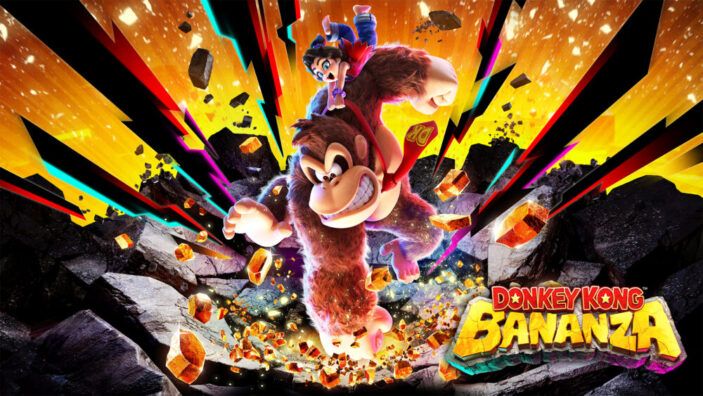
Can you believe that Donkey Kong Banaza is only the second 3D Donkey Kong game ever and the first one in 25 years, since Donkey Kong 64? While you let that sink in, it’s also worth taking the time to consider what incredible weight such a sequel or follow-up would even bring with it in the first place.
That being said, Donkey Kong Bananza is finally here. While we’re quite puzzled as to how this wasn’t a Nintendo Switch 2 launch day title, it’s better late than never, I suppose, as we just got not only the best game available on the new hardware, but one of the best 3D platformers of the modern era.
While many would have expected a sequel to Super Mario Odyssey, Nintendo has put their powers and skills together to create a spiritual successor that plays like a dream, runs like a charm and ultimately feels like a winner.
Up and Away
Donkey Kong Bananza sees our main gorilla working in the mines, digging away for gold bananas known in this game as Banandium Gems, before the villainous Void Company (or VoidCo) sucks up all of the surrounding Gems in the area, including Ingot Isle, pushing it much deeper underground. DK soon discovers a mysterious singing Odd Rock, who is revealed to be Pauline, a young girl kidnapped by VoidCo, who simply wants to return to the surface. DK agrees to help, all while attempting to collect as many Banandium Gems as he can on the way.
It’s a relatively light story that serves as more of a backdrop as you dig deeper into the planet’s core, described to players as a necessary journey downwards to go back upwards. But at the same time, it’s all the experience needs to get the point across, explaining the lore and necessary story beats along the way as you chat to various NPCs in each sub-layer.
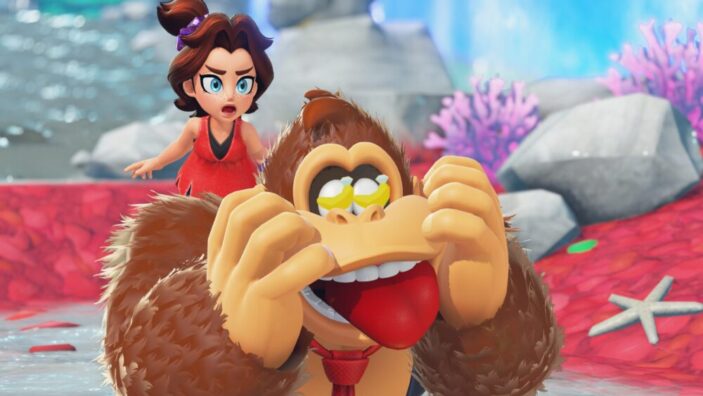
Pauline is charming enough, and DK drops some occasionally funny expressions along with some slapstick comedy, which does lend itself to a few laughs and smiles. I liked how Pauline is portrayed as a talented singer who suffers from stage fright, who, throughout the narrative, learns to face her fears.
The only caveat to such a minimal story is that while Donkey Kong Bananza prides itself on moment-to-moment gameplay, rather than a deep and engaging story, as there’s simply not much else to it. There’s no real emotional depth or significant character development, and it generally just expects you to nod and agree as the story unfolds. There’s plenty of digging to be done here, just not in the narrative.
Dig Deep
As far as general gameplay is concerned, Donkey Kong Bananza is an absolute blast. True to the character, you’ll spend most of your time smashing through layers of terrain, with most of the controls centred around you punching downwards, upwards or forwards. You’ll also be able to rip pieces of terrain out to swing as a weapon or throw at enemies. DK can also do what’s called Turf Surfing, where he can use that piece of terrain to surf around the environment, which makes traversal a little quicker.
Like Super Mario Odyssey, DK will spend most of his time punching, jumping and climbing from point A to point B, which usually results in jumping into a tunnel that leads him and Pauline deeper towards the planet’s core. DK will generally come across chunks of Gold, in which he can press the R button to slap the ground and collect everything in a small radius in an instant.
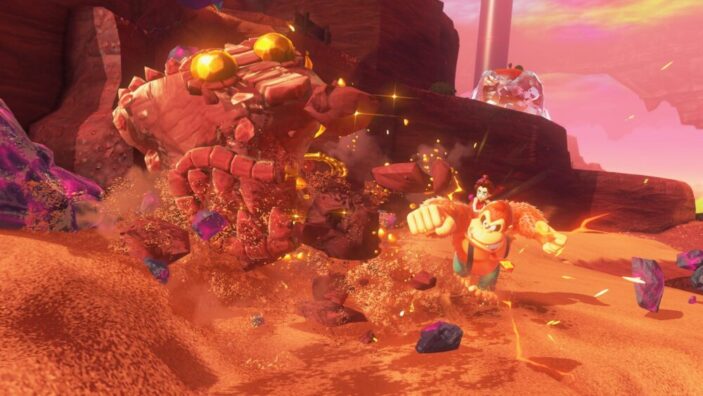
But more importantly, there are the Banandium Gems, which act like Super Mario Odyssey’s Moons. Unlike Super Mario Odyssey, though, players won’t need to collect a certain amount of Gems to proceed, and instead complete a list of specific objectives dished out by NPCs in that area. Every five Gems collected grants DK a skill point to unlock a range of abilities, which we’ll touch on a little later in this review.
I do like this change as the pursuit of Gems encourages a level of exploration that Donkey Kong Bananza is trying to lean into at every turn. While there are boundaries and limits, every environment allows DK to punch through terrain, to either dig downwards into hidden areas, through walls, or even back towards the surface. While later stages bring with them tougher terrain, it feels consistently rewarding, with plenty of hidden corners and collectibles to find.
While Gems are usually the goal, you’ll also be able to dig for hidden chests, which can contain large sums of Gold, and even dig for Fossils, which can be used as currency to unlock a range of customisable outfits and fur colours for DK to spend at certain stores along the way.
The only gripe I had out of the gate with punching and digging in general was the camera when digging into the terrain. Certain areas allow DK to dig quite deep into the ground, but it always felt a little tough to get my bearings. Digging directly downwards and creating a tunnel gives players a see-through look at DK within that layer, but it’s hard to see where you are within the actual environment, should you want to climb out again or traverse in a different direction.
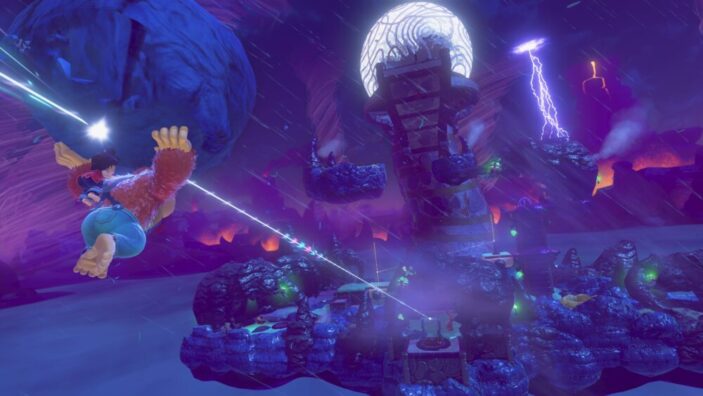
DK will also be able to climb on certain surfaces, which helps with traversal, but it’s not all straightforward. For example, certain surfaces and objectives are often covered in Purple Metal, a substance that can’t be destroyed by any of DK’s moves or abilities. Instead, DK must find a nearby core by whistling with the L button, which helps guide DK towards an objective. Pauline can then sing with that same L button, causing the bond around the core to shatter. Once this core is destroyed by DK, all surrounding Purple Metal will disappear, allowing you to proceed.
Combat is equally as engaging, usually involving some approach before approaching them before taking them out. While certain enemies can be defeated with regular punches, some enemies need to be hit with projectiles first to have their armour broken. In contrast, some enemies need to be defeated with one of DK’s transformations, which we’ll touch on in just a moment.
There’s even some cool additional 2D levels that prove incredibly effective as far as nostalgia trips are concerned, barrels and all.
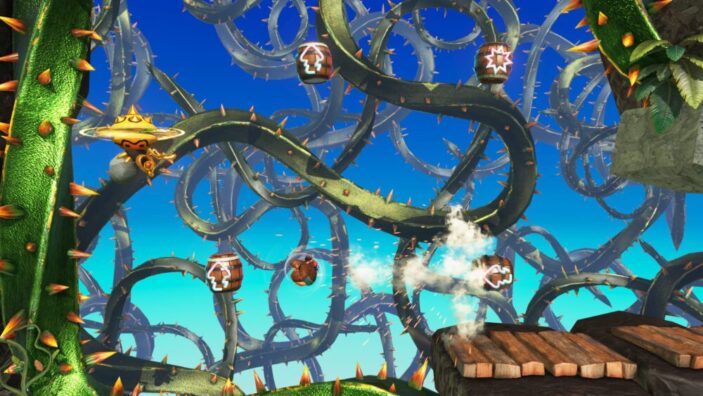
Either way, Donkey Kong Bananza’s level of variety through various mechanics and unique approaches makes this an entertaining romp that’s easy to learn through its simplistic controls and mechanics, but engaging to stick with as you figure things out and explore in and around each unique environment.
Respect Your Elders
Along the way, DK will also meet several giant elders throughout the narrative, who grant him five unique Bananza transformations, which are unlocked as you meet each elder. For example, Kong Bananza allows DK to smash through harder surfaces, while Zebra Bananza allows DK to run at much faster speeds, and Ostrich Bananza allows DK to fly across larger gaps and chasms. Most of these transformations are tied to the environment and levels around them, but can all be used in conjunction with each other to help you through a level.
DK can cycle through any of these once unlocked via the directional buttons, and activate them once the associated metre is full. This is generally done by collecting Gold. Once activated, a small bar beside DK will deplete until empty, causing DK to revert to his original form. These transformations are fun, but do take away from any difficulty the game throws at you, as once revealed, they make those tasks a breeze. I would say the challenge is in keeping these transformations accessible, but Gold is rarely in short supply; you’ll be able to use them whenever you like.
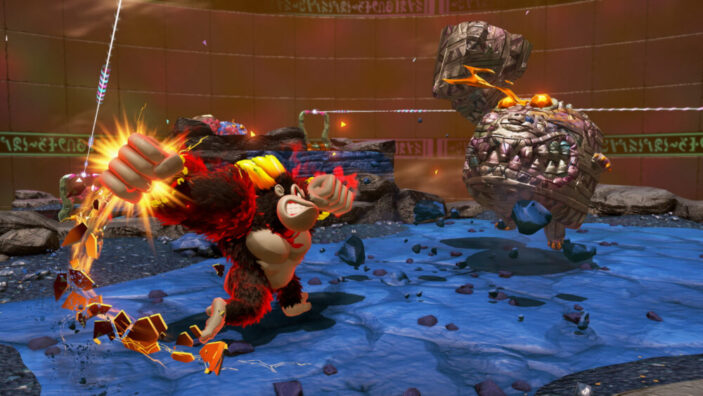
Certain boss battles and enemies will generally favour one or more of these transformations, but there are times during regular levels where they don’t always feel necessary to get the job done.
But when you’re not transforming, there are plenty of ways to upgrade DK as he is. Every five Banandium Gems collected will grant you a Skill Point to spend on upgrading various abilities. For example, you can upgrade the overall amount of health DK has, but can also upgrade his Slap ability to grab chunks of Gold and various items that are further away, or even upgrade any of DK’s Bananza transformations to help those abilities last even longer. They rarely redefine the gameplay, but help it feel that much easier and more convenient as you progress. But at the rate you find Banandium Gems, there’s always a few points to spend at the end of each level.
Look the Part
It’s definitely in its early days, but Donkey Kong Bananza is easily the best-looking game on the Nintendo Switch 2. Mario Kart World looks great, but Donkey Kong Bananza is so much more expansive while looking just as detailed and vibrant.
Things run at a steady 60 FPS in both handheld and docked modes, and only rarely dips when you’re smashing about busier levels and environments. But it seems to run anywhere between 1200p and 1080p, which can, at times, bring out some rougher edges up close.
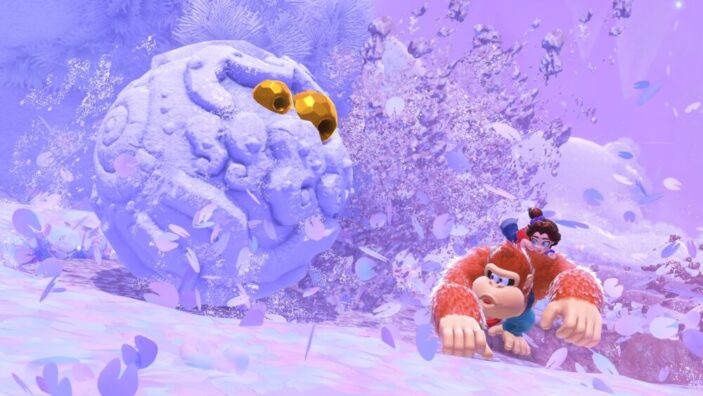
With a range of unique environments, though, it’s hard to complain. Be it the rocky terrain, the snow, the jungle, or anywhere in between, it all looks about as good as we could have asked for on the new hardware, short of a 4K or even 1440p resolution when docked.
Final Thoughts
For all that it’s worth, most of Donkey Kong Bananza’s flaws simply can’t hold it back from what I consider some of the most fun I’ve had on a Nintendo console in quite some time.
It’s just so satisfying to smash and explore as DK within this world, as I’m still hunting for Banandium Gems long after the credits have rolled.
Even though we’re still in the early days of the Nintendo Switch 2, Donkey Kong Bananza already feels like an essential addition to the collection.


FOUR AND A HALF STARS (OUT OF FIVE)
Highlights: Engaging gameplay; Solid visuals and performance; Plenty of mechanics to mess around with
Lowlights: Story feels a little thin; Camera controls can get a little muddled when digging
Developer: Nintendo EPD Tokyo, 1-Up Studio, tri-Crescendo
Publisher: Nintendo
Platforms: Nintendo Switch 2
Available: Now
Review conducted on Nintendo Switch 2 with a pre-release code provided by the publisher.
Featured header image provided by Nintendo.
