

There is an old saying about not fixing what isn’t broken. Despite being sage advice, the modern video game industry appears to have adopted it as a primary business model. Remakes, remasters, and re-releases have become some of the safest tickets in town.
The Last of Us. Dead Space. Resident Evil. Silent Hill. Oblivion. Not to mention games barely old enough to have developed wrinkles are being hauled back onto the operating table to have their textures scrubbed, lighting replaced, and frame rates doubled. Now, Ubisoft has gone rummaging through their own attic.
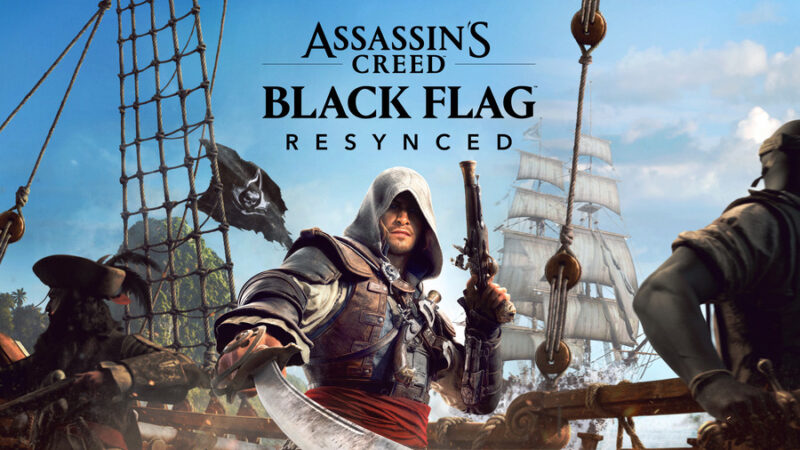
Thirteen years after its original release, Assassin’s Creed IV: Black Flag returns as Assassin’s Creed Black Flag Resynced, rebuilt with modern visuals, overhauled mechanics and enough quality-of-life improvements to make Edward Kenway’s Caribbean adventure feel remarkably comfortable in 2026.
Black Flag Resynced represents much of what bothers me about the industry’s current obsession with nostalgia: a creatively safe bet from a mega-publisher revisiting one of its most beloved games rather than throwing that money, talent and technology at something genuinely new.
As a remake/remaster sceptic, the most frustrating thing is that it’s excellent. As an original Assassin’s Creed fan, it is also precisely the sort of fan service I am entirely susceptible to.
Unfortunately, sailing through the Caribbean again, watching sunlight bounce from turquoise water as the crew of the Jackdaw erupts into a sea shanty, makes maintaining any principled position considerably harder.
Nothing Is True, Everything Is Permitted
For all the discussion surrounding what has changed, the most important thing about Assassin’s Creed Black Flag Resynced is what hasn’t.
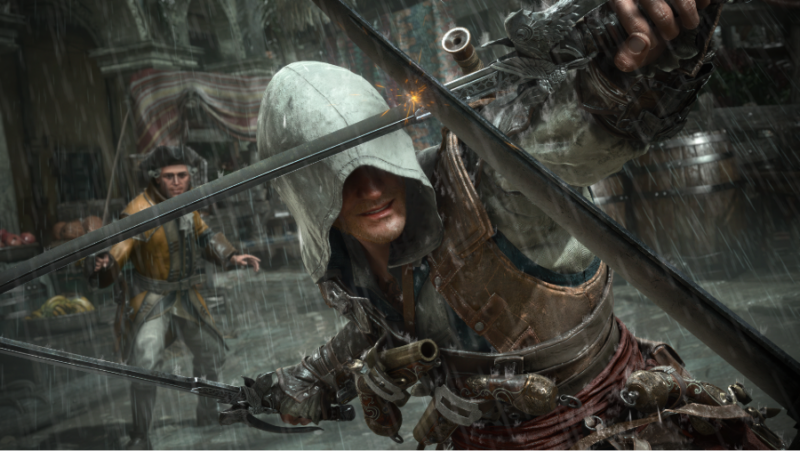
Black Flag remains a great game and one of the high points of the series. Set across the West Indies during the dying days of piracy’s Golden Age, the story follows Edward Kenway, a Welsh privateer-turned-pirate with considerably more interest in fortune than philosophy. After killing an Assassin and stealing his robes, Edward inadvertently stumbles into the centuries-long conflict between the Assassin Brotherhood and the Templar Order.
For a franchise obsessed with destiny, bloodlines and inherited responsibility, Edward is an unusual protagonist. He doesn’t particularly care about the Creed or honour. In true pirate fashion, he wants money, status and enough freedom to do whatever the hell he likes.
What begins as a swashbuckling romp gradually becomes something far more melancholy. Edward’s relentless pursuit of freedom comes at the expense of almost everything capable of giving that freedom meaning. Ironically, it is also where Black Flag’s relationship with Assassin’s Creed becomes complicated.
Edward spends much of the game adjacent to the Assassin-Templar conflict rather than embedded within it. The Brotherhood remains important, particularly as his character develops, but Black Flag has always felt like a pirate game with an Assassin’s Creed sticker slapped on the side rather than an Assassin’s Creed game about pirates.
At release, that felt like a significant departure from the mythology-heavy adventures of Altair and Ezio. After the series’ later expansion into RPG systems and increasingly fantastical territory, Black Flag’s radical departure now feels almost conservative by comparison. Either way, the pirate part remains magnificent.
A Pirate’s Life
Central to everything is the Jackdaw, Edward’s ship and perhaps the game’s most important supporting character.
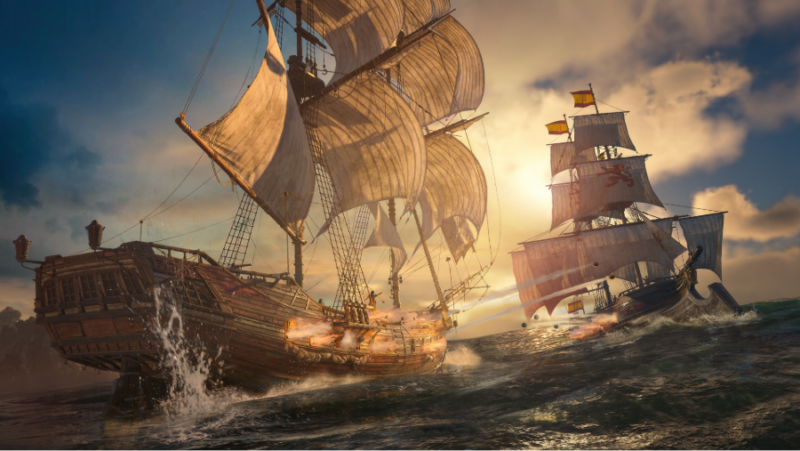
What began as a relatively contained diversion in Assassin’s Creed III became the defining mechanic of Black Flag, and remarkably little about its appeal has diminished. The loop remains beautifully simple. Sail into open water, spot another vessel through the spyglass, decide that whatever it has now belongs to you and begin manoeuvring into position.
There is enough positioning, weapon management and environmental chaos to keep naval combat engaging without Black Flag forgetting that controlling a pirate ship is supposed to be fun.
The upgrade system feeds neatly into that loop, with resources strengthening the Jackdaw’s hull, cannons and other systems until Edward’s modest vessel becomes capable of terrorising almost anything unfortunate enough to appear on the horizon.
Pointing the Jackdaw toward a distant island, opening the sails and listening as the crew erupt into a sea shanty creates an open world where travelling through it remains part of the attraction. Storms also transform peaceful journeys into battles against the waves and waterspouts, while whales breach nearby and ships emerge as tiny silhouettes against the horizon.
That was impressive in 2013. In Resynced, it is spectacular.
Paradise Found
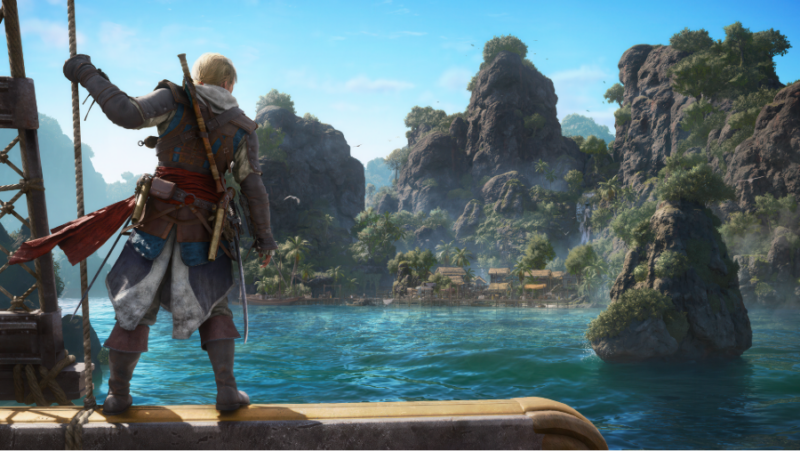
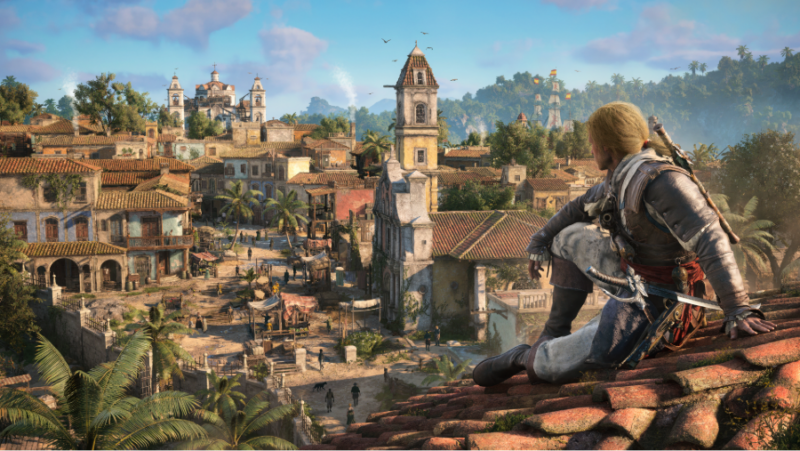
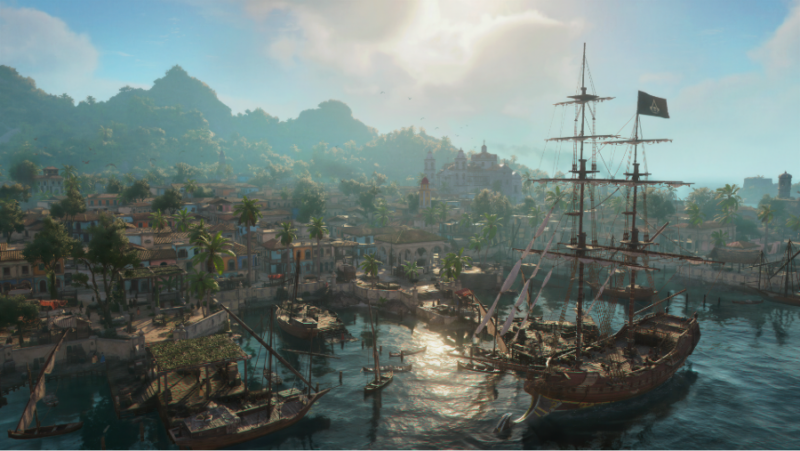
The Caribbean is an almost unfair candidate for a visual remake. Turquoise water rolls onto white beaches. Dense jungle surrounds crumbling ruins. Havana’s colourful colonial buildings glow beneath the sun while Nassau remains held together by timber, canvas and the questionable civic planning of several thousand pirates.
Resynced takes environments that were already attractive and gives them the technology necessary to properly show off. Lighting is the biggest beneficiary. Sunlight cuts through jungle canopies and reflects across the ocean, interiors transition more naturally into daylight, and storms can turn postcard-blue seas into violent walls of grey within minutes.
More importantly, the overhaul serves exploration rather than simply producing prettier screenshots. Settlements feel more cohesive, environments richer and wandering around considerably more convincing. From crowded streets and taverns to isolated sandbars sitting in an enormous blue ocean, Black Flag still understands the value of giving each location a distinct sense of place.
There is plenty to find within them too. Treasure maps lead to buried riches, wrecks hide upgrade materials, forts can be captured, and legendary ships await sufficiently confident captains, alongside the usual Assassin’s Creed collection of viewpoints, contracts and collectibles.
There is unquestionably some open-world bloat here. This was around the period when Ubisoft maps began developing an addiction to icons, but the world remains manageable enough that exploration rarely feels like working through a spreadsheet.
Old Dog, New Tricks
Where Resynced earns the remake label rather than simply functioning as an expensive graphical upgrade is in how it approaches the original game’s weaknesses.
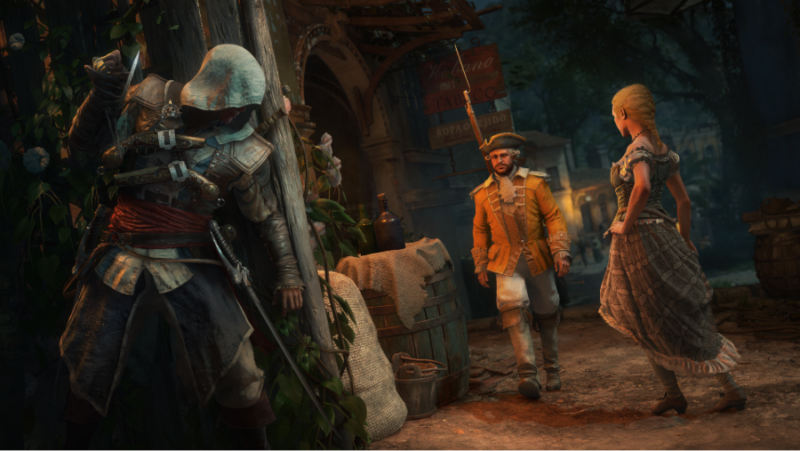
Tailing missions are the single most frustrating element of the older AC games. The original relied on these sequences far too frequently, particularly when combined with forced stealth and instant mission failures. These missions have been redesigned around a more modern stealth system, allowing greater flexibility in how Edward moves through spaces and tracks his targets.
It doesn’t turn Edward into Agent 47, nor should it. Instead, Ubisoft has identified where thirteen years of game design expose the original’s age and have selectively modernised those elements without sanding away its identity.
Combat receives similar treatment. Edward retains an extraordinarily dangerous collection of pistols, swords and questionable morals, but fighting feels smoother and less mechanically stiff. Swordplay retains the counter-heavy accessibility of the original while benefiting from cleaner animations and more responsive controls.
Assassin, Pirate or Both?
One omission in this remake feels more significant than anything else: the modern-day storyline is gone.
For many players, removing the sequences outside the Animus will probably improve the pacing. Even in 2013, Black Flag’s Abstergo Entertainment sections were criticised for dragging players away from Edward just as they were getting comfortable behind the wheel of the Jackdaw. This has also been a long-running complaint throughout the series. Their removal nevertheless changes the game’s relationship with the wider series.
The original Assassin’s Creed was built around two interconnected timelines. Altair, Ezio and Connor weren’t simply historical protagonists selected because their respective periods made interesting open worlds. Desmond’s journey through their memories connected those stories to an Assassin-Templar conflict that had survived into the present.
I have always been more fond of that science-fiction framework than most, and Black Flag already arrived at a transitional point immediately following the conclusion of Desmond’s story. Removing the modern-day material entirely pushes Resynced another step further away from that structure.
There is certainly an argument that it produces a cleaner game. Edward’s story now unfolds uninterrupted, and the Caribbean was always the more interesting place to be, but something is lost. Without the push and pull between history and the present, the Assassin-Templar war feels less like an ancient ideological conflict continuing through generations and more like a purely historical adventure.
That distinction is particularly interesting because Black Flag was arguably the moment Ubisoft discovered that its historical settings could survive without much of the machinery that originally justified them. It turns out Assassin’s Creed could become just a pirate game.
Final Thoughts
Black Flag’s story is still surprisingly affecting. Edward remains an excellent protagonist and the Caribbean provides a rare combination of open-world exploration and traversal where getting somewhere can be as enjoyable as whatever waits when you arrive.
Resynced wisely leaves those qualities alone and concentrates on where age has been less forgiving. The world is stunning, stealth is more flexible, the worst mission structures have been reconsidered, and the mechanical improvements largely make Black Flag play the way nostalgia insists it always did.
Assassin’s Creed Black Flag Resynced understands that modernising a classic should involve more than replacing textures and increasing the resolution. Black Flag wasn’t exactly an inaccessible artefact trapped on long-lost hardware. We aren’t digging through cupboards for a Nintendo 64 cartridge and searching Gumtree for a television with those mysterious yellow, red and white holes in the back.
There is value in preservation and in introducing great games to new audiences, but remaking a beloved game is also one of the safest creative bets available to a major publisher. The audience exists. The design has already been proven. Even the nostalgia comes pre-installed.
It demonstrates exactly why remake culture can feel creatively bankrupt while simultaneously demonstrating why people keep buying the bloody things. Because this is an excellent remake. More frustratingly, it’s an excellent remake of an excellent game. Its redesigned missions address some of the original’s worst repetition, modern stealth mechanics provide greater freedom, combat feels smoother, and the rebuilt Caribbean is frequently spectacular.
Beneath those improvements remains the thing that matters: Black Flag.
Edward Kenway’s journey remains one of the franchise’s strongest character arcs, while the Jackdaw and its naval combat still deliver one of gaming’s great pirate fantasies. The removal of the modern-day storyline further separates Black Flag from the mythology that once made Assassin’s Creed distinctive, and there are places where thirteen-year-old open-world design remains visible beneath the renovation.
Few of those wrinkles diminish what remains an enormously entertaining adventure. That is both Resynced’s greatest achievement and the uncomfortable irony behind its existence. Ubisoft has spent considerable time, money and talent proving that one of its best games is still one of its best games. I don’t want the next decade of Assassin’s Creed spent reminding us how good the old ones were; I want Ubisoft to remember why they were good.
Because the greatest tribute Ubisoft could pay to Black Flag isn’t remaking it again in another thirteen years. It’s simply making the game we’ll want remade thirteen years from now.


FOUR STARS (OUT OF FIVE)
Highlights: Spectacular visuals; endlessly satisfying naval combat remains; Redesigned stealth and tailing missions
Lowlights: Some dated open-world design still shows through; The remake’s existence highlights Ubisoft’s reliance on familiar successes
Developer: Ubisoft Singapore
Publisher: Ubisoft
Platforms: PlayStation 5, Xbox Series X|S, PC
Available: Now
Review conducted on PlayStation 5 with a code provided by the publisher.
Featured header image provided by the publisher.
