

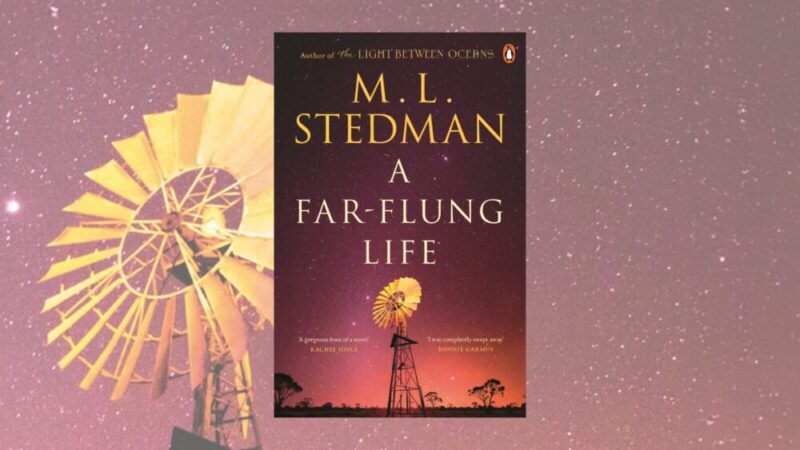
It’s been fourteen years since M.L. Stedman‘s debut novel The Light Between Oceans was published, and went on to become a bestselling sensation. In the intervening years, there’s been very little news about the West Australian born writer, who now lives in London, aside from the novel’s adaptation into a film starring Alicia Vikander and Michael Fassbender in 2016. Stedman, who is also a lawyer, is not on social media and does not do many (if any) events, preferring instead for her work to stand on its own, and to let readers parse meaning from her novels themselves, unbiased by any impulse to find the author on the page. As she told the Sydney Morning Herald in a 2012 interview, ‘As the book’s not autobiographical, details of my life won’t really shed light on the story for the reader and I’d much rather let readers focus on the book and their own experience of it.’
Her second novel, A Far-Flung Life, was released in March earlier this year. Like The Light Between Oceans, the story centres around a tragedy, and the moral quandaries that follow in its wake. In the early chapters, Phil MacBride and his two sons, Warren and Matt are driving together through the grounds of Meredith Downs – a vast sheep station north of Perth. It is January 1958 – the three MacBrides, who are part of a proud pastoralist lineage – recount the family story of why there is a pearling lugger in a shed on the property, thousands of kilometres from the ocean, and why they keep up the tradition of sharing a beer with the ashes of an uncle killed in the Great War. Suddenly, a kangaroo bounds out in front of the car. It is the work of moments. All three men are injured in the crash. Warren and Phil do not survive; Matt experiences a traumatic head injury, and it is only because the postman happens to be driving by not long after that he survives at all.
If this tragedy seems awful enough there is more to come. The accident leaves Lorna MacBride and her daughter Rosie to keep things going with the help of an aristocratic employee there to learn how to run his own family properties. They depend on the kindness of their community, from the roo shooter Pete Peachey, who keeps a paternal eye on the increasingly troubled Rosie, to the mail carrier who discovered the crash, to the flying doctor who rushed Matt MacBride to hospital in the city. But the MacBrides are also isolated – on a vast expanse of land leased from the crown for 99 years, and surrounded by the stories of the MacBrides who have come before them. The theme of legacy is all over this book; from the handwritten ledgers kept by the family and their staff to record the comings and goings at Meredith Downs, to the school projects about family trees which will come later, prompting one character to wonder why being a MacBride is so important, when all of his maternal forbears had previously been part of other presumably great families too. This isolation is both a blessing and a curse, as the reality of their changed family begins to set in.
Many readers may find the ethical dilemma at the heart of this novel too hard to stomach. Early on, one of the doctors warns that Matt’s traumatic brain injury may change his personality, cause confusion and give him certain impulses and urges beyond his control. They warn the MacBrides about the dangers of things like alcohol. Then, they let him return home for a visit. Matt and Rosie go out to explore the property, and lulled into a false sense of comfort by how much like himself Matt seems, Rosie allows her baby brother to talk her into letting him have a drink or two – or six – when they get trapped in a shearing shed in a downpour. As the situation gets out of hand, a confused Matt crosses a line without realising what he is really doing.
These two big events – the car crash, and the night in the shed- are the two grenades thrown into the peaceful existences of those at Meredith Downs. As the book unfolds, the ripples drift outwards and begin to touch the lives of those beyond the property boundaries – the new police sergeant intent on upholding the law properly; the post-master’s wife who keeps a card catalogue of funeral notices and sticks her nose in everyone’s business; the geologists who move into the paddocks on Meredith Downs looking for precious metals under the soil; and a young boy who looks at the world differently.
As ever, Stedman’s ability to delve into the nuance of these complex situations and to remain focused on the human heart of stories that would otherwise make for sensationalised tabloid articles gives this novel a warmth and a gentleness that guides the reader through trickier territory. Her characters are richly developed and their lives are given such specific detail that they feel supremely real – from Rosie, whose ritual for ‘absolving’ herself from the many lies she tells, to Myrtle at the post office who keeps a bowl of lollies on the counter for ‘kiddies only’. Her storytelling reminds the readers that there are real families at the heart of every tragedy. The prose in this novel sparkles, evoking both time, place, and philosophical musings in a way that feels effortless, but in actual fact most likely took the better part of fourteen years to polish and perfect.
Though the novel’s resolution may not be as satisfying or romantic as some readers may have hoped, it is a resolution, and it does fit with the book that has come before. Indeed, it fits with the style of the M.L. Stedman readers came to know through her first book, and with the tenor of history. Tragedies happen – both personal and on a global scale- and afterward, ordinary people must carry on with their lives, finding a way to be okay with whatever the new normal may be.

FIVE STARS (OUT OF FIVE)
M.L. Stedman’s A Far-Flung Life is out now through Penguin Books. Grab yourself a copy from your local bookstore HERE.
