

Whose perspective shapes history?
What happens if we look through a different lens?
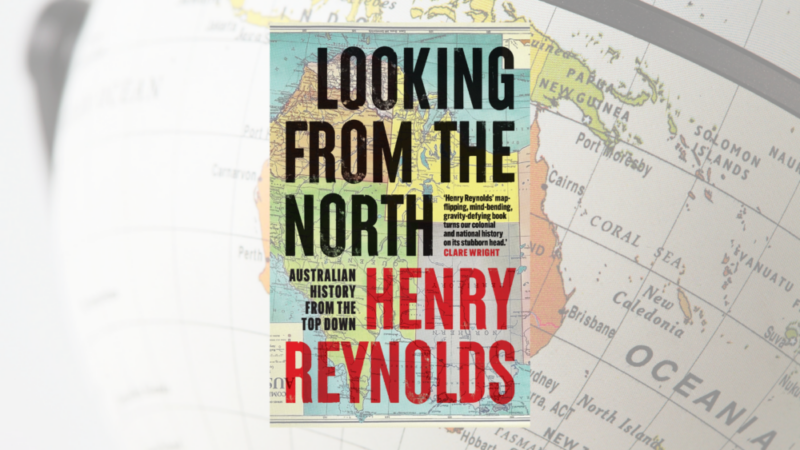
That’s what acclaimed historian Henry Reynolds’ asks in Looking from the North: Australian History from the Top Down. His latest book explores history from the vantage point of the tropical north, delivering an important truth telling. Known for seminal works, including Why Weren’t We Told? and Forgotten War, Reynolds challenges his readers to interrogate the horrors embedded in Australia’s past — the parts history often chooses to ignore.
The catalyst for this was Reynolds’ move to Townsville in the 1960s to teach Australian history. He quickly realised how little the curriculum covered of Townsville and northern Australia’s regional past. Likewise, the rich history of First Nations people was skimmed over. The blind acceptance of a sanitised version of events left Reynolds enraged. So, he decided to challenge it.
In Looking from the North, Reynolds paints a distinct picture of northern Australia. Like its different climate, landscape and lifestyle, different too is its history. He begins with the colonisation of the north, noting that it unfolded in distinct phases. He writes: “It was an Australian, not a British venture. For better or worse it is our responsibility. We cannot escape from it or from its latter-day consequences with which we still live.”
Reynolds doesn’t shy away from the bloodied and shameful events that follow as the north came to be settled. The frontier wars, and the introduction of the state-run Native Police, mark particularly dark chapters in which so many Indigenous lives were lost. Reynolds examines the racist policies of federation and how they made way for the cruel hypocrisy of the White Australia policy – the effects of which were felt heavily in the north.
Before 1901, the north had been a multicultural place where First Nations peoples, Chinese immigrants, Pacific Islander divers and others worked alongside each other. Reynolds points to the peaceful trade network between the Yolngu people and the Macassan’s as an early example: Macassan fisherman would sail on monsoon winds to harvest sea cucumbers, and in return the Yolngu received tools, cloth and materials. This agreement came to an abrupt end in the pursuit of a white frontier.
Governments were desperate for the north to be ‘white’, yet given the harsh climate few settlers were willing to work or live there long term. Instead, the region depended on the labour and knowledge of First Nations people. Their deep connection to Country and understanding of the land made them indispensable to farming, pearling, fishing and fruit growing. Settlers shamelessly relied on their work, while trying to dispossess and erase them.
Safe to say, Looking from the North is a heavy read. It’s devastating to read about the blatantly racist policies on which Australia was founded, particularly as they continue to fester today. But, Reynolds continually highlights the resilience of First Nations communities, alongside that of the Asian and Pacific Island diasporas. We are enriched by our multicultural history, and by looking deeper into the history of the north, we can gain a far better understanding of how Australia was shaped.
Given its brevity, the book only scratches the surface of a long and textured history. It’s more focused on Queensland than other areas, but this is unsurprising as it’s where Reynolds spent the most time. Nonetheless, the book is a great starting point, with thoughtful structuring keeping the information easy to digest.
Through Looking from the North, Henry Reynolds continues to ask us to rethink the history we’ve been told for so long. It’s an urgent call to shift the national gaze to a more inclusive, interrogative, and informed understanding of out past. An important read that anyone will learn something from.

FIVE STARS (OUT OF FIVE)
Looking from the North by Henry Reynolds is available now from NewSouth Books. Grab yourself a copy from your local bookstore HERE.
