
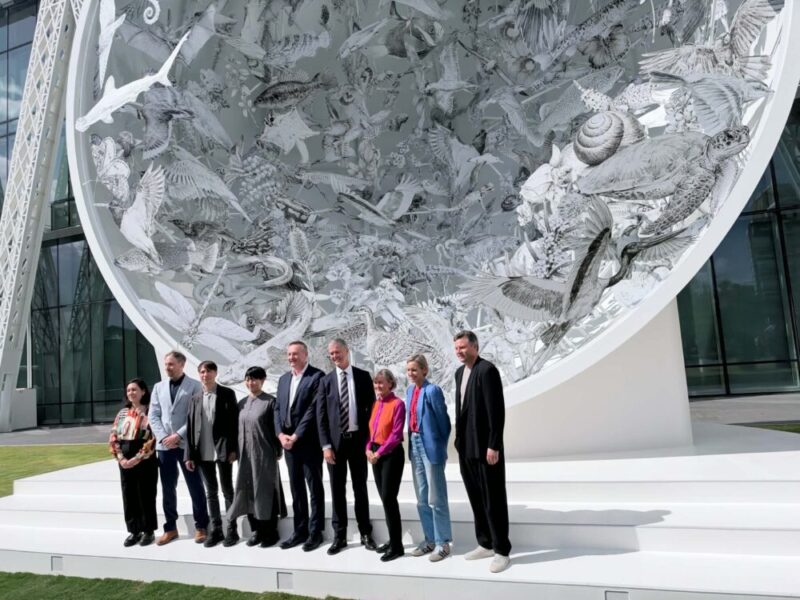
My cynicism about Parramatta’s worldly ambitions was torn to shreds the minute I saw Es Devlin’s extraordinary outdoor sculpture, Come Home Again.
Gathered outside Powerhouse Parramatta for its official media preview on Friday morning, I watched as a small part of the team responsible for NSW’s most ambitious new cultural institution assembled around Devlin’s monumental circular sculpture, filled with 244 hand-drawn depictions of vulnerable and endangered species from NSW.
The media preview wasted very little time making a statement. This is going to be big. For Parramatta, certainly, but also for an international audience accustomed to the enormous cultural institutions of New York, Paris and Vienna.
Making Parramatta a world-class destination has always been hard work. As a born-and-bred westie, when I first heard the NSW Government was betting big on turning Parra into a global attraction, I laughed. Plenty of people did.
For a city better known for Westfield and a dining scene that’s taken years to find its feet, Parramatta isn’t exactly at the top of most international tourists’ itineraries. I’m sure there are Sydneysiders who’ve never even visited.
That could change when Powerhouse Parramatta officially opens on Saturday, 7 November.
Inside Powerhouse Parramatta’s $915 million museum
The enormous riverfront museum contains 18,000 square metres of public and exhibition space across seven levels. Its steel exoskeleton, designed by Moreau Kusunoki and Genton, is imposing enough from outside, but the interiors are where the architecture really starts to make sense.
Natural light pours through the glass facade, illuminating a restrained palette of cream and pale grey. Even the walls have a story, with sections finished in textured render made from 600,000 locally sourced crushed oyster shells. Wide corridors overlooking the Parramatta River are furnished with places to sit, encouraging visitors to spend time with the building itself.
Our first stop was Overflow, an exhibition exploring First Nations relationships with water and Country. The gallery is wide, flooded with natural light and opens visually towards the river. There’s an effortless relationship between the building and its surroundings, something that feels appropriate given the exhibition’s focus on Indigenous knowledge and caring for waterways.
That connection to place matters. Powerhouse Parramatta stands on Burramattagal and Dharug Country, in one of Australia’s most culturally diverse regions. The museum wants Western Sydney’s communities to see themselves represented in a major cultural institution, with around 80 new commissions drawing on the Powerhouse collection and contemporary creative practice.
Leonardo da Vinci, James Turrell and Task Eternal
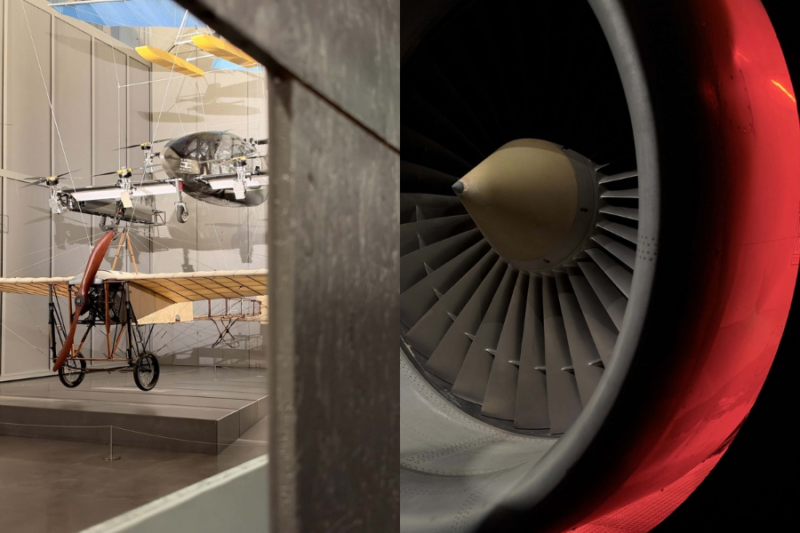
Then there’s Task Eternal, the centrepiece of the opening program and an enormous exploration of aviation and space.
It’s easily one of the most ambitious exhibitions I’ve encountered in Australia. Rather than following a conventional timeline of aviation history, it explores humanity’s fascination with the sky through scientific achievement and cultural imagination.
There’s a fantastic hit of nostalgia in the Qantas section, where a bright red room is filled with memorabilia from the national carrier’s past, including vintage Business Class seats and cabin crew uniforms. It’s a colourful reminder of just how integral Qantas has been to Australia’s aviation identity, particularly as international travel became more accessible to generations of Australians. The exhibition then opens into a staggering display of aircraft engines, with dozens of them assembled in one enormous space. Among the highlights is a Rolls-Royce jet engine that once powered Qantas Boeing 747-338 jumbo jets, the aircraft that helped define the golden age of long-haul travel for so many Australians.
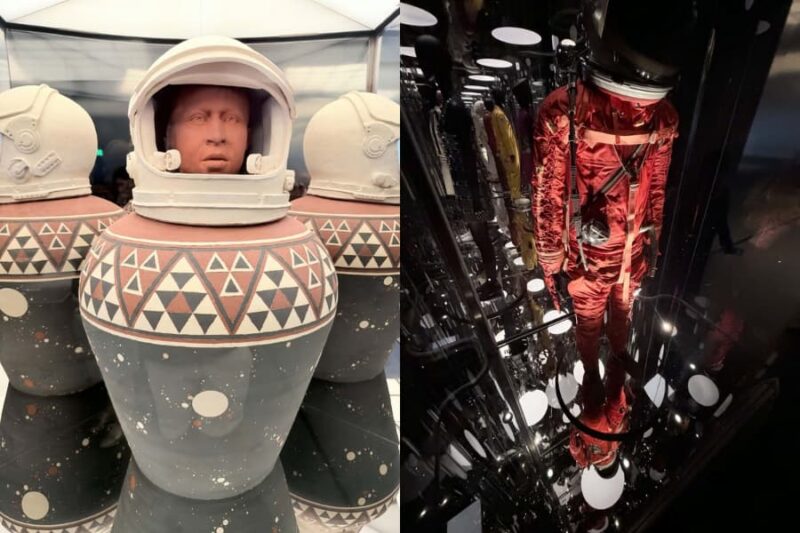
The collection is staggering. Four Leonardo da Vinci drawings have travelled from Milan, while loans from the Smithsonian’s National Air and Space Museum include an Apollo command module test model. There’s even the spacesuit worn by William Shatner on the Blue Origin, heightened by an eerie voiceover from the Canadian actor on what he witnessed in space.
But what interested me most was the exhibition’s willingness to challenge the familiar story of aviation and space exploration. Indigenous knowledge is given its rightful place alongside the technological achievements usually associated with Western institutions. A historic boomerang collected from the Parramatta area in the early 19th century, on loan from the British Museum, offers an important reminder that sophisticated aerodynamic knowledge existed on this continent long before European settlement.
Elsewhere, The Mall explores the shopping centre as a cultural institution, using retail history and suburban nostalgia to examine consumer desire and community identity. There’s a recreation of the famous Roselands shopping centre fountain, while material from the David Jones archives connects the exhibition to Australia’s changing retail culture. There are also references to R.M Williams amongst other iconic Aussie retail moments.
It’s a clever subject for Parramatta, where the shopping centre has played such a prominent role in the city’s identity.
Families will gravitate towards The Dark, an exhibition for children aged four to 12 housed inside a gigantic replica meteorite stretching more than 22 metres. Photography is prohibited inside, with visitors required to put their phones away before entering.
High above the museum, American artist James Turrell’s Shangri La (Over The Hump) is another highlight of Task Eternal. Part of his celebrated Ganzfeld series, the immersive installation surrounds visitors with shifting light and colour, gradually dissolving any sense of depth or distance.
It’s a fascinating exercise in sensory perception, where the absence of a visible horizon makes it difficult to tell where the room actually begins or ends. There’s a clever connection to the exhibition’s broader fascination with flight and space, particularly the disorienting experience of looking out into an apparently endless expanse.
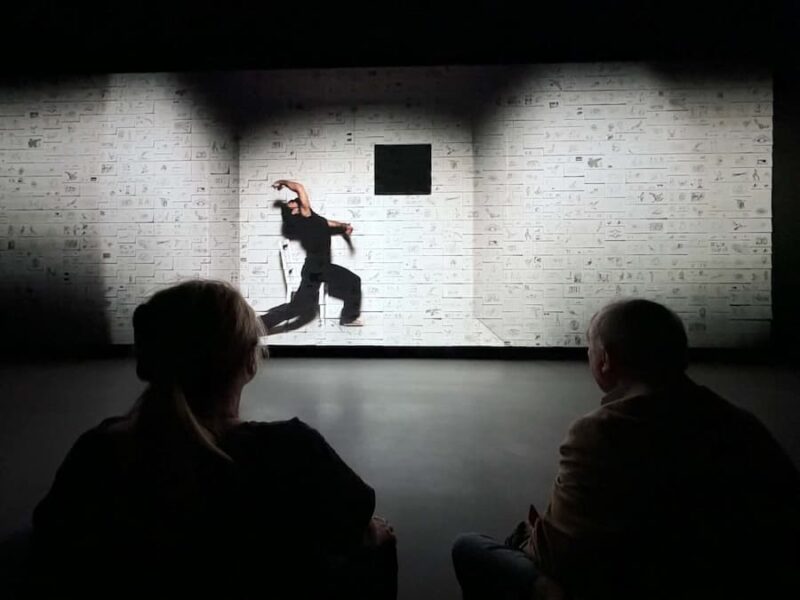
Es Devlin’s The Turning is worth the trip alone
But it was Devlin who made the strongest impression on me.
I was at Design Festival Homo Faber in Venice this September, where I saw what the British artist is capable of when given the freedom to curate an immersive environment. There’s a similar atmospheric quality to The Turning, her first major Australian exhibition, where ambient music heightens the experience of moving through five interconnected installations.
Devlin has spent decades designing elaborate stage productions for artists including Beyoncé and Kanye West, but her own installations are just as theatrical. Here, she’s interested in how we see ourselves in relation to others, and how drawing can become an act of attention and exchange.
The mirrored labyrinth of Forest of Us is extraordinary, using reflections to disorient visitors and make them reconsider their place within a larger living system. Its branching forms draw a connection between the trees around us and the structures inside our lungs.
Memory Palace takes a different approach, using an intricate three-dimensional landscape to map moments that have changed human thinking across thousands of years. The Australian iteration includes significant sites such as The Block in Redfern, giving local history a place within Devlin’s wider exploration of human imagination.
Then there’s ScreenShare, where a cinema screen is assembled from 1,500 sketchbooks spanning three decades of Devlin’s career. A film of Vietnamese choreographer Dam Van Huynh dancing alongside projections of his younger self plays across those accumulated drawings.
There’s even a reference to Devlin’s stage design for Kanye West’s Saint Pablo Tour hidden among the sketches.
I asked Devlin about her relationship with West, whose brilliant work has become, at least to those who don’t understand the context of psychosis, inseparable from his increasingly controversial public behaviour. She was candid about his influence on her career, telling me that his drive and determination helped shape her own creative ambition. She also made clear that acknowledging his contribution to her artistic development doesn’t mean endorsing his behaviour.
The sketches make it possible to trace how individual collaborations have fed into a much larger creative practice.
ScreenShare also has a generous purpose. Visitors leave with a drawing of their own, completing an exchange begun in Collective Portrait, where they’re invited to contribute their own marks to a shared artwork. In Collective Portrait, strangers sit opposite one another and spend 15 minutes drawing after sustaining eye contact. It’s a deceptively simple exercise in paying attention to another person, something that feels increasingly unusual in a world where our attention is so often elsewhere.
Devlin wants people to recognise creativity as something that passes between us, gathering meaning through participation. The exhibition asks visitors to give something of themselves, then leave with something another person has made.
Outside, Come Home Again extends that thinking into a choral performance centred on the endangered species represented in Devlin’s sculpture. It’s another expression of her belief that imagination can change how we relate to the living world.
Powerhouse Parramatta’s opening festival runs for 23 days
The museum’s opening celebrations run from 7 to 29 November, with more than 170 events spanning performances, talks and workshops. Local voices will feature alongside international artists, with Western Sydney’s Bankstown Poetry Slam among the participants.
Four of the five opening exhibitions are free, while Task Eternal is ticketed for adults. Visitors under 16 can access all five exhibitions free of charge.
Powerhouse Parramatta has attracted plenty of controversy over its cost and ambition. Those questions deserve scrutiny, even after the doors open.
But walking through the museum this morning, I found myself thinking about how rarely Western Sydney has been afforded this kind of cultural investment. The building is extraordinary, and the opening exhibitions suggest the curatorial ambition is every bit as serious.
Powerhouse Parramatta opens Saturday, 7 November 2026, at 34 Phillip Street, Parramatta. Its opening festival runs until 29 November, with many events free to attend.
