

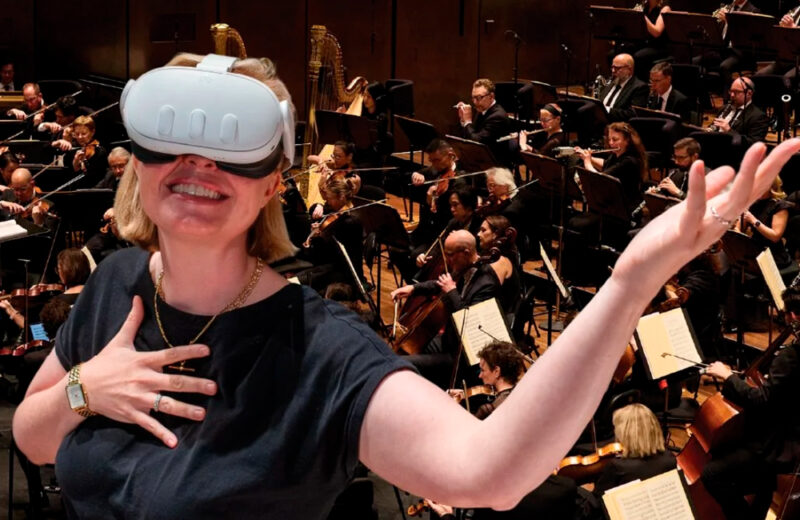
Have you ever wanted to know what it might be like to perform with one of the world’s most lauded Symphony Orchestras? Now is your chance, with the immersive VR experience at the Edinburgh Fringe, Concerts of the Future.
A collaborative experiment between The Sonicrats and the MSO (Melbourne Symphony Orchestra), Concerts of the Future sees participants – five at a time – journey from the lobby of Summerhall through three spaces.
In the first, guests are handed an iPad where an impressively designed interface helps decide which instrument will be allocated to you. In the next room, you get to meet that instrument, and learn how to use it. All the instruments are 3D printed structures, with a small motion controlled digital unit built into it. My instrument was called a “Fluctos”. It was long, almost flute like, with an interweaving design running through. It looked like something you might find in Rivendell in Lord of the Rings.
Movement of the device – speed, intensity, direction etc. – would change the tone and the sound that came out of the speakers. Some instruments hit higher pitches, like mine, and others hit lower frequencies, like that of my friend. Playing it right side up or up side down also changed what you heard.
Once you got comfortable with the instrument, and you watched a video that explained more about the experiment, it was then time to move to the final space and put it to work. Here, you sat on a swivel chair with a VR headset, and were welcomed on stage with the MSO to perform Beethoven’s “Symphony No 7” with your new fangled musical instrument.
The experience of sitting on stage and hearing the Symphony play around you was worth the price of admission alone. They’ve done an impressive job with this. Those who they filmed on stage are aware of your presence, encouraging you as you play along. The opportunities with the technology, both in and out of education, are endless.
It’s a great way to encourage people who otherwise don’t have access to Symphony orchestras. And if just one person leaves the experience thinking “I’d love to do this”, then what an amazing outcome that would be. Furthering on that, it’s also a chance for Symphony Orchestras – a notoriously difficult entity to tour outside their home city – to play to audiences who wouldn’t otherwise have the opportunity to see them perform. And if one person does go see the MSO when they’re in Australia because of this experience, then likewise – what an amazing outcome.
I would actually love to see what the experience is like with a real instrument, however, as it’s hard to argue that the sounds you’re making in the room are adding positively to the aural experience. While the instruments have been designed to play alongside Beethoven’s classic Symphony, they do sound out of place. And while my instrument was audible, my friend’s – with much lower tones – was not. This unfortunately means that the experience is not going to be the same for everyone in the room. And if it’s a full room, with all five instruments running at once, I imagine it could sound like quite a jumble of noise.
But that doesn’t take away from how fun the whole experience is, and the opportunity that VR can bring for the Symphony experience. I’ve never participated in anything like it, and that’s a rare thing these days. Taking up just 30 minutes of your time, it’s worth checking out. I’ll also be interested to see what they learn from it all, in terms of how people engage. Just like the instruments themselves, everyone’s relationship with music is different. But hopefully you’ll leave the experience with a little inspiration, and at the very least, with a well orchestrated (pun intended) look at what it means to sit in with one of the world’s best orchestras.


FOUR STARS (OUT OF FIVE)
Concerts of the Future continues at Summerhall during the Edinburgh Fringe until 31st August 2026, except the 17th and the 24th, with five spots available every half hour from 1pm to 530pm.
For tickets for more details about the experiment, head HERE.
The author attended on 14th August 2026.
