

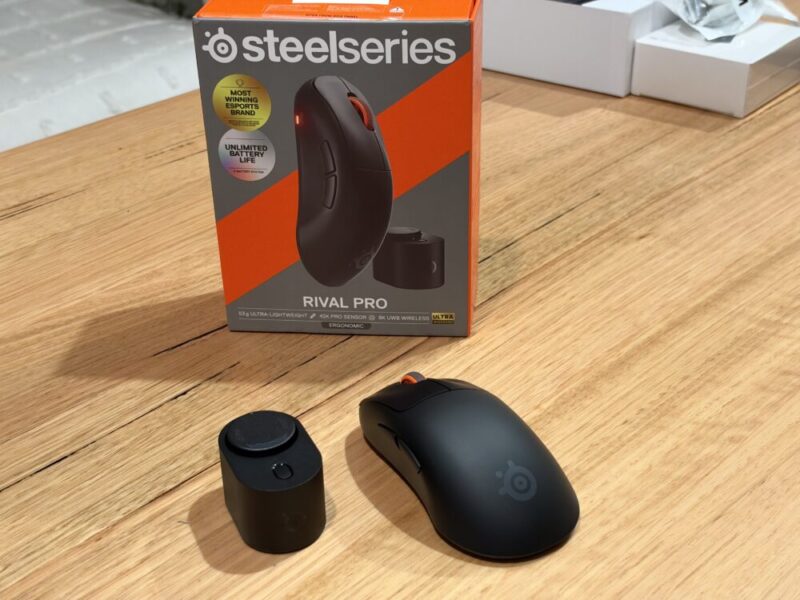
SteelSeries is no stranger to some seriously premium gaming peripherals, and their new range of gaming mice certainly fits the bill. Their new Pro series, featuring the Sensei and Sensei Pro Mini, along with the Rival Pro and Rival Pro Mini, provides almost anything you could want from a mouse, including virtually unlimited battery life. With a premium price tag to match, it’s really hard to argue with the results.
It is worth noting that we are reviewing the Rival Pro specifically, but we will touch on the similarities and differences between the Sensei Pro and Mini models along the way.
Design
Available in Black or White, the Rival Pro is the ergonomic mouse in this new range, differing from the Sensei Pro, which features a symmetrical design. As such, the Rival Pro features a design that dips inwards towards the right thumb and brings its hump or peak on top to the right-hand side as well. I tend to grip the mouse a little flatter where possible, so I really feel like this is not only the most comfortable option, but the one I would choose to use on a daily basis anyway.
This is a right-handed mouse, though, so left-handed gamers might unfortunately have to settle for the asymmetrical design of the Sensei Pro, unless you’re fine with using the mouse in your right hand. Both the Sensei Pro and Rival Pro also feature Mini variants, which are a little shorter and lighter. That being said, while the Rival Pro does feel like a larger mouse, it does feel like the perfect size for adult hands, unless you prefer more of a claw grip.
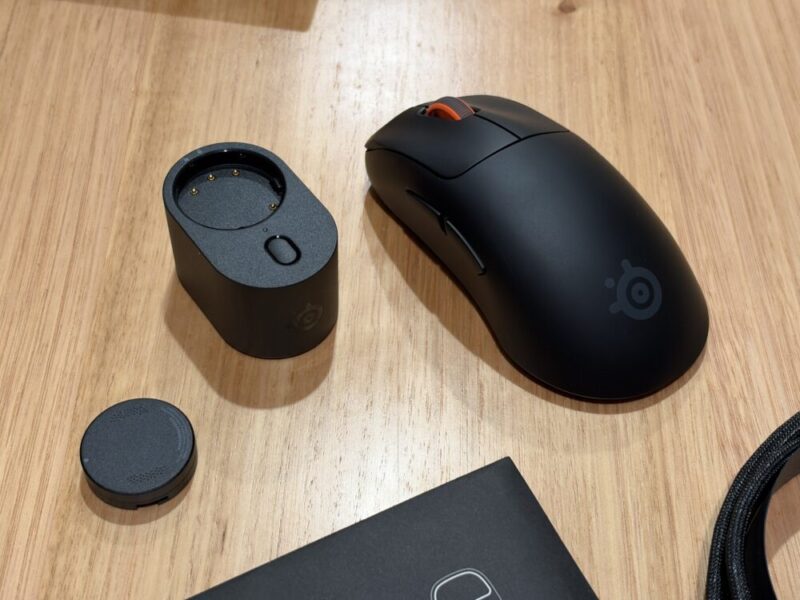
The Rival Pro, along with the Sensei Pro, is also quite a lightweight mouse, clocking in at just 53g, which is undeniably lighter than most gaming mice on the market. It isn’t the lightest, though, so if you’re really paying attention to the weight, there are similar options like the Corsair Sabre v3 Pro, which clocks in at just 41g. That’s really not a massive difference to most of us, but you do find you get used to that feeling, as it was the mouse I was using on a daily basis prior to this review.
From a design perspective, the Rival Pro is rather minimal, featuring your standard left and right buttons, along with two buttons along the inner left-hand side. I’ve previously mentioned that I’m not a fan of mice with plenty of buttons and RGB features, so as you would expect, I’m a massive fan of the way it looks.
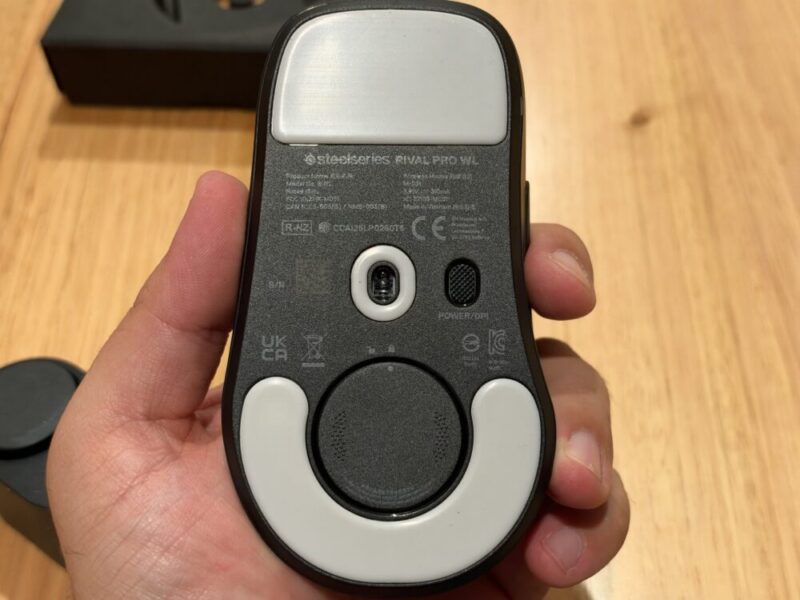
While there’s no USB-C or charging port to be found (which we’ll touch on soon), you will find a single button under the mouse, which acts as the power, pairing, and DPI button. You’ll find a small round battery under the mouse, which can be removed by simply twisting it to the left to unlock it, and back again to the right to lock it in place.
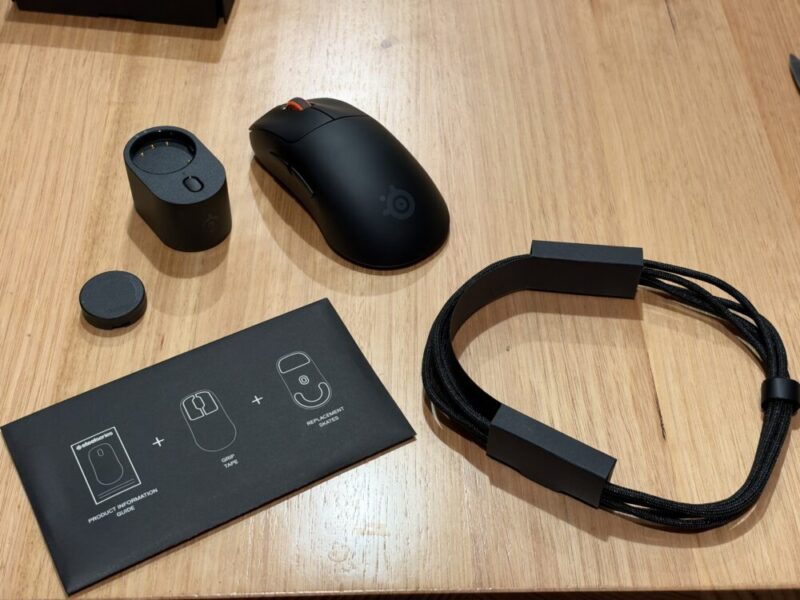
Also included is the Ultra Wideband (UWB) Wireless Base Station, with an additional battery, a 2m USB-C to USB-A cable, grip tape, and an additional PTFE skate set.
Performance
Featuring the SteelSeries TrueMove 42K Pro Optical Sensor, you’ll get a crazy 8,000Hz polling rate, adjustable sensitivity from 100–42,000 DPI and 70G max acceleration; I don’t think you could ask for much more in a gaming mouse.
Of course, it can be overkill for most casual users, but the ceiling here is so high that it’s such a great investment for various games and gamers alike. You can even customise this down to the lift-off distance. With a range of 0.7-1.7 mm, you can play with how responsive the mouse feels as soon as you move it, in minuscule 1 mm increments.
It’s just so responsive and satisfying to use as a result, and in tandem with the lightweight design, it glides like a dream. After using it for a couple of weeks, I’ve been trying to find the words to summarise this mouse, and I don’t think I can say it’s one of the best gaming mice I’ve had the pleasure of using.
Battery
The battery, like other products in the SteelSeries range, including the Arctis Nova Pro Wireless and Elite headsets, is virtually unlimited. This is indeed thanks to the included Ultra Wideband (UWB) Wireless Base Station and additional battery, which essentially allows you to hot-swap the batteries as you use it, leaving the other one to charge in the station. It’s a great feature, and assuming you don’t have any issues with one of the batteries, it will make traditional charging a thing of the past.
This does explain the lack of a USB-C port, and while you might think it’s still a valid inclusion for the sake of a wired connection to increase responsiveness, you only need to look back at that Ultra Wideband (UWB) Wireless Base Station to see why the port isn’t there.
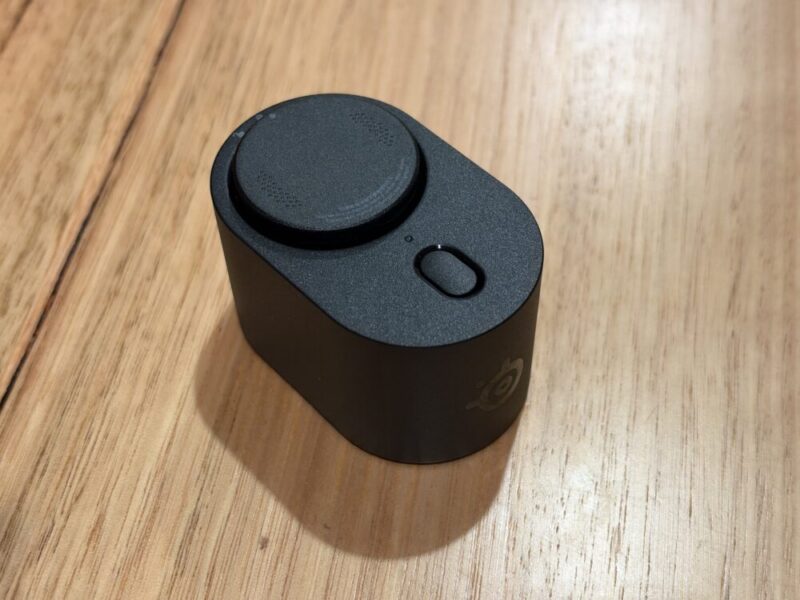
Each battery will last you up to 120 hours on a 1K polling rate and up to 16 hours on an 8K polling rate, the latter of which feels much more accurate. While this doesn’t feel like a massive amount, swapping the batteries is so easy that you can do it in around 5-10 seconds, and you’re off and running for at least another 16 hours.
Software
Like every SteelSeries peripheral, you’re also able to connect the Rival Pro to your PC via the SteelSeries GG Engine companion program to customise any commands, and even adjust things like DPI, polling rates and lift-off distance to your liking.
There is only one on-board profile, though, meaning you’re not able to swap between sets of pre-configured commands on the fly, but as I rarely do it myself, I’m willing to give it a pass.
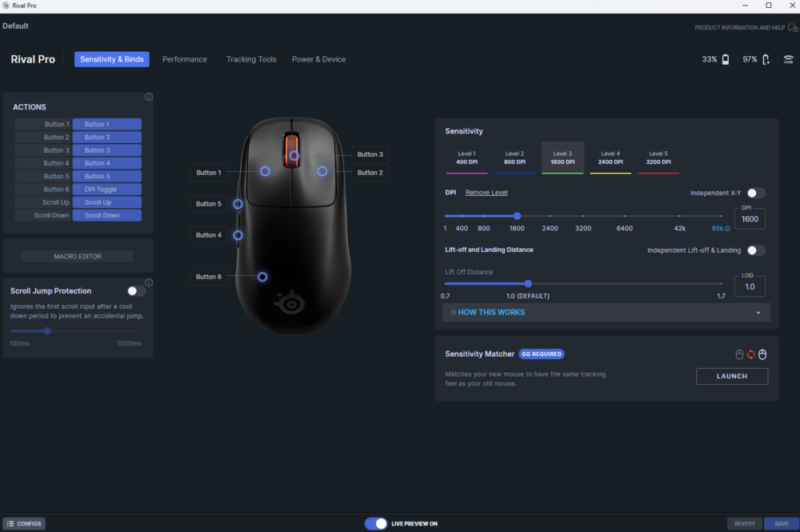
Overall, the program is easy enough to navigate, and the Rival Pro is incredibly easy to customise.
Vedict & Value
The SteelSeries Rival Pro is one of the best gaming mice I’ve ever used, and more than justifies its premium price tag.
With its comfortable ergonomic design, responsive performance, and virtually unlimited battery life, it’s made for any gamer looking for their next big upgrade.


FOUR AND A HALF STARS (OUT OF FIVE)
Highlights: Sleek and ergonomic design; Easy to set up and satisfying to use; Unlimited battery life is incredible
Lowlights: There are lighter gaming mice out there if you’re prioritising weight
Manufacturer: SteelSeries
Price: A$299
Available: 26 November via the official SteelSeries website
Review based on unit provided by SteelSeries.
