

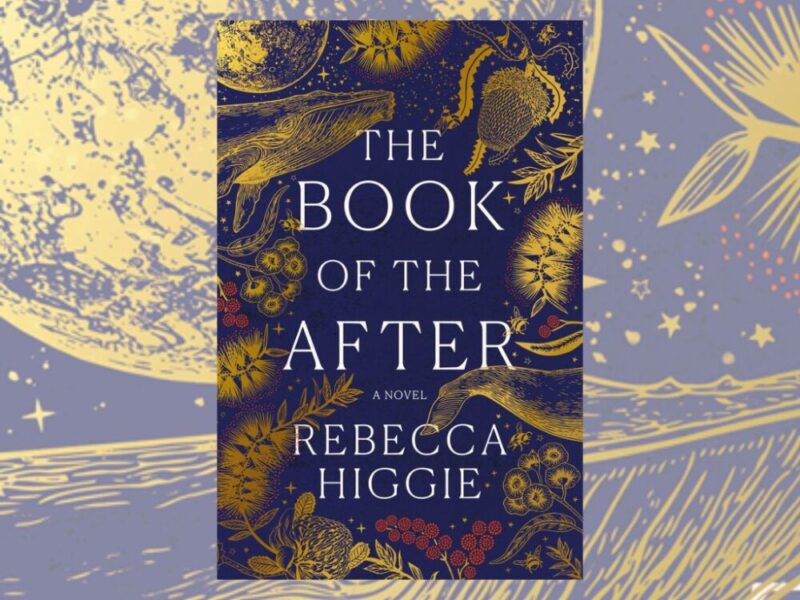
Rebecca Higgie‘s second novel, The Book of the After, is big.
I don’t mean in terms of its size, although at 560 pages, it is definitely on the larger side.
No, what I mean is The Book of the After is big in terms of concept. Spanning continents and thousands of years, this novel is about grief, love, hope and climate change. The sheer scope of the novel is breathtaking.
In the not so distant future, Australia 2049, after the country has been plagued by deadly bushfires and soaring temperatures and elected members feel compelled to be active members of fire fighting brigades, a shocking act of political violence rocks the country. Negus Kebede, scarred physically and emotionally by the Year of the Fire, finds himself the reluctant Prime Minister of a nation in crisis. The planet is still burning. Billionaires look beyond the Earth’s atmosphere for solutions. Protests and natural disasters dominate the news. Through it all, Guy Fawkes, a man whose name is forever associated with violence and protest and rebellion, and a whale who was named Otto by the people who strung his bones up in a museum, watch events unfold from the After.
Negus has been fascinated all of his life by a book, The Book of the After, which is a book of the dead and seeks to explain what happens to people after they die. He has read it so many times, but when the woman he loves is killed, he finds himself questioning. If what the book says is true, he will see her again. If it is not, and all he has is memories of her, then perhaps he is truly alone. The question tortures him, even as he must lead the country and the people who cling to an image of him that feels less real by the day.
The Book of the After is a powerful novel which gets at the heart of why stories, and memory, and learning the lessons of the past are so vitally important. Rebecca Higgie is an author with an awe-inspiring capacity to think about the big picture. Rebecca’s work ties past with present with future, and she is a writer who can see connections between things that others either miss, or take for granted. This was true of her Fogarty award winning novel, The History of Mischief, and it is true of her latest work, The Book of the After, which in my belief, is a novel that is destined to become a modern classic. I feel as if it should be mandatory reading for all of our elected members, at all levels of government. It is a book which takes the far off problem of addressing climate change and makes it feel immediate – and by attaching this message to a compelling story that is in turns dark and hopeful, one which I hope will move readers to action.
A deeply visual book which traverses the halls of Parliament House in Canberra, lies on the wooden floor of Hackett Hall at the WA Museum Boola Bardip, jogs around Kings Park overlooking Perth’s Swan River and rockets into space, the great skill that Higgie has shown is in taking the familiar and using it to craft a future that feels distinctly possible. This does not seem like the dystopian climate fiction which shows us a barren wasteland hundreds of years in the future, but a reality twenty years away which seems almost inevitable at points. Temperatures which have soared, technological changes, changes to our skylines, issues with the supply of food and water and medicine, and through it all, a desperation in the way that societies cling to any political figures who seem to offer them hope that things might improve. 2030 is the end of the critical decade in which the United Nations called for action on the Sustainable Development Goals in order to address some of the world’s biggest challenges – poverty, gender equality, climate change – The Book of the After shows a very real prediction of what things will look like if we fail, and if governments fail to take appropriately proportionate action. The efforts of individuals do matter, but only efforts at the scale that governments can initiate will be enough to tip the scales.
On top of this, Higgie’s novel is a reflection on cultural memory and myth-making which engages with recent events, such as the Black Saturday bushfires (and Morrison’s assertion that he doesn’t hold a hose, mate) and the cults of personality around political figures which emerged online during the COVID-19 lockdowns and border closure period, such as ‘State Daddy’ Mark McGowan and Daniel Andrews (who had his statement about getting on the beers turned into a song). The story begs the question – who gets to be remembered, and why? Alongside this, it asks the reader to consider what the impact of a long remembrance is on divorcing a person’s remembered self from the person they might have been to those who loved them. At what point does a person shift from someone who was a father, brother, husband and friend to a symbol?
At its heart, this is a love story, but it is also a powerful warning about climate change, and about not learning the lessons of the past. Reading it, I felt myself obsessed, or perhaps possessed, carrying the characters and ideas around with me even when I could not sit down with the book. I saw parallels from the novel to real life everywhere I looked, and reflected often on the way that history is made.
The Book of the After is a novel which speaks the important truths some of us might not even have the words for yet.
It is my book of the year so far, and one which I think will be hard to beat.

FIVE STARS (OUT OF FIVE)
The Book of the After by Rebecca Higgie is out now from Fremantle Press. Find a copy at your local bookstore HERE.
