

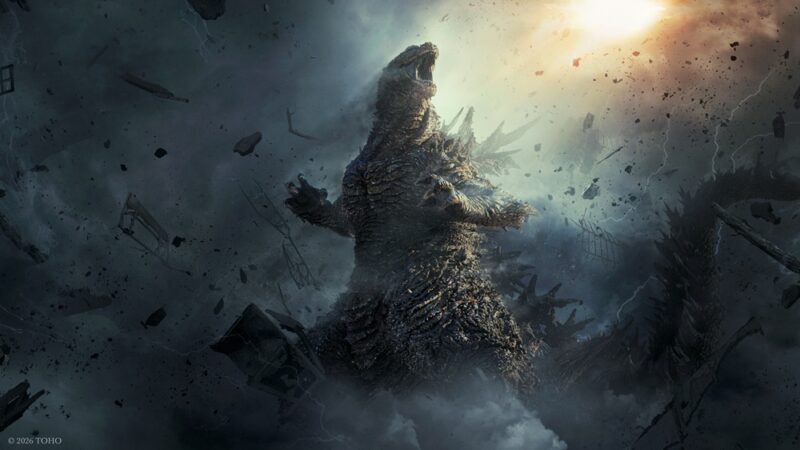
There is a long legacy that Godzilla Minus Zero must live up to. The original Japanese Godzilla film was released in 1954, over 70 years ago. According to the VFX team for this 39th film, Godzilla Minus Zero:
Godzilla was born on the silver screen in 1954, created specifically to be experienced in a cinema. To deliver the ultimate sensory visual experience that can only be felt in a theater, every creative layer was built with a ‘theater-first’ mindset. Technical skill and passion have been poured into every element – visuals, acting, acoustics, and drama – to craft a Godzilla movie that must be experienced firsthand. Only in the cinema does Godzilla truly become Godzilla.
And it indeed needs to be experienced in this way to have that full sensory explosion of Godzilla in all its might and power – something that audiences have come to expect with any Godzilla film. And on that note, Godzilla Minus Zero is a worthy contribution to the legacy of this cinematic monster and provides just as much action as it does colossal storytelling.
Godzilla Minus One was released in 2023 and received an Academy Award for Best Visual Effects. Godzilla Minus Zero, a sequel if you will, takes place a short two years after, where the Japanese citizens are learning to manage rebuilding a life after (seemingly) destroying Godzilla. However, they are now posed with a new threat (that would be, a new kaiju, that will not be revealed here).
Returning to this story is the Shikishima family (Koichi Shikishima played by Ryunosuke Kamiki, Noriko Shikishima played by Minami Hamabeand, and little Akiko Shikishima played by Sae Nagatani). Their story is central to the heart of the film and reflects the strong bonds of family. New characters include Professor Kanji Murakami (Min Tanaka), who carries a heavy burden and trauma of Godzilla’s first attack, explored in the new interactions with the monster.
It is the lived experiences of these characters, both in flashbacks, dream sequences, and present narrative, that makes this Godzilla addition so uniquely Japanese. Although the monster VFX is nothing short of spectacular, the story lines are central and at certain times greater and more meaningful than the spectacle of the kaiju.
Director, Takashi Yamazaki, has revealed that he wants Godzilla Minus Zero to carry more weight; “Rather than a hero carrying a noble cause, I wanted to depict them as relatable individuals whom anyone would want to protect. Instead of trying to save the world under a grand premise, by depicting humble, almost egoistic desires… I aimed for a structure where that turns around to highlight the wish of all humanity.”
Some of the themes explored are relative to the Japanese lived experience, especially considering that this film is set in 1949, postwar. This is explored particularly with the character of Professor Kanji Murakami, but also with the Shikishima family.
In a first in the history of Japanese cinema, Godzilla Minus Zero is filmed for IMAX, and will be released as such. Although the story is central to the film, note that the budget is bigger, hence more spectacular action scenes to satisfy fans. And with that, VFX, sound and music are exemplary and allow a fully immersive experience but of course, never eclipses the narrative and character journey.
As mentioned, there is a new kaiju that faces off with Godzilla and it is quite the spectacle, but nothing more will be revealed here as experiencing it first, in IMAX no less, is way more fun.


FOUR STARS (OUT OF FIVE)
Godzilla Minus Zero is screening in Australian theatres from November 5th, 2026, following special Godzilla Day previews on November 3rd. It will also receive 4DX and D-BOX sessions from November 10th.
