

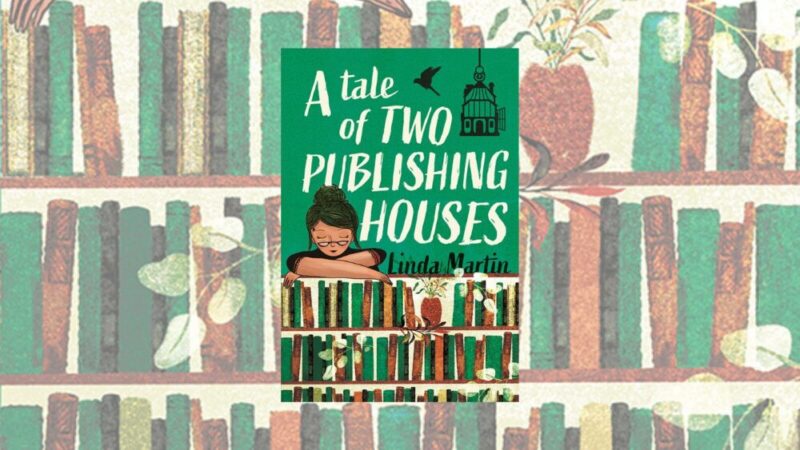
It’s a niche subject, the history of Australian publishing. Even more so when you take regionalism into account, and choose to focus on the history of one of Western Australia’s oldest publishing houses alongside one of its newest. But this is exactly what Linda Martin has done in her debut book as an author, A Tale of Two Publishing Houses.
One of the book’s subjects, Fremantle Press, is also the publisher for the book – a fitting project given that they turn 50 in 2026, and have been using the opportunity to look back on their legacy, while simultaneously looking forward to the future as they moved into their new permanent home on Parry Street earlier this year.
As Martin notes in her book, fifty years ago when Fremantle Press began, a critic predicted that they would soon run out of authors. Yet, nearly four decades later, Martin and fellow editor Laura Keenan felt that there were so many voices with stories to tell that they founded their own publishing house, Night Parrot Press, which focuses on tiny, powerful stories in the form of the flash fiction, micro fiction, micro memoir and novellas which otherwise struggle to find a home.
Martin, having edited a number of other books in her career as well as working at several Western Australian publishing houses, is no stranger to the struggles writers face. Drawing on her own experience of working at Fremantle Press as a publishing coordinator, and her role as one of the co-founders of Night Parrot Press, her work is part history, part memoir, but one hundred percent readable. For those sceptics who may look at the subject of this book and think it too narrow to be of interest, it may prove to be a pleasant surprise, as Martin documents the process of interviewing key figures from the early days of Fremantle Press, including Ray Coffey and Clive Newman, as well as her research in archives. She reflects candidly on the frustration and elation of her discovery process, and is honest in depicting herself as a passionate advocate for WA writing with skin in the game.
There are no rose coloured glasses here. Martin does not shy away from talking about some of the less glamorous aspects , neither in the fifty years of Fremantle Press, nor the five-odd of Night Parrot. She documents the exhaustion, the clashing of egos, the financial strain, the disparagement of critics, the challenge of marketing books to the monolithic Eastern States publishing world. This is not so much a story of the underdog coming out on top as a celebration of what a community can do when there are people willing to do the hard work, and while Martin may be self-deprecating towards herself and the roles that she played, she is warm and appreciative of the people she has crossed paths with – even those who decline to be interviewed, or who have passed away prior to the beginning of the interview process, who she constructs a picture of as best she can whilst remaining respectful of their inability to respond to her analyses.
This is a book that will have you racing out to track down some of the earlier Fremantle Press titles mentioned- A B Facey‘s A Fortunate Life, the success of which ensured that the publishing house would see itself established on the national stage, and Sally Morgan‘s My Place – being the two major books which mark the early days of Fremantle Press.
Perhaps because of Martins’ closeness to the subject or perhaps due to the passage of time, she reflects less on the significance of the early titles produced by Night Parrot Press, and more on the joy of creating them, though Ros Thomas‘s How to Shame the Devil does find itself noted as a major publishing event, the success of which surpassing Martin and Keenan’s wildest dreams. Every reader who is familiar with Fremantle will surely have their own catalogue of favourites, and I could have read many more chapters reflecting on books which have been significant to my life, or from later decades.
A must read for Western Australian readers, and a book I hope will find its readers in other states as well, this is a charming, eminently readable book not only about the story of two publishing houses, but about Australian literature, and therefore about Australian readers. What has captivated us, what has moved us, what has entertained us.
If you enjoyed The Books that Made Us – either the ABC documentary series with Claudia Karvan, or the book by Carl Reinecke – then this one is for you.

FIVE STARS (OUT OF FIVE)
Linda Martin’s A Tale of Two Publishing Houses is out now through Fremantle Press. Grab yourself a copy from your local bookstore HERE.
