

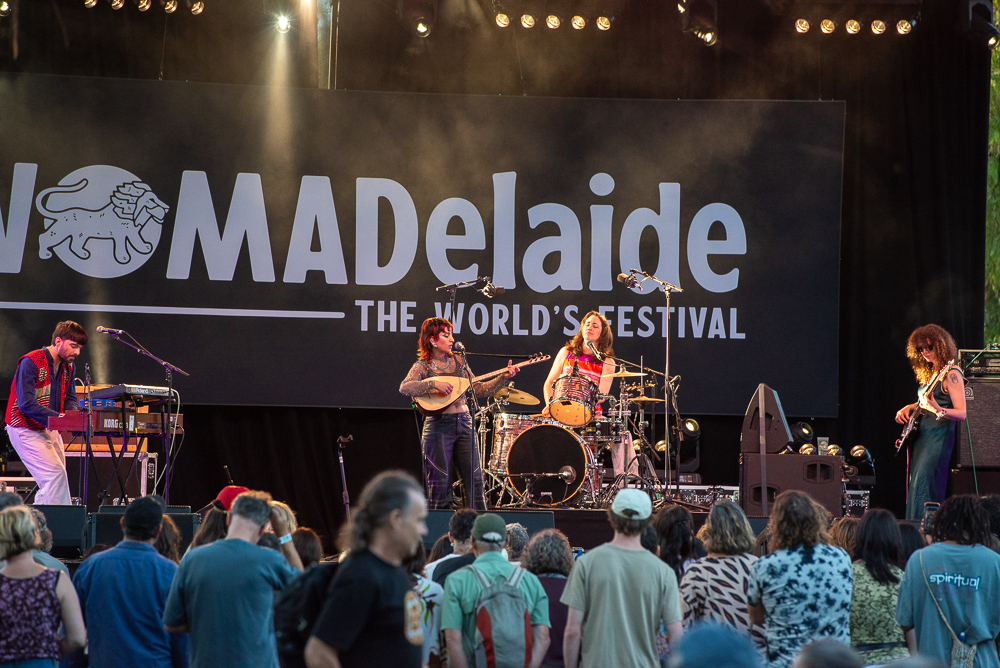
In 2026, the multicultural festival was an antidote to big tech’s flat pitch.
Kankawa Nagarra is turning 80 in June. She says you’re invited to her birthday party, if you can get yourself to Fitzroy Crossing. At WOMADelaide on the weekend, I listened to the Walmatjarri, Gooniyandi and Bunuba Elder yarn with Darren Hanlon under the eucalypts in Adelaide’s Botanic Park. Nagarra fell in love with guitar music after hawkers visited her station to sell wind-up gramophones and Buddy Holly LPs. She recalls a childhood “on the edge of the desert”, where she’d creep out into the men’s camp and fall asleep in the laps of the elders at night. By the campfire, the men would continue their songlines ‘til daybreak.
Nagarra and Hanlon performed selections from the Australian Music Prize-winning LP they recorded together, Wirlmarni. Hanlon says, “For me personally, even singing words that I don’t understand, on the actual land where these words were spoken for way longer than English, has a really spiritual effect.”
The night before, I watched a teenager raise an orange digital camera in front of Yothu Yindi performing “Treaty” on its 35th anniversary. I wondered if she felt the same way.
This long weekend was an easy distraction from the artificial-intelligence arms race I usually follow when I’m home. Language is one of the friction points some tech prophets like to say AI will sand down. Last September, Apple’s Airpods Pro 3 were launched with the capability to “seamlessly” translate foreign conversation for their wearer, as assessed by the New York Times. OpenAI and Google’s Gemini followed suit with similar services.
Writing for The Atlantic, professional translator Ross Benjamin detailed the cost of flattening this linguistic divide: “the negotiation between different ways of structuring the world, the humility and curiosity that come with navigating a foreign context.”
At WOMADelaide, I felt my head slow down as curiosity took over. Saturday afternoon, I sat cross-legged with a crowd of 800 people, beneath about 800 cross-armed bats, dripping from their pine-tree canopy. All of us were transfixed by Tamil Nadu vocalist Ganavya. Singing in English and Tamil, her voice moved like a weft, interlocking with bass, harp, breeze, birdsong, to produce something silken and strong.
Like Kankawa Nagarra’s ancestors, using songlines to preserve knowledge embedded within Country, Ganavya explained that according to pilgrimage traditions, setting poems into song lyrics helps keep them in your body. She performed “Land” – lifting words from Palestinian poet Suheir Hammad, and “Pasayadan” – using text from a Hindu prayer that wishes for sunlight to soften cold hearts.
At the front of the stage, I watched a man in a crisp Australian Open cap hanging over the metal barricade and tapping out the rhythms to each song. All weekend, it felt like the audience shared a sense of real gratitude for these performances. The expanded Middle Eastern conflict barred several artists scheduled to play WOMADelaide from flying into Australia on time. Others represented the diaspora of presently wartorn countries, like Ukrainian electro-folk siren GANNA. On Friday night, her euphoric set ended with a direct address to the crowd of dancers: “When there are so many ways of being separated… places like this give hope that after all, somehow, everything is going to be better.”
Surveying the field of picnic blankets abandoned to take part in a “Mami Mambo” with ex-Buena Vista Social Club pianist Roberto Fonseca, I considered the apparent music discovery drought which sprouted federal campaigns like #Ausify and Music Australia’s “Listening In” research last year. In the Guardian, critic-journalist Liz Pelly wrote about the rise of AI-powered products which claim “to ease the daily burdens of reading, writing, researching”, to the point where the joy of assembling a playlist and building your own music taste is framed as an inconvenience. “But this is the work that helps shape how we think, how we make connections, what we remember and what we forget,” she warned.
On Sunday evening, I bounced along as Baker Boy intercut the hip-hop bombast and metallic guitars of his latest album, Djandjay, with his early breakout hits. Golden hour gave way to dusk and a digitally-rendered sunset blazed behind his staunch figure in motion: nailing explosive dance combos, rapping from platforms fringed with outback grass, aiming his Yidaki at the sky. With lyrics in Yolnu Matha, Burarra, and English, the former Young Australian of the Year sends a clear message: mastering language – holding it, bending it, unleashing it – is a flex.
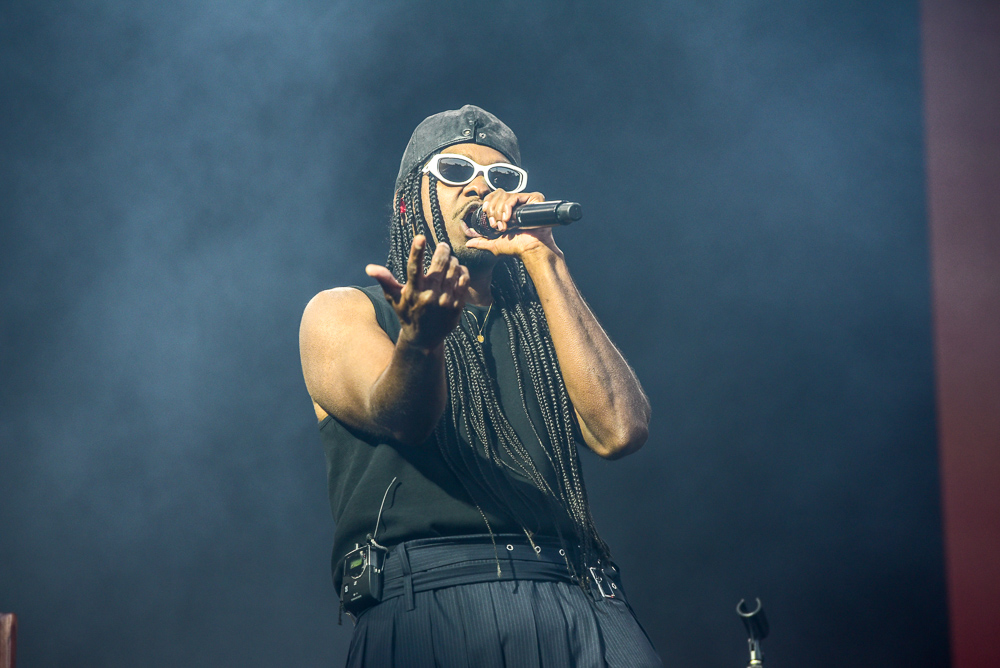
I watched the performance next to two of the coolest punters on-ground: a pair of tween girls with identical halter tops and henna designs snaking around their wrists.The older one said to the younger: “‘Meditjin’ is his best song”. Her confidence reminded me that understanding is not the only way to know the power within a performance.

This feature has been published as part of The Music Writer’s Lab initiative, supported by Music Australia, WOMADelaide and the VMDO. For more information, visit www.themusicwriterslab.com.
Photos from John Goodridge
