

It’s hard to imagine something so beautiful can come from something so… ugly.
And yet freedom is an ecosystem that rarely functions without friction. It’s the endpoint of a long, arduous and often cruel journey, and the beginning of a life so wonderfully and exclusively yours that it’s impossible not to take the good with the bad.
Such thinking makes suffering seem like an essential prerequisite for freedom. It’s not. But a freedom that is earned through struggle moves differently. It has an outsized impact.
The cold, brutal realities of African-American slavery in the Deep South were, are, always will be, unacceptable and unjustified – a distinct lack of humanity that has marked American history with a deep and persistent shame.
Yet from a very bad thing came a very good thing: the sound of freedom.
I’m not talking about the freedom you get from big city living or true artistic expression. Nor am I talking about the freedom of unfettered free speech. I’m talking about the kind shaped by contrast, supercharged by centuries of oppression. That’s the kind of freedom that changes the world. That enlivens culture. That creates movements and music that have given life so much meaning for so many people.
It’s a pervasive absence of inner-tension.
And so what happens when an entire location is paved with the abstract feeling of complete and utter relief? Freedom can also be an atmosphere.
If freedom really is infectious, I’ve found Patient Zero
Patient Zero is not a human being, nor an individual entity. It’s not something you can buy at Walmart for $9.99 or find at the bottom of a salt-rimmed glass at Jewel of the South. It’s certainly not the Statue of Liberty.
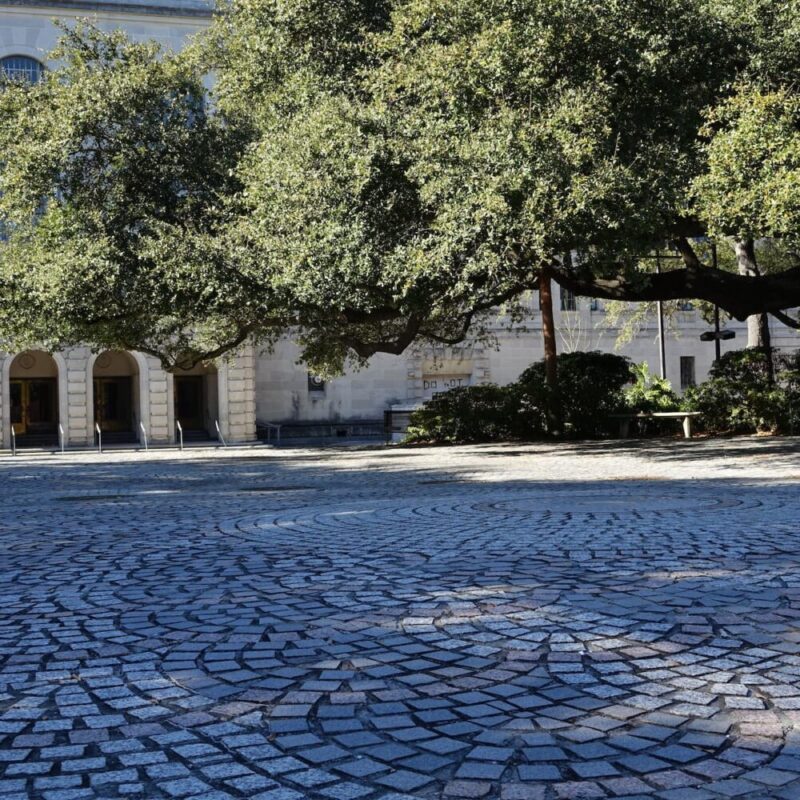
It’s a patch of pavement in a park; a confected plaza shaded by a canopy of stately Southern live oak trees framed by magnolias. Granite is arranged in an interlocking fan-like pattern that radiates outward, creating these gigantic swirls emanating from the centre. Walking over them, you can feel the thud of thousands upon thousands of enslaved Africans, mostly people of the Kongo, as they dance, sing and preserve their heritage amidst such shocking and unfair treatment.
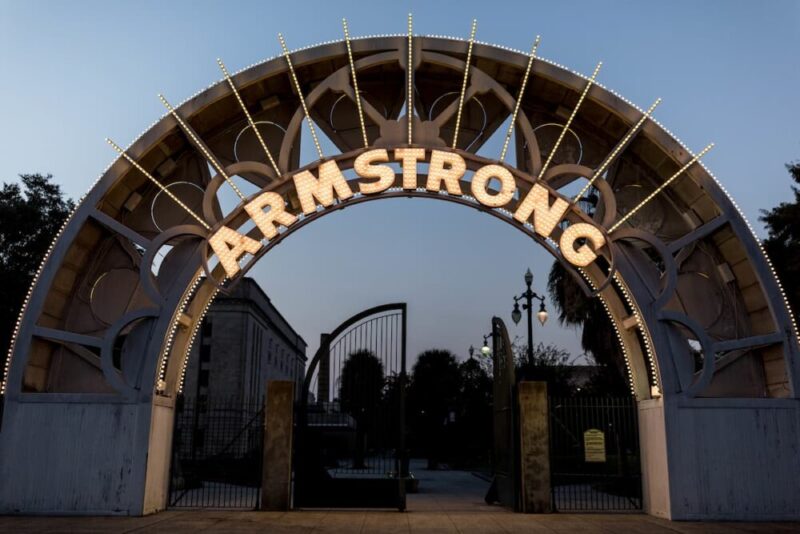
This is Congo Square, a historic open-air plaza in the southwestern corner of Louis Armstrong Park in the Tremé neighbourhood of New Orleans. It takes all but five minutes to walk from the French Quarter to this sprawling green space, making it as central to America’s most charming city as the jazz that bounces from every corner at all hours of the day.
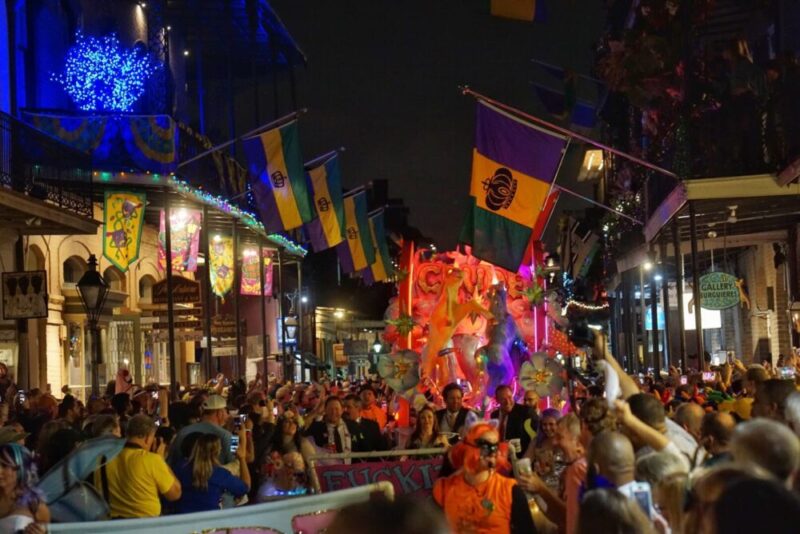
After all, jazz was born from this very spot. As was New Orleans’ most famous traditions, including the dazzling Second Line and wild-beyond-belief Mardi Gras. All three of these institutions are tied together by freedom and bound by Congo Square, presented as potent packages of liberation that have been healing people for decades.
You don’t understand that until you’ve been to New Orleans
During the French and Spanish colonial era, enslaved Africans were “allowed” to have Sundays off from work, as per King Louis XIV’s Code Noir.
The French decree, however, also severely restricted the movement of free slaves of colour and left them with no right to congregate. Yet they did, slowly turning a clearing called la place congo into a site of cultural preservation, where each Sunday would be marked with singing, dancing and trade. Enslaved Africans would buy and sell goods to raise money to escape slavery.
In 1817, then-mayor Augustin de Macarty officially restricted gatherings of enslaved people to Congo Square, which would have a seismic impact on the city’s psyche, as well as on how it tastes, sounds, and marches forward.
People from the Caribbean, Latin America, and tribes all over Africa would climb through that tiny weekly window of freedom (granted as a way to encourage Catholicism) and amalgamate ideas, traditions and expressions. But they weren’t just singing, dancing and laughing under the constraints of time; they were showing the world exactly what it means to be free.
How New Orleans helped me feel free
My first time in New Orleans was during the Fourth of July weekend in 2024. Not to overshare, but I’ve had a long and traumatic connection with this city since 2010, and so I wanted it to be the final stop on an emotional three-month journey across America.
Nostalgia is a powerful thing. The deep, restorative connections it can forge between you and your inner child are why travel and healing often work in tandem. There’s no better way to practice self-reflexivity than by travelling back to places where you found some sort of meaningful connection.
And so most of my 90 days in North America were taken up by places I’m very familiar with. Chicago, Los Angeles, New York, Seattle, Vancouver. I love these cities without reservation, but my final stop was always going to be this one city I had thinking of every day for 14 years.
It’s not overrated.
New Orleans is one of the few storied cities in the world that blasts past expectations, because there’s no way you can measure just how different NOLA is from the rest of the USA. Such a distinction is multisensory. You taste, see, touch and sometimes even smell the difference. You also hear it.
Time your visit for a Sunday afternoon. Head on down to Congo Square at around 3pm, and you’ll see exactly what I mean. You’ll feel it. Dozens of people meet for a joyous (and free) celebration of music, inviting everyone to let their emotions move them while an enormous procession of drummers takes the rhythm in all sorts of directions.
Many people watch, most people dance.
When opening the 1964 Berlin Jazz Festival, Dr. Martin Luther King spoke powerfully about jazz and what it represents for the world:
“God has wrought many things out of oppression. He has endowed his creatures with the capacity to create—and from this capacity has flowed the sweet songs of sorrow and joy that have allowed man to cope with his environment and many different situations.
Jazz speaks for life. The Blues tell the story of life’s difficulties, and if you think for a moment, you will realize that they take the hardest realities of life and put them into music, only to come out with some new hope or sense of triumph.
This is triumphant music.”
Tha Block is Hot
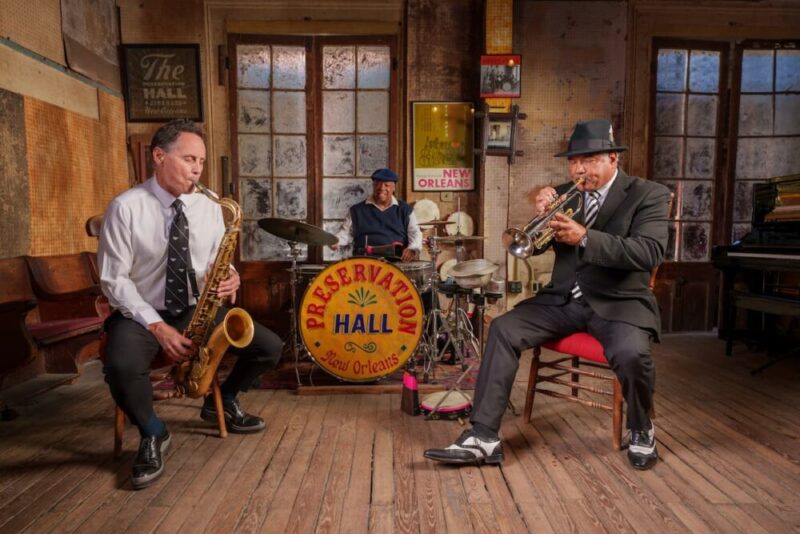
When you think about it, New Orleans has the most confusing musical output in the country. Jazz and bounce don’t share any aesthetic similarities, but they are both characterised by an uncompromised and pure freedom of expression.
Jazz is a cacophony of syncopated rhythms that both go their own way and work in concert. This complexity is why jazz is so fascinating for the mind. Pieces ebb and flow. Players resist each other, breaking off into their own solos before finding each other again. Each piece is full of multiple ideas coming together and creating something much more than the sum of its parts.
Jazz is gestalten in a way that’s much larger and more profound than other styles of music.
Bounce gets its freedom from scat singing, which originated from jazz. Considered an offshoot of the much larger hip hop scene of New Orleans, it’s fast-paced, rhythmic call-and-response style borrows many elements. Its urgency and repetition are grounded in club culture, specifically in the LGBTQI+ community, best preserved today by artists like HaSizzle and Big Freedia.
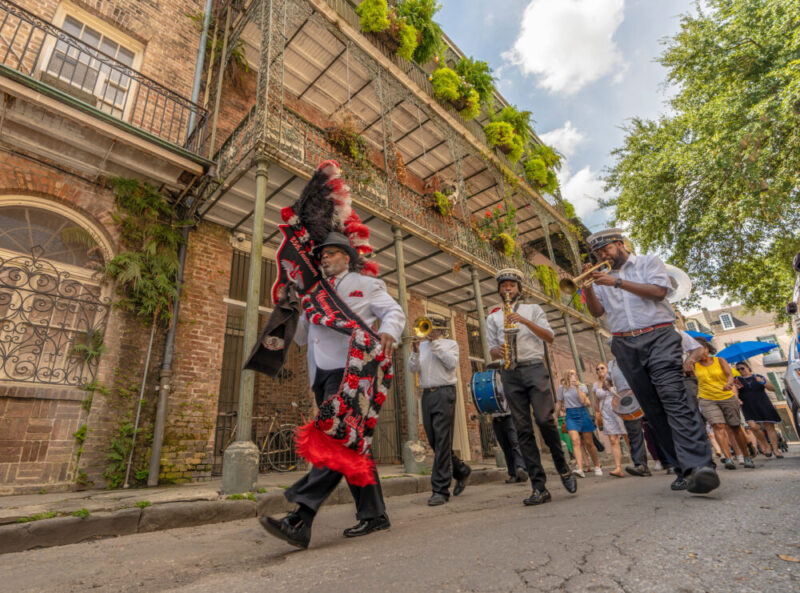
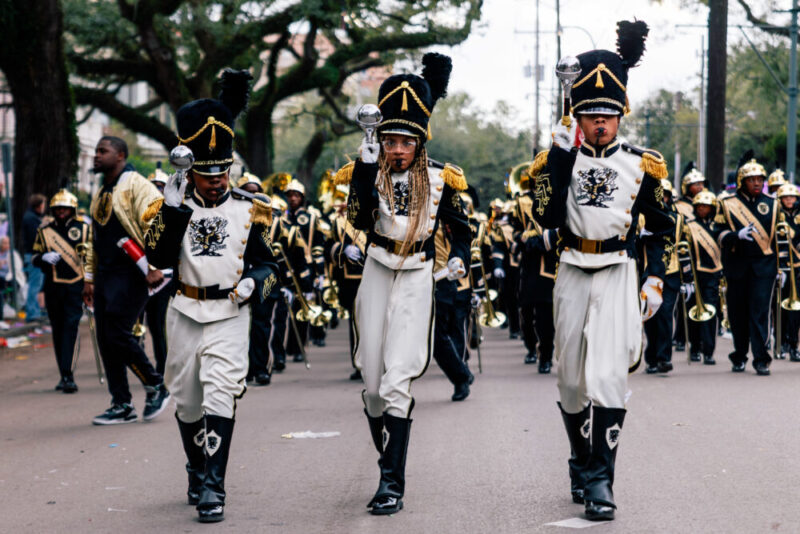
On the surface, these two styles are nothing alike. One is elegant and culturally elevated, while Bounce is seen as restless noise. You don’t see any white men in ponytails rolling their r’s over Triggerman beats. But Bounce was born from the Second Line, inspired by the freedom that pervades the city’s brassy parade culture.
The relentless freedom these genres symbolise speaks to a deep yearning that sits outside our consciousness. Both emerged from the African American experience as a form of liberation, grasping the concept of improvisation in a way that’s liberating for both player and listener. These expressions are made to break musical and social constraints.
That’s why jazz, at least, was used as a tool during the Civil Rights Movement. It’s a declaration and desire to be freer. An acknowledgement that no one is ever truly free while others are oppressed.
The syncopated rhythms that define jazz went on to refine the entire music world, from blues, soul and bluegrass to rock and roll. And in that sense, jazz also liberated music, making Congo Square the point of origin for so many great things.
Finding it on one of the last days of my emotionally loaded trip felt like fate. But perhaps that’s part and parcel to discovering this city. New Orleans feels like fate.
Chris Singh travelled to New Orleans as a guest of Visit New Orleans.
Feature image credited to Paul Broussard.
