

Los Angeles’s swag of massive art galleries and museums isn’t talked about in the same way people talk about the art scene in dense urban centres like New York and Chicago.
It’s clearly much different, in more ways than one. In New York, art is vertical. Museums and galleries play around with scale, weaving through masterpieces with a healthy mix of classic, contemporary and forward-thinking. It’s transportive too. Head past Harlem and search for The Met Cloisters in the disorientating Fort Tryon Park. It’s a medieval castle that’ll take you straight to the deeply spiritual Romanesque and Gothic periods.
Chicago’s art scene is monumental. For art lovers, it’s just as prolific. For tourists, it’s overlooked. The Art Institute of Chicago is one of the world’s most impressive, hosting countless masterpieces (there’s always something you’d want to see that’s on loan to a major museum) like Edward Hopper’s Nighthawks, Grant Wood’s American Gothic, and Vincent van Gogh’s The Bedroom. In fact, the museum has so many legendary works to swap out that it leaves room for seamless, sharp chronologies on various art movements. To me, it’s like New York’s The Met, but just the right size, as I wrote last year in this piece for Channel 9
But in L.A, art is spatial and epic.
Art is spatial in the same way that Los Angeles is spread out. Unless you’re taking an art crawl around Downtown L.A., you’ll be doing some driving (or Waymo’ing) and heading up into the hills.
L.A’s art scene has world-class institutions like The Broad and LACMA, as well as fun niche museums like the Academy Museum of Motion Pictures. But it’s the wealthy J. Paul Getty whose name dominates Los Angeles, split across two unforgettable, elevated, and almost monastic spaces: Getty Center and the Getty Villa (both free, and not just for locals).
These aren’t places you pop into, which encourages a more patient and deliberate experience. You aren’t rushing through MoMA so you can catch a show at Broadway, or skipping that one last thing at Chicago’s Field Museum so you can make your architecture boat tour. You see the landscape up here and… you kind of just want to spend all day examining, discovering, learning, and contemplating.
Ancient Rome meets the Californian Coast at The Getty Villa
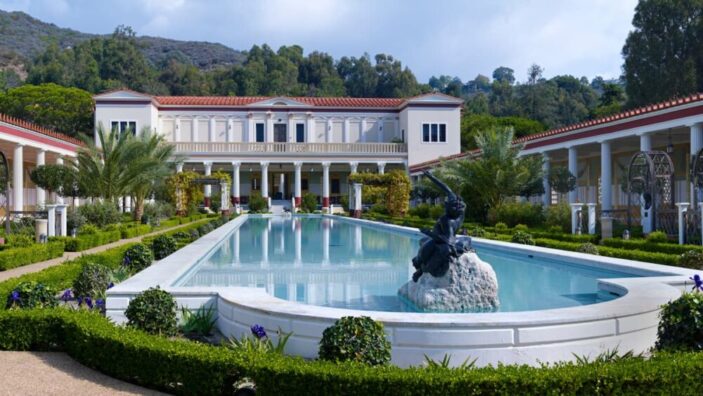
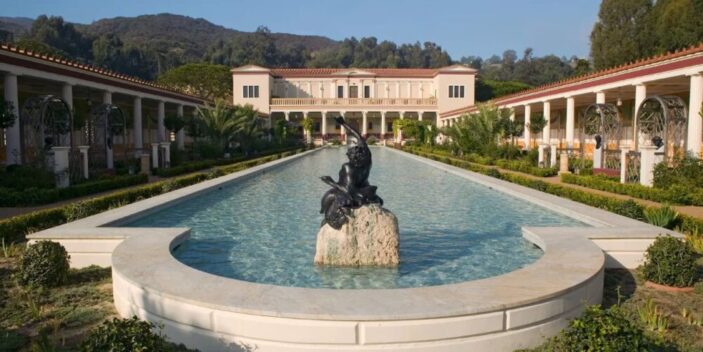
Getty Villa was my introduction to Getty’s legacy. The Malibu estate, just a short drive from Santa Monica, set amongst the hills of the Pacific Palisades, isn’t a radically stripped-down carbon copy of Italy’s ancient Villa dei Papiri, a historic Roman country estate that Mount Vesuvius destroyed in AD 79. J. Paul Getty built the Getty Villa in 1974 to exacting standards, using historical records and the kind of research I find hard to comprehend.
And that’s why, like The Met Cloisters above, it’s so wonderfully transportive. Head out back to the Outer Peristyle garden and you’ll find a stately long mirror pool surrounded by ancient bronze sculptures and both ornate Corinthian columns and austere Doric columns. It’s one of the most jaw-dropping and intimate views of any art institution across the country.
The entire estate was built to house Getty’s extensive (40,000+) collection of ancient Greek, Roman and Etruscan. Some of the most important Roman statues in the world are displayed across these intimate, rustic galleries, which, importantly, position art in a home, as opposed to a traditional museum.
How art is presented is as fascinating as the work itself, all hyperdetailed with the deep cracks and fissures of an unfathomable amount of time. Yet, be warned, after you’re done looking at the art, you’ll want to explore every inch of these immaculate gardens, offering many reflective spots as well as staggering views over the hills.
Art is intelligent, rich and historic at Getty Center
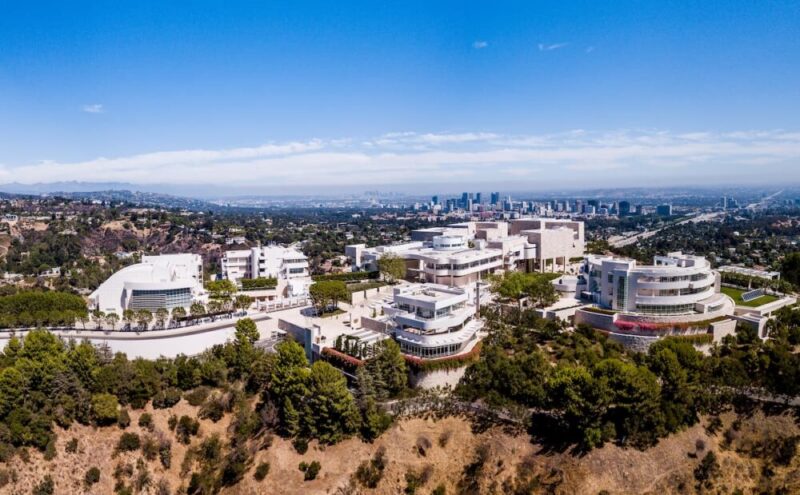
Whereas the Getty Villa is a very lived-in experience and intentionally theatrical, Getty Center puts a bigger focus on the intellectual depth of art and the intimate, onerous process of restoration. You’ll head up, catch a short tram ride around the hills and ring around to this large, impressive series of wings that house mostly post-antiquity Western art, coupled with spectacular landscaping and the best view in Los Angeles.
These interlocking wings house a formidable collection, from medieval manuscripts and Renaissance painting to photography and modern decorative arts, each presented with a clarity that reflects the Getty’s role as a research institution as much as a museum. But for all its academic rigour, the setting never feels didactic.
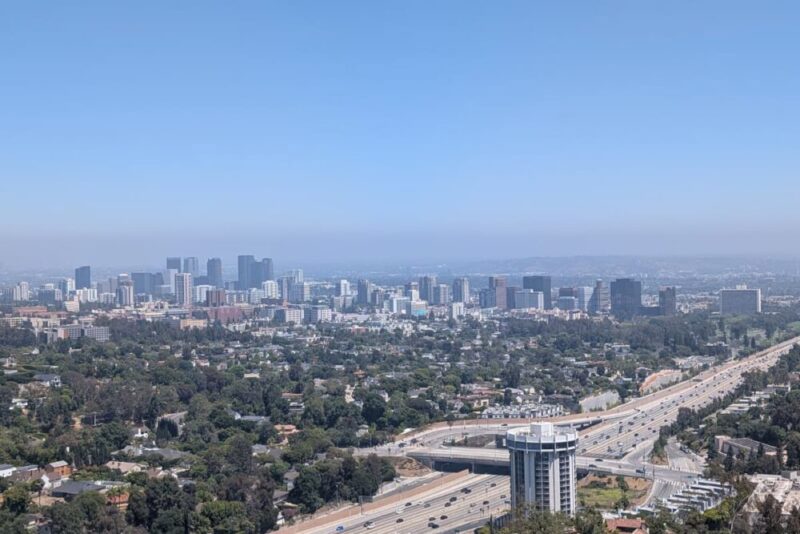
And, yeah, the art is great. It’s one of the most important collections of Western art in the world. But my favourite thing about Getty is the art out there. Carefully choreographed sightlines frame the city below, and from the outer terraces, the view stretches from downtown to the Pacific, making a strong case for this being the finest vantage point in Los Angeles.
It’s not an easy view to forget, and it could make even the most confused “why is this city so fucking spread-out?” first-timer instantly fall in love with the City of Angels.
I’d been to L.A. a handful of times before I visited the Getty Museum’s two wings, and I’d never really done that. Fall in love with the city. But that echoes something West Hollywood icon Jonny D’Amico told me last year when I took his Rock ‘N Roll Walking Tour around West Hollywood, “everything cool in L.A. is hidden.” You have to work harder to find the magic in L.A., and the art scene is no different (although if you’re lazy, just go to DTLA’s arts district).
What’s next for the Getty Museum?
Both elements of the Getty Museum are as dynamic as any other museum. Timothy Potts, Director of the J. Paul Getty Museum, tells me that there are several major capital projects in the works for both venues, alongside a focus on upgrading and modernising each with a focus on sustainability and experience.
The old tram, which was installed in the late 90’s, is being replaced, and visitors can expect improved ventilation and temperature control. Behind the scenes, work is being done to expand storage for the Getty’s collections.
As for the Getty Villa, that’ll see some changes too. Necessary ones, of course. The Getty Villa was famously one of the only landmarks in the Pacific Palisades that escaped destruction during the L.A wildfire at the start of January 2025. As Potts tells me, the destructive flames presented an unprecedented challenge. Work is being done on more robust preventive protocols, and there are efforts to reduce the site’s carbon footprint.
There’s also a commitment to providing bilingual English-Spanish labels for all future gallery and exhibition installations, as well as expanding digital access to the collections and exhibitions.
Not many visitors know this but…
The Getty Villa and Getty Center are about a 20-minute drive from each other (but it’s L.A. so don’t count on it being that fast). They both offer free entry for both locals and tourists, but you’ll need to pay for parking.
The trick is, you only have to pay for parking once if you’re visiting both sites on the same day. Given the exchange rate for Aussies right now, saving around US$15 (AU$21) by fitting both into one day is wise.
The Getty Villa
Address: 17985 Pacific Coast Hwy, Pacific Palisades, CA
Contact: +1 310-440-7300
The Getty Center
Address: 1200 Getty Center Dr, Los Angeles, CA
Contact: +1 310-440-7300
The writer travelled as a guest of Visit Santa Monica to the Getty Villa and of Visit Los Angeles to the Getty Centre.
Feature image supplied by J Paul Getty Trust.
