

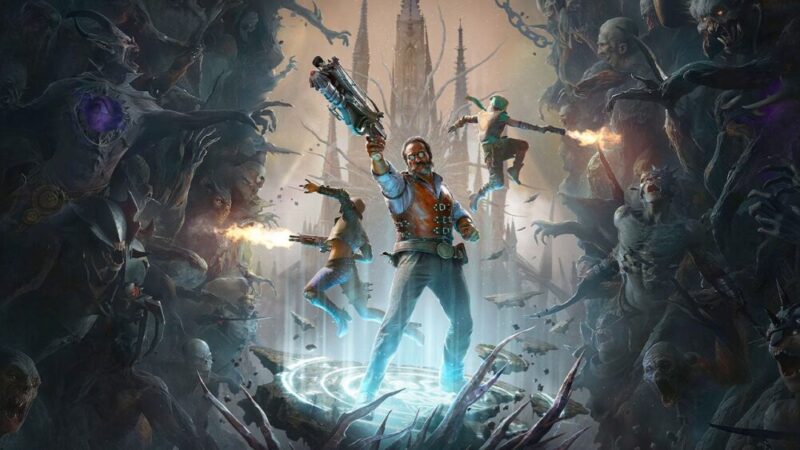
Funnily enough, I actually have my original PC copy of 2004’s Painkiller, and while I was way too young to be playing it, I enjoyed the first-person chaos. As you would imagine, I was actually incredibly excited to find out this underrated gem was getting a full remake. While 2025’s Painkiller is a functional shooter with some enjoyable moments, it ultimately misses the mark.
Sure, it might use plenty of elements from existing ‘boomer shooters’ like Doom, but not all of it really works here. The levels are somewhat unique, but filled with repetitive missions and enemy types, while the range of weapons and abilities, while upgradeable and unlockable, wears out its welcome a little too soon.
Cooperative online play is also available, but I just had so much trouble matchmaking, either struggling to find other players or finding matches with poor connections and high ping. Any of Painkiller’s strengths comes directly off the back of its gameplay, which is disappointing given the lack of any real variety or longevity.
Put the ‘Kill’ in ‘Painkiller‘
Players take control of one of four unique characters, who wake up in Purgatory, to stop the demon Azazel from taking over Earth. Guided by the voice of the Angel Metatron (who, surprisingly enough, is not a Transformer) to stop the waves of demons and ghouls sent to put an end to your fight.
There really isn’t much to the story, and while most of it is divulged and explained through voiceovers and dialogue between characters, there’s barely any sort of character development or cinematic quality to help players feel invested. There are a few witty lines here and there, but that’s about it.
Painkiller gives players two modes to choose from: Raid and Rogue Angel. The Raid mode serves as the game’s main mode, which can be played cooperatively with three players online, or solo with AI-controlled bots. The mode takes place across three distinct acts, with each act being broken up into three chapters.
I say chapters, but you’ll be doing the same thing in each of them. While the environments are unique, the Raid mode sees players taking on waves of enemies, or filling up barrels of blood by killing enemies near them, and placing these barrels in specific areas in order to progress.
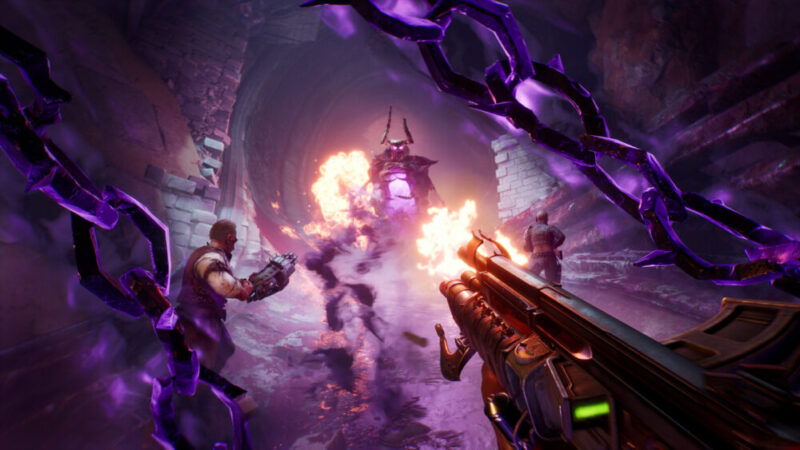
The only issue I have with these barrels is that they mask and dumb down what are effectively unique objectives. Early on in the first Raid, you’ll need to silence a bell, but instead of finding a way to actually do that, you simply need to grab and fill a barrel and place it in a socket nearby, which silences the bell. It feels like a missed opportunity, and wears the Raid mode quite thin, early on.
Thankfully, the Raid mode has a few saving graces, as navigating levels can be fun thanks to hidden passageways and an impressive level of verticality. While they’re comprised of areas you feel like you’ve seen before, it’s nice to be able to zip around on certain points with your grappling hook, or hit certain switches to uncover secret rooms for extra coins, health and ammunition. Finally, there are some cool boss battles at the end of each level, which do present a fair challenge.
The Rogue Angel mode feels much more enjoyable simply because the roguelike elements merge roguelike elements, with all the existing challenges in the Raid mode. Where you eventually finish each level in the aforementioned Raid mode, you’ll return to your hub to upgrade weapons, change characters and abilities, and jump into the next level.
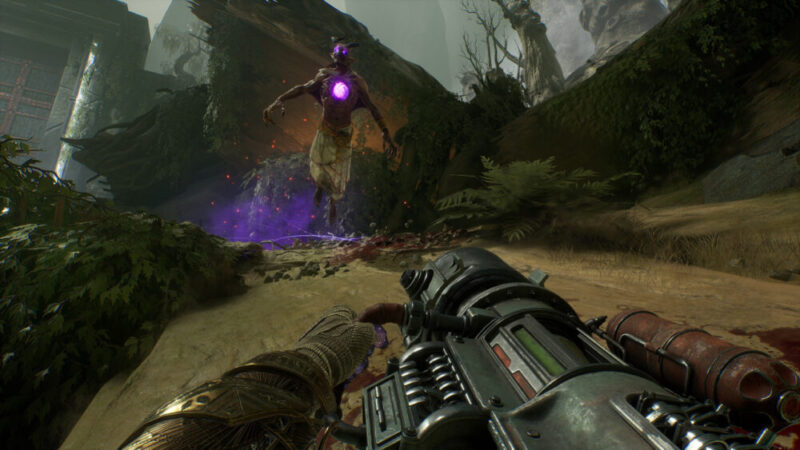
In this Rogue Angel mode, you’ll need to smash through procedurally generated levels and choose to make it out when you feel you’ve had, or have got, enough. There’s a great mix of platforming, boss battles and plenty of waves of enemies, and it goes a long way in making the game’s multiple progression systems feel earned as a result. While I struggled to find people to play with, I imagine this is what players will be sticking with moving forward.
Boom, Boom and More Boom
As far as the gameplay goes, Painkiller is incredibly solid and generally satisfying. Gunplay is punchy, responsive and fast-paced, and much like Doom, you never have to reload your weapon. There are six weapons to unlock and choose from throughout the game, including the Electrodriver, which fires small bouncing disks, the Stakegun, which fires long projectiles through multiple enemies, the SMG, for rapid fire, the Handcannon for high-powered shots, the Shotgun for close-range encounters, and the Rocket Launcher, which speaks for itself.
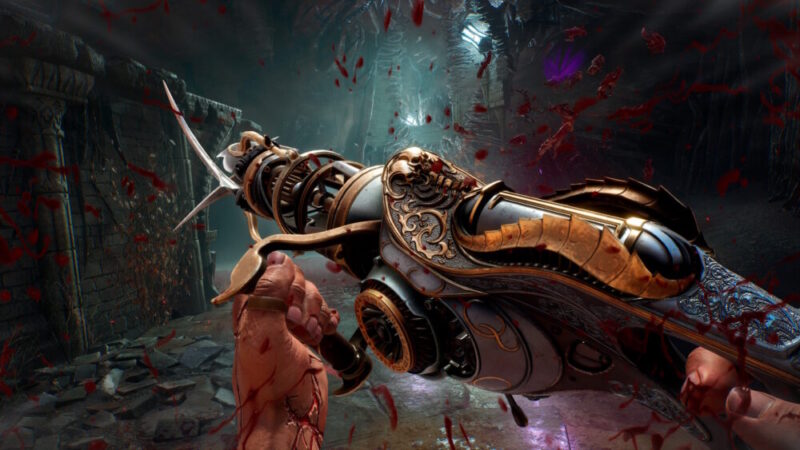
You will, however, have another weapon with you the entire time, which is the titular Painkiller. The Painkiller essentially acts like a big spinning blade that can tear through waves of enemies, and causes enemies to drop ammunition for your two chosen ranged weapons. It feels quite overpowering at times, but it is always incredibly satisfying to use as you watch the limbs of your enemies go flying in all different directions.
Players can pick from one of four unique characters being Ink, Void, Roch, and Sol, each with their own unique perks. That being said, players can also purchase tarot cards and equip them before each mission, which gives players access to unique abilities. Keep in mind, however, that these cards only last for a specific amount of time, usually a single mission.
Players can spend coins or Ancient Souls to purchase them again, but this soon becomes a balancing act between purchasing these tarot cards and upgrading their weapons with coins.
Each of the six weapons can be upgraded, with their own skill trees branching in various directions based on your playstyle. As each weapon comes with its own secondary firing modes, players can choose to upgrade these weapons by spending coins on them, but the game rarely gives you enough to do everything. While I found the Shotgun and SMG to be the perfect mix, I found I could upgrade those weapons almost fully within the game’s main Raid mode, but not much else.
Painkiller’s gameplay might feel repetitive, but it’s incredibly competent and generally satisfying, and carries most of the experience on its shoulders.
Look the Part
Painkiller looks fine for the most part and runs quite well. It’s not quite as detailed as some of the higher-profile new releases out there, but it hits 60 FPS almost the entire time on the Xbox Series X, with very minimal frame rate drops when things get a little crazy.
I wish environments felt a little more unique, but I tip my hat to the cool weapon designs across the board. There’s not much more to say about Painkiller in this regard, as it feels stitched together with elements of games you’ve played before. But at the very least, it works.
Final Thoughts
Piankiller isn’t really broken or terrible in any meaningful way, but it’s just not doing enough of its own stuff to justify a full reimagining such as this. The story is practically non-existent, and the game’s main Raid mode is quite thin.
But that being said, the gameplay ultimately carries the experience in such a way that makes the game worth checking out, for those into older boomer shooters like Doom, for example. While I can’t imagine this having any sort of real longevity to keep players around for cooperative play, there’s at least something to fill a single weekend.


THREE STARS (OUT OF FIVE)
Highlights: Solid, functional gunplay; Decent performance; Rogue Angel mode is fun
Lowlights: Lacklustre Raid mode; No real storytelling or character development; Repetitive mission structure
Developer: Anshar Studios, Saber Interactive
Publisher: 3D Realms
Platforms: PlayStation 5, Xbox Series X/S, Windows PC
Available: Now
Review conducted on Xbox Series X with a code provided by the publisher.
Featured header image also provided by the publisher.
