

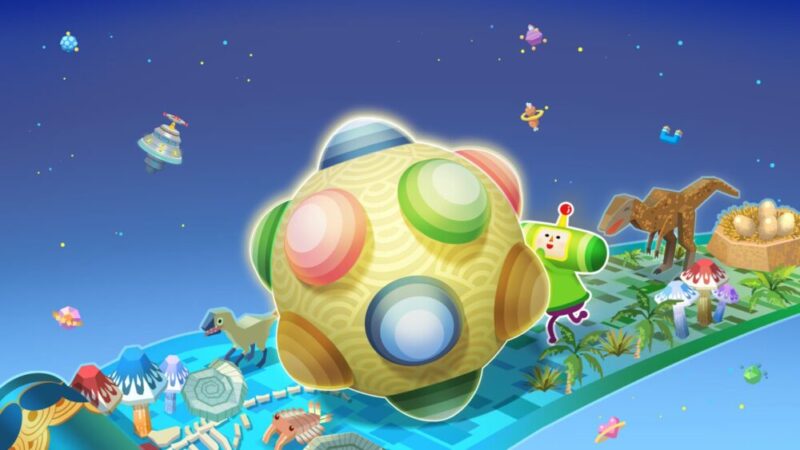
As a great song once said, get your star, because another game in the weirdly wonderful series, Katamari Damacy, has just dropped. This new entry, titled Once Upon a Katamari, introduces a night sky of inventive new levels while still having the original’s solid gameplay at its core.
Just as bold and brilliant as the rest of this beloved franchise, Once Upon a Katamari is a delight to play – whether you’ve played every game or are just tuning in.
What is a Katamari, and how does one Damacy?
If you’re not familiar with the Katamari series, it’s a little hard to explain without having to add a ‘no, I promise, it’s really good’ at the end. Essentially, in each game, you play as the Prince of All the Cosmos. His father (the King of All the Cosmos, naturally) has accidentally destroyed some of the starry skies he is supposed to be ruling, so he sends his son to the world below to help him create new astral bodies in a process that I’m sure is completely accurate to the formation of real stars.
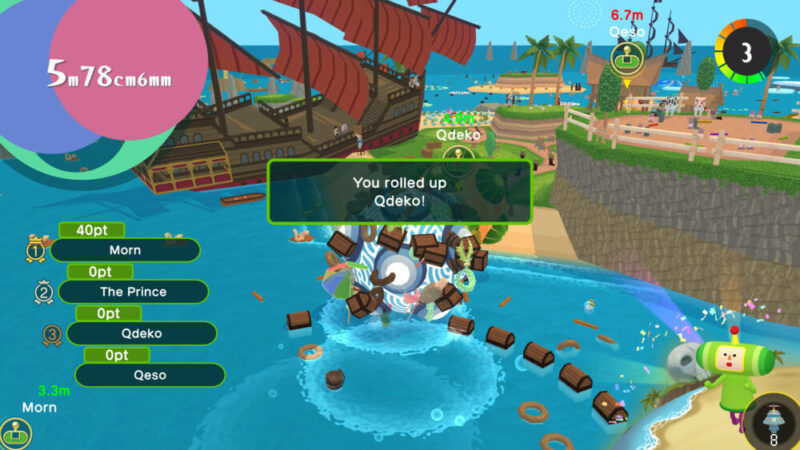
As the Prince, you must roll around a sticky little ball (the titular ‘katamari’), and as you roll, collect scattered items. Over time, it gets bigger and bigger, until you go from rolling up a line of candies to toppling a row of apartment buildings – just as long as its size and your speed satisfy the King. If it does, he’ll throw it up into the cosmos, transforming it into a beautiful star. Some levels challenge you to get as big as possible, while others experiment with this formula to collect specific types of items or judge based on other merits.
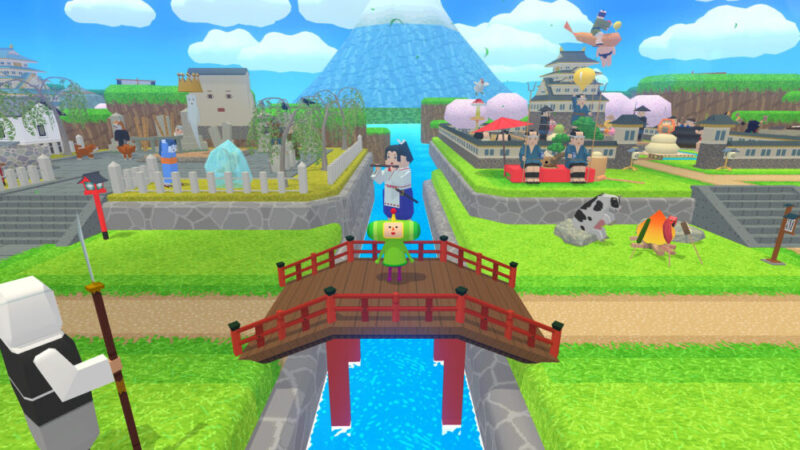
It is almost unbelievable how satisfying that seemingly simple formula is in practice, especially when it’s combined with Katamari’s signature low-poly art style, banging Shibuya Kei soundtrack and ridiculous sound effects. But you had better believe it, because it resulted in a huge series beloved worldwide for its quirky premise and whimsical sense of humour.
This latest entry takes a bit of a different approach, in an attempt to modernise a series that started all the way back in 2004. In Once Upon a Katamari, the King has accidentally destroyed the entire Earth. Whoops!
Luckily, there is a way to bring everything back, and even more luckily, it involves rolling a whole bunch of katamaris. In this game, the Prince must take a time-travelling spaceship to a hottest hits mixtape of the earth’s eras and build stars from dinosaurs, cowboys, and pirates. By completing a wide array of levels divided by time period, they might just be able to save the Earth.
Let’s Roll Up (to be a single star in the sky)
I must admit, when I first heard about this game, I was a little sceptical. I love Katamari Damacy’s soundtrack, and We Love Katamari is my go-to game when I’ve had a bad day, but the original game’s director, Keita Takahashi, hasn’t worked on the series since the original game’s sequel. Not to mention some of the more recent entries (such as Touch My Katamari, a simplistic mobile version of the game) have been contentious at best, or simply remasters of old games. Publisher Bandai Namco are counting this as the first mainline game in 14 years.
Then I booted the game, and as soon as Once Upon a Katamari’s main theme started blaring, all those concerns were rolled up into a big ball and tossed into the sky.
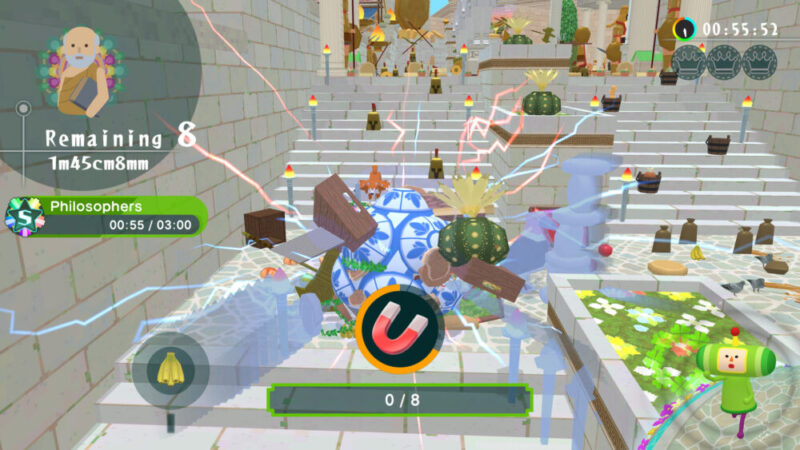
It relieves me to say that this new game is delightful. It perfectly captures what made the original Katamari Damacy so much fun to play, while adding enough of a twist to its formula to feel fresh and original. It splits the difference between what the old fans want and what is inviting to new players. Separation of the game into time periods lends it a new character, soaking each stage with its own particular personality. This format also means this game is stocked entirely with new levels, and plenty of them.
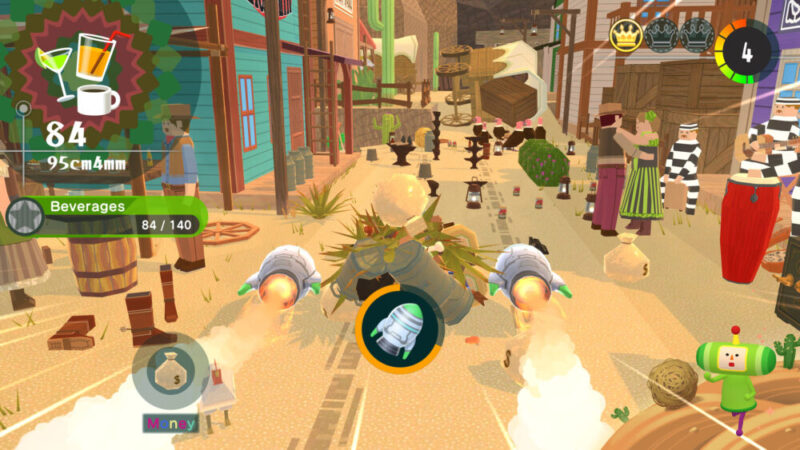
But do not mistake these distinctive stages for being only a surface-level change to the beloved Katamari format – an in-depth approach ensures that the whole game feels, albeit subtly at times, a little different to its predecessors. This includes a different control scheme, a change from the original’s two-stick ‘tank’ controls sure to be welcomed by new players (though my fellow oldies can still use the classic format), a grading system to make level scores clearer, and the return of power-ups. There are even some levels that change while you play, and a new co-op mode.
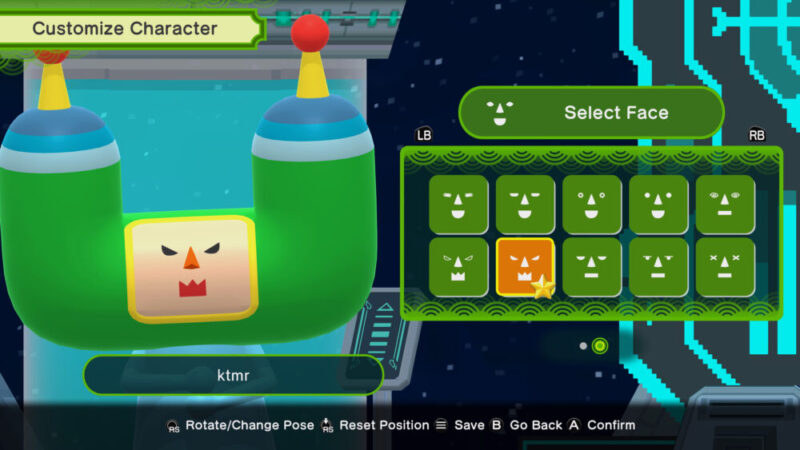
That’s not to mention enough customisability to satisfy even the King of All the Cosmos, including a family’s worth of extra cousins to the Prince (what the game terms the alternative player characters) and the ability to expand the family yourself by creating your own Katamari character.
There are also more collectables and extra challenges for perfectionist players, with their goals aided and abetted by the new grading system. For some reason, there’s even a King-themed gacha for some of these collectables, which was certainly not on my bingo card for this game.
Now THAT’S a beautiful star
If Once Upon a Katamari had departed from the series’ arguably old-fashioned (but now delightfully retro) low-poly art style, I would have rioted. But instead, it embraces it, so the devs are safe for now. It’s just as bright and beautiful as the rest of the series, a treat for both eyes and ears.
The over-the-top colourful aesthetic (a statement which applies to everything from the visuals to the level design, music, and even to the sound effects, which are completely ridiculous in the best way) was such a beloved part of the original Katamari Damacy. Once Upon a Katamari not only effectively captures this prismatic style but also expands upon it with its new worlds. Many of the objects that grace these new levels feel straight out of the original Katamari games, especially when they’re placed alongside objects and sound effects from the original. The cutscenes are silly and bright. The soundtrack is a bop.
Sometimes the visuals are just a tad wonky, especially during the interactions with 2d and 3d assets, but not enough to be truly notable unless you’re a pedant like myself.

This Katamari is on the rocks
Ironically, given this game’s penchant for level design, all these new aspects do leave the game feeling cluttered at times. There’s just so much that, at times, it takes away from the simple joy this game is known for – rolling a little ball around and tidying up a messy place.
The start of the game epitomises this. In the tutorial and first few levels, there is barely a moment to catch your breath between half a dozen helpful pop-ups, humorous interjections from the King, new features demanding your attention, and cutscenes. This first segment is on rails as well; it’s only once you get to the third era that you are allowed to choose from a few different levels on your own, rather than being forced into a particular one. It’s not enough to suffocate, but it does feel like the game needs just a little more breathing room at times, especially at first.
Similarly, the sheer amount of new content, while a blessing for the most part, can also at times feel like a bit of a curse. There’s so much competing for your attention at all times, and while most is welcome or fun, most isn’t truly revolutionary. The game feels a little bloated, and just a little slimming down would really help – it would bring it closer to that core game, which is so beloved.
Final Thoughts
No, Once Upon a Katamari isn’t perfect, but honestly? It’s surprisingly close. Closer than I was expecting.
It might not revolutionise the series, but it does bring a fresh new approach and a full suite of new levels, in an approachable blend of old and new. The music is amazing, the art is charming, and the gameplay as delightful as ever. I for one welcome this new entry into the iconic Katamari series – and I think it’s here to stay.


FOUR STARS (OUT OF FIVE)
Highlights: smooth gameplay, huge level range, great music
Lowlights: cluttered game design, minor visual issues
Developer: RENGAME
Publisher: Bandai Namco Entertainment
Platforms: Nintendo Switch, PlayStation 5, Xbox Series X, and Windows
Available: Now
Review conducted on Windows PC with a release code provided by the publisher.
Featured header image also provided by the publisher.
