

I can’t remember the last time I hopped behind a steering wheel. I’ve attempted to get my learners several times throughout my life, though I’d only ever make it as far as a few streets before the freeze started to set in. I’d feel tears form and panic take over. Learning to drive may be possible for me one day, but it hasn’t so far in my 38 years of life.
From the outset, that’d look pathetic. I’ve grown accustomed to watching semi-polite smirks hide fits of laughter. Infantilising men who grew up with almost any level of complex trauma is considered an entitlement these days, and so a deep, soul-shaking sense of shame always hits whenever I’m asked why I don’t drive. Many people in a city like New York don’t; in Sydney, Australia, it’s considered a moral failing.
In L.A., it’s completely impractical.
Note: For an explanation of what Waymo actually is and why it’s so revolutionary, scroll to the bottom sections.
Some backstory…
For context – promise – I was in a fatal, life-altering car accident when I was just over a year old. No one could really figure out how I survived, and yet I did, but not without a sufficient level of growing pains. I don’t like getting behind a wheel (or riding anything with perpetual motion). And I don’t like not being able to breathe.
As they say, the body keeps the score.
I hope to one day afford a driverless car. I think that might be the only way I could ever “drive” without depending on someone else to take the wheel. And so you can imagine how eager I was to climb into a Waymo on a recent trip to Los Angeles, where the service launched earlier this year.
What riding in a Waymo was like for me
I’ve never paid much attention to the evolution of driverless cars. Or cars in general. I’m absolutely fine as a passenger, but the thought of being responsible for others’ lives as a driver terrifies me.
Yet here I am, attempting to save money in the face of Uber’s increasingly extortionist prices. I’d heard Waymo has finally made its way down from San Francisco, and so I’m curious to test it out. Would I feel safe? People I tell back in Australia say they would never be brave enough to try a driverless car. Am I stupid for ordering one? How will I react?
Surprisingly, fine. More than fine.
First fine thing: my Waymo fare is almost 50% of the projected Uber fare.
After checking into The Godfrey in Hollywood, I order my first Waymo from over to the Sunset Strip. The app is easy enough to use, working almost exactly like Uber with a few notable differences.

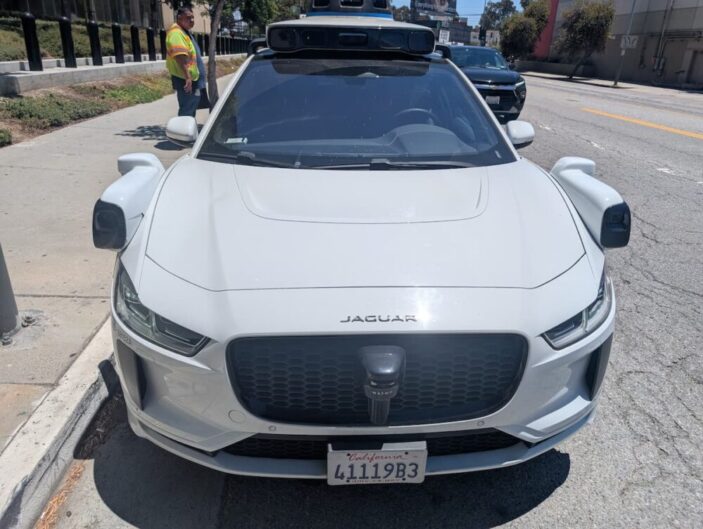
Instead of a number plate, the Waymo arrives with an LED display on a funnel atop the car. The initials “CS” tell me that this is my ride. I press “unlock” on the app, and the car handle pops out with a Tron-like whirr.
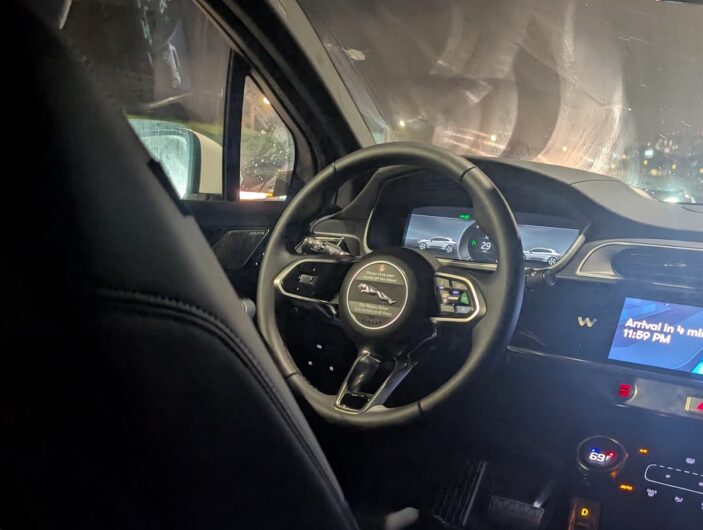
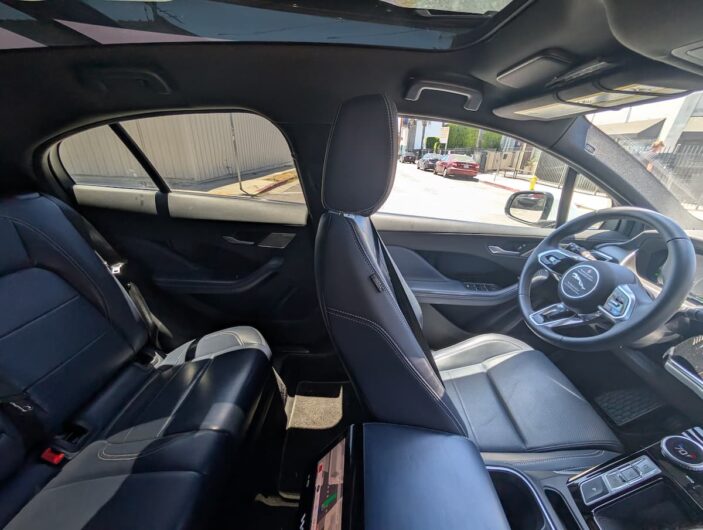
I pop into the backseat as if I just caught an Uber, then realise I can sit anywhere I want. I choose the passenger seat and press the big blue “Start Now” button on an LED Screen.
“Hello from Waymo. As we get going, just give us one minute to cover a few riding tips. This experience may feel futuristic, but the need to buckle up is the same as always. So keep your seatbelt fastened, please.”
The robot voice is a standard, smooth and clear woman’s voice by default.
After you’ve pushed the button, it’s just like a regular ride in a comfortable Jaguar I-PACE SUV. Watching the steering wheel spin around is strange for about a minute before the strangeness of the entire situation starts to feel completely normal.

I watch the indicators go off and on. Waymo will almost always try to avoid taking left turns, especially if they are unprotected, and so there is some re-routing during my drive. That’s a downside, I guess; Waymo is very conservative (as it should be) and always errs on the side of safety when there’s a novel situation.
This can add some time to your ride, but after taking a total of eight Waymos over 3 days in L.A., I hadn’t noticed any mismatch between projected arrival time and actual arrival time.
Uh oh, a punctured tire?
On my third ride, I’m cruising along in Inglewood, on my way to the futuristic Cosm (L.A.’s version of Vegas’ The Sphere). The Waymo Driver must have blown past some sharp debris because all of a sudden, I hear “her” say, calmly: “Chris, there seems to be an issue with the tire pressure, I’m finding a safe place to pull over now”
Gently, the Waymo Driver finds a spot and parks perfectly. “A service staff will be with you in a second”.

A voice enters the ether. A friendly call centre type tells me that he’s assessed the damage and that, unfortunately, this Waymo will have to be driven to a service centre.
“That’s absolutely fine, I’m in no big rush,” I say. “Should I just order another one?”
“If you’d like to do that, we can load your account with $100 credit so your next few rides are on us.”
I love it when a minor inconvenience turns into a major convenience, especially in a land that can easily send you bankrupt if you don’t practice restraint.
“You can do whatever you want while we wait for the service team to arrive. If you want to wait in this Waymo until you’re other one arrives, please do so, your safety is our top priority.”
I’m in the heart of Inglewood, so I opt to stay in the car. The service staff rocks up around 25 minutes later, the same time my replacement Waymo arrives (I was in a very residential area with no Waymos around)
He drives off with the injured Waymo. I hop into mine and continue on my way.

Catching Waymos can be way mo’ fun than traditional rideshare
There’s no human driver to distract in a Waymo. You could sit there with four of your friends (no one can sit in the driver’s seat) and have a big karaoke session to pass the time. Some preloaded iHeartRadio Stations are always working, but you can also connect the car to other apps. A lot of it is still in beta, however.
You have to use the Google Assistant app and connect it to Waymo to play your own streaming services. Watch videos, listen to music – content works as it should, and since there’s no driver to distract, you can play your music as obnoxiously loud as you want.
I throw on Clipse’s latest album and rock with it while driving back from Inglewood to Hollywood. Then I’m feeling like some Rufus Du Sol, then Ice Cube, then Snoop Dogg, then The Supremes. It may not seem like a big deal to most, but being able to play my music in a car with no one else felt very special to me.
Plus, Waymo tends to take residential streets, so I get to see more of L.A.’s oddball architecture in places I don’t expect. The city unfolds in a way you don’t usually see when zipping up and down the freeway (Waymo avoids the freeway for obvious reasons), echoing what a local told me earlier in this trip. “Everything in L.A. is hidden; you have to work harder to find the magic.”
I pass other Waymo Drivers and smile. I see passengers doing the same thing I am. Singing, filming content, enjoying a driverless ride and passing the time with their own content. Groups of friends are dancing in their seats. I spot one group playing what seems to be charades while one of them inhales a pie.
Keeping an eye on the screen is mesmerising. The Waymo Driver has this strange, ethereal view of the world, and you can pass the time by watching it shape and taking note of surrounding objects. Most of it helps with confidence if you’re feeling nervous.
Smooth, Safe, Secure
Was I scared taking a Waymo the first time? A bit. But the nerves melted away quicker than I expected. It’s also nice to know that a big issue for women riders is solved here; there’s no potential safety issue with aggressive male drivers. I’m not surprised that most riders I see are young women.
I hop onto Reddit after my fifth drive to see what other people are saying. “My wife swears by it now, won’t bother with Uber,” while another claims it’s “changed her life.”
Most point to the consistency of service. While most Uber and Lyft drivers are fine, occasionally you might get the off-putting one, or a car that stinks, or a driver that wants to rant about politics at you. Women might get one who expects a conversation (or attention) and then gets shitty when he doesn’t get one. The Waymo Driver only cares about getting you from Point A to Point B safely.
And, again, it’s often half the price of an Uber.
There are issues with Waymo’s lack of assertiveness, of course. I’ve had a few instances where I’m waiting longer than I should because no one wants to let the poor robot into their lane. Curious looks are common, but there have been instances where stupid people genuinely attempt to confuse the Waymo. Just recently, I saw an Instagram reel of a bunch of college kid stereotypes doing flips of a Waymo’s hood and confusing it (no rider was present).
As always, the real danger on the road is how stupid other people can be. But Waymo seems to deal just fine. It’ll never go beyond the speed limit (hence, no L.A. freeway). Refusing to break the rules might add a few minutes, but this also means Waymo is less prone to putting itself in difficult situations.
The pros vastly outweigh the cons here, and in a city like L.A., where driving is an absolute necessity, that’s important.
One of the best parts: you don’t leave with the psychological tension of “do I tip, or not?” You just don’t.

Uber made big cities more manageable; Waymo takes that further.
The introduction of Uber was a profound change to how people navigate cities. All of a sudden, something as stretched out as L.A. was actually manageable for visitors who don’t have a hire car. The city’s public transport still leaves much to be desired.
I remember I had mixed feelings about L.A. on my first visit as an adult because my mates and I were staying in Santa Monica, but still wanted to see it all. Foolish. The third time, however, was much easier. This was when Uber Pool was just being introduced, and I was staying out in DTLA. It wasn’t as pricey back then, but being able to make it down to Venice Beach for the day and back to DTLA in the evening felt great.
Uber doesn’t have the same city-shrinking appeal it once had, given the rising costs and dwindling lack of quality control of its drivers
If I’m staying in Santa Monica, for example, and want to have a night out in West Hollywood, I’d need to consider the cost of getting there and back. Uber is too expensive now, and that’s before you factor in the wallet-chewing exchange rates. That option is completely doable with Waymo.
Where does Waymo drive in L.A.?
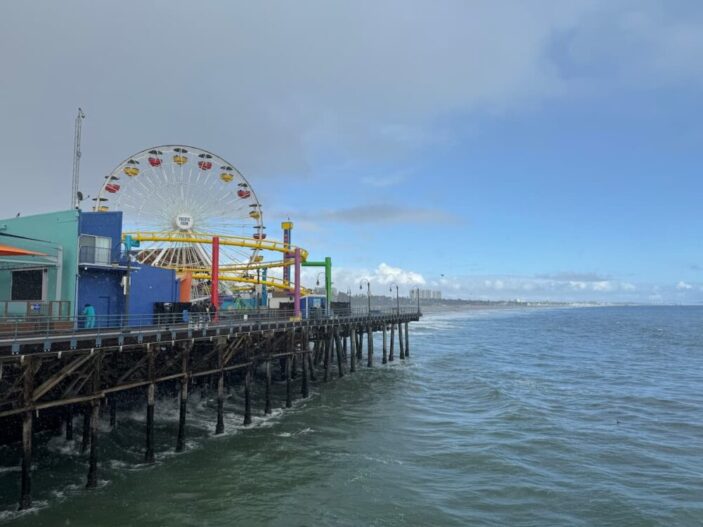
Waymo currently covers a radius of 120 square miles in Los Angeles. That is from Santa Monica to Inglewood. It doesn’t yet go to LAX, and the closest pickup/dropoff point I’ve found is at the Hilton Los Angeles Airport.
The radius includes West Hollywood, Hollywood proper and Downtown L.A. in its scope. Which is important, especially for a city that’s cleaning up ahead of the 2028 Summer Olympics.
As Larry Heath writes here, if you thought L.A. was an exciting city, you ain’t seen nothing yet. By the time the Olympics roll around, the City of Angels will open various major new attractions to add to its already sizable swathe of things to do.
This includes the immersive wizardry of Meow Wolf. A futuristic George Lucas museum. There’ll be a ton of new rides and attractions at Universal Studios. The Broad Museum is working on a substantial expansion. The California Space Centre, too. DTLA will see a Frank Gehry-designed performance space. And we’ll see renovations at LACMA and the Institute of Contemporary Art.
Most excitedly, the city of L.A. is really going to start picking up its art scene in South L.A. Destination Crenshaw will be a new precinct taking over a 2.1km stretch of Crenshaw Boulevard, with a mix of community spaces, landscaping and 100 commissioned works by black artists. It’ll be the largest public and private arts program in the USA dedicated entirely to black culture.
It’s also nice to know Waymo services the entire Downtown L.A. area right now. I used to love staying in DTLA. I did last year for a travel conference, but right now it’s largely a ghost town, and many parts can be uncomfortable as a result.
During the day, it’s fine walking around the Grand Central Market area, but there’s actually so much to do and see in DTLA that you could spend a few days just in this area and not get bored. With Waymo, at least it feels like I can get around safely and cheaply without having to constantly pay attention to who is around me at all times.
And that’s probably my first call of order next time I find myself in the City of Angels. Learning to love DTLA again by stitching this fractured city together with the help of my robotic friend.

What is Waymo?
Waymo is an autonomous arm of Google’s parent Alphabet, dedicated entirely to creating a fleet of self-driving cars.
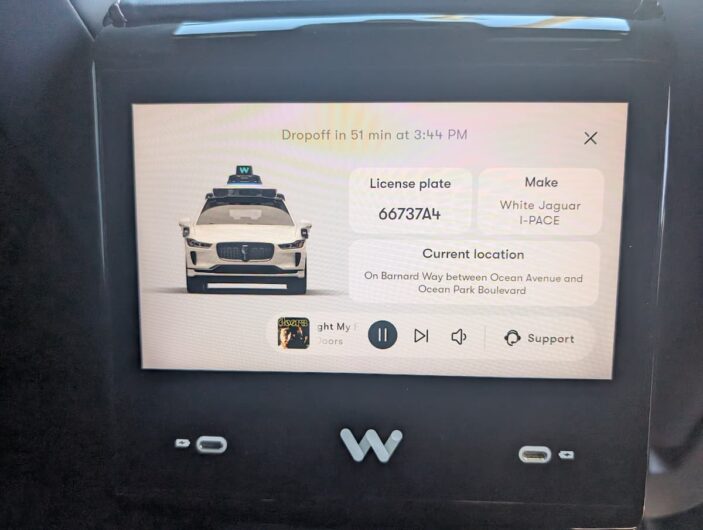
In its current iteration, the Waymo One fleet utilises a 5th-generation Waymo Driver, integrated into fully automated Jaguar I-PACE EVs. All of them have a plain white exterior with cones on top. This roof-mounted rack contains a variety of sensors and cameras, primarily using a LiDAR radar to enable safe, driverless operation.
When a rider enters the car, they can choose to sit anywhere (just not behind the wheel) and will find a large touchscreen on the dashboard to control settings, confirm trips, choose from various drop-off points and view an overhead map of their route. There’s another screen on the console in the middle for anyone sitting in the back, and both are framed by two USB-C chargers for your devices (no cable provided).
Also displayed on the screens: a visual representation of every notable vehicle and object around the car, from the street it’s driving down to all the side streets. These are represented by blue geometric shapes that differ in size. So a bus, for example, appears as a large rectangle. A smaller car would be more like a tiny rectangle.
Waymo is so far available in the following US cities:
- San Francisco (where it started)
- Los Angeles
- Phoenix (Metro area)
It’ll soon be available in these US cities:
- Atlanta
- Austin
- Washington D.C.
- Miami
- Denver
- Seattle
And internationally:
- Tokyo
Waymo maps its territory with intricate detail, taking note of all lane markers, stop signs, curbs and crosswalks. These maps are then matched with real-time sensor data and AI to determine the road location at all times. There’s no GPS, which can lose signal strength at times.
During the ride, the Waymo Driver’s complex perception system draws on data from its sensors and AI to contextualise everything around it, from pedestrians and cyclists to vehicles and road construction. There’s little room for error, and since 2021, Waymo has been involved in a total of five car accidents (and a human was at fault in all of them).
AI brings everything together for the Waymo Driver. Real-time data is fed into the system, drawing on over 20 million miles of real-world driving and more than 20 billion miles in simulation. This allows the Waymo Driver to anticipate what other road users might do, and helps it understand how each object around it moves differently, so it can effectively plan scenarios at all times. The driver pays attention to precise trajectory, speed, lane, and steering maneuvers to keep safety paramount.
Is Waymo the future?
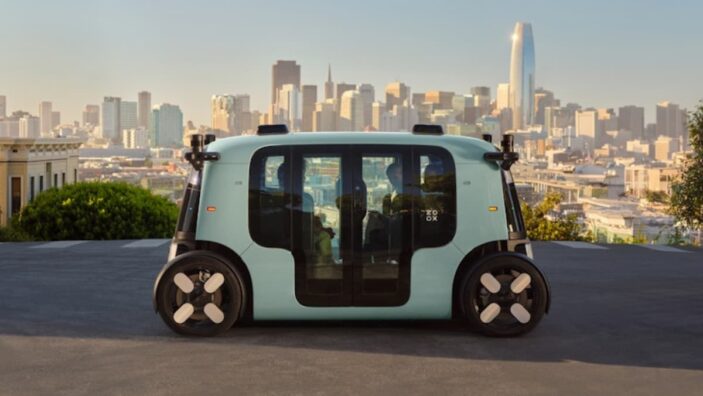
Musk, Google and Amazon are duking it out right now. Waymo is winning. Amazon’s Zoox looks great and much more futuristic than a Jaguar SUV (think of it like a big green gondola car on wheels), but they are only in San Francisco right now.
You’ve probably been thinking about Tesla while reading this the entire time. Elon Musk is indeed working on a fleet of robotaxis to compete with Waymo, but there’s an important distinction.
Waymo uses LiDAR sensors to capture three-dimensional images. Right now, Tesla cameras are only able to capture the world in two dimensions and must map that data to a 3D world. Waymo’s method seems to work better right now, giving the vehicle a precise 3D understanding of its surroundings before AI then contextualises it all.
Who knows who Musk has planned to further blend the self-driving category with rideshares. But for now, I’m extremely happy with my Waymo experience. More than that, actually: it instilled a sense of freedom I haven’t felt before.
I can just imagine its use for elderly people who can no longer drive, or people like me who never learnt how. In a city like L.A., few things are more important than being able to get around by car. That is, unless you want to stick to your little pocket of the city, which is what most visitors tend to do.
And for that, I’m already itching to get back L.A. so I can justify exploring more of the city without spending hundreds of dollars on Ubers.
Getting There & Getting Around
If you’re thinking of spending some time in Los Angeles, I suggest flying with Fiji Airways. Not only is it one of the more affordable premium airlines out there, you’ll have the advantage of that classic, soulful Fijian service. Plus, you can spend a few nights in Fiji before or after your trip.
The author explored L.A. with the help of Discover Los Angeles.
