

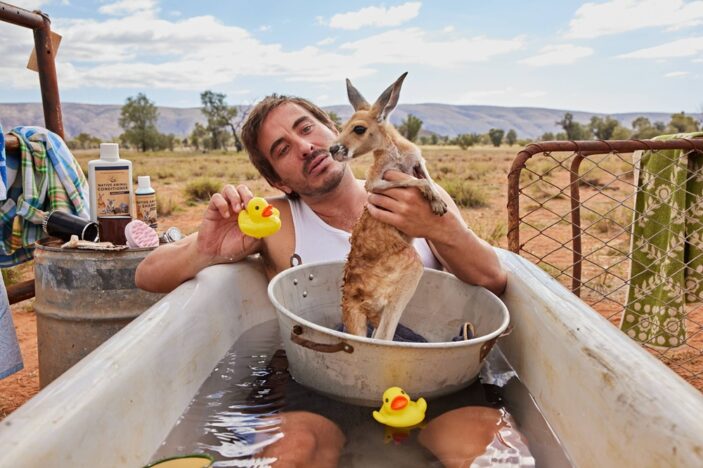
Kangaroo is a heart-warming family comedy about ex TV personality Chris Masterman (Ryan Corr), who becomes stranded in an Outback town outside Alice Springs. There, he teams up with 12-year-old Indigenous girl Charlie (Lily Whiteley). The pair form an unlikely friendship and work together to rescue and rehabilitate orphaned joeys in the remote but stunning Outback community – an endeavour that proves to be life-changing for them both.
And as our Peter Gray spoke to Corr in the lead up to the film’s release, he discovered it wasn’t just life-changing for Ryan’s character, but for the actor himself, as he detailed bonding with the young joeys on set, being immersed in the spiritual energy of Alice Springs, and how he found the notion of “not working with animals or children” not applicable.
We were speaking, off camera, about the recent wave of nostalgia with films and a certain brand of comedy, and you can’t get any different with Kangaroo. Obviously a much more wholesome film…
(Laughs) It is a lot more sweet, but, for me, it’s reminiscent of the films that I grew up with, going with my family and grandparents and watching it in the cinema. In a weird way, they’re the most important ones when you’re growing up. I think they affect you slightly differently. The type of film when you’re of a certain age, and they’re not just there to entertain you. They land, and they inform little parts of who you are, how you understand family loyalty. In our case, the relationship with nature and the healing relationship with animals, and finding your community. In a weird way, that’s nostalgia. I hope it carries over and puts families and young people in the cinema together. having that experience together.
Chris, as a character, is a long from the city of television, both geographically and spiritually. For you, were there any key emotional beats in Chris’s journey that you knew you had to land in order to make his transformation believable?
Yeah, when we first meet Chris, he’s sort of caught up in his own world. He’s very career focused. He’s very caught up in his phone and technology and what’s next. I think he’s lost. He’s lost that balance. He’s lost part of himself. He’s in search of something that’ll give him meaning. I think it was really important that we saw the change from Chris that we made at the start of the film. For me, it’s about finding answers in the most unusual places and, potentially, in the most unusual relationships. (Which we see) through him and young Charlie, and with the joeys themselves.
(Chris) is coming from a world in Sydney, in Bondi on television, caught up in himself, and as the community, and Alice Springs itself, affect him, and as his relationships with these animals develop, we see how that change grounds him and how it reminds him of who he is. I think, ultimately, it gives him purpose. I think that was the carryover from the original Chris, too. He founded the Kangaroo Sanctuary in 2009, he was a tour operator before that, and I believe a zookeeper. He feels like Crocodile Dundee. There were a lot of vulnerable joeys, often involved in accidents, that no one was doing anything about, and I think (Chris) saw purpose in rehabilitating and re-releasing these animals into the wild. He’s been doing it for 20 years now, and who knows how many dozens of lives (he’s saved), so that essence of finding your relationship with nature is what (my character) finds, just in a slightly different place.
On the mention of the joeys, did you find any surprising overlap between the unpredictability of animals and your experience on set as an actor? Both require some improvisation…
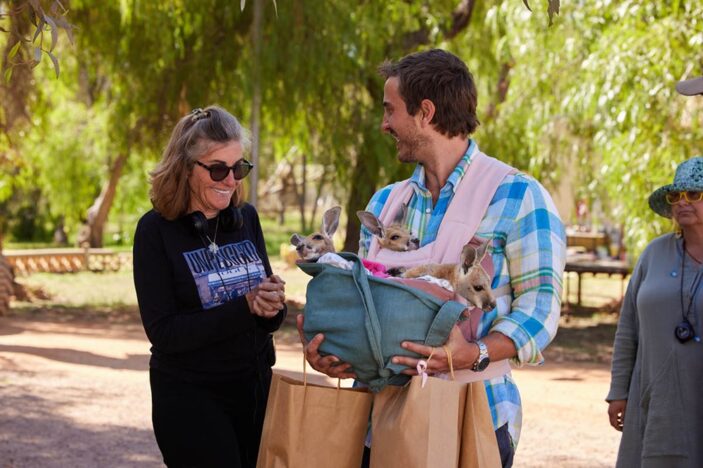
Well, the kangaroos had more breaks than (the actors) did. A lot more riders (laughs). Our main joey was called Margot, but she’d get tired after a couple of hours, so we’d switch her in for a twin. At any time we’d be just making sure they’re okay. They’re not like cats or dogs, you can’t just train them to go, “Hey, can you come over here? Stand in the doorway. Do something cute.” We spent a number of weeks, myself and Lily (Whiteley) with Chris (Barnes) at the Kangaroo Sanctuary before shooting, swaddling them, bottle-feeding them, playing with them. Eventually, if you went to the toilet, you’d have shadows following behind you. It was really about developing that bond, so that when wwe were on set they could recognise they felt safe, to a certain extent.
We found because of that relationship developed beforehand, we’d often find that they’d come to us, they’d want it. Every time you’d open a piece of fabric or your shirt, they’d try and somersault into it. It was an interactive relationship. I think for all the scenes with the kangaroos, except for some of the visual effect ones, it’s about seeing how they joey felt that day and playing with what they brought. Margot must have known she was a star, because, almost as if she’s read the big print, she’d stop doing exactly what she was meant to.
In the Red Center, especially, kangaroos hold so much cultural and ecological significance. How much did you and the team discuss the symbolic role of the joeys in the story? Especially as a bridge between Chris and Charlie, or even Chris and yourself?
Definitely, between Chris and myself. It was all about getting to know Chris and the reasons for creating the sanctuary in the first place, and seeing that genuine love and passion for the animals. And, of course, Charlie’s character, Kangaroo is her totem. So there was sort of spiritual elements (there). It was about understanding different totems and what they mean from an Aboriginal point of view. That was a very important part of it.
But it was more about people finding answers that were unexpected with community and within family. When you start, as an individual, to understand those priorities and where to place your energies, I think, more than anything, Alice Springs, as a place, is incredibly spiritual. I don’t know if you’ve been, but the energy, you can feel it as soon as you arrive. The way the light bounces off the country, it just feels like an ancient, sacred place. Alice Springs isn’t just a backdrop in our film. It’s very much a character. I think because of the ways that we’ve captured (it), I hope its raw magic and powerful beauty comes through on screen.
I was going to ask, being immersed in that, do you feel like it brought anything out of you as a performer as well?
I mean, huge amounts of awe. We were like a travelling circus. We were all staying really close together, and every day we’d arrive at a new place that would take your breath away. It’s incredibly humbling. And I think very much from Chris’s journey from when we first meet him and arriving in Silver Gum, our little fictitious, slightly elevated, colourful little town, I think the country very much affects him. Like the animals do, and the community does. I found in a very similar way it was affecting all of us who were over there. We were pinching ourselves every day, and just feeling very grateful to be able to be a part of the experience of shooting somewhere so unique and rich.
And mentioning Chris, and playing a fallen TV personality, as it were. Does it make you reflect on your own career, or public identity at all?
Yeah, I mean certainly in terms of getting too caught up in what’s next, and you forget to call your friend and check in that they’re doing okay since you last spoke on Tuesday, you know? It’s about keeping those friendships alive. I think it’s a good reminder for everyone, and it certainly was for me. Chris finds himself in a place where that balance is completely thrown out, and Charlie, for very different reasons, her balance is completely thrown out too. The film is a reminder of the healing relationship we have with nature and animals. It’s certainly reminded me of my own priorities. My sister’s just had a baby, and it puts things completely into context. I think it’s just about checking in with yourself and checking in with those around you, and reaching out outside of yourself to find that balance and comfort.
Looking at everything you’ve done in your career so far, do you feel that there was something about working on Kangaroo where you discovered something about yourself for the first time? Either as Ryan the person, or Ryan the actor?
Both Ryan the person and the actor, you know, working with animals in this close way, it makes you open in a different way. You have to be receptive to whatever’s happening in front of you. There’s literally creatures trying to bond (with you). And this is a comedy, it’s a fun, family film, and it’s slightly elevated with all these characters, who are larger than life, so being this grounding force within that world was about finding the fabric, and finding that it was fun and laughter where that sits together. I think every job you do sort of rubs off (on you). It teaches you new things, and I know there’s the old trope of don’t work with children or animals, but (whoever said that) haven’t met Lily Whiteley or Margot, because they are absolutely the draw cards for this film.
Kangaroo is screening in Australian theatres from September 18th, 2025.
