

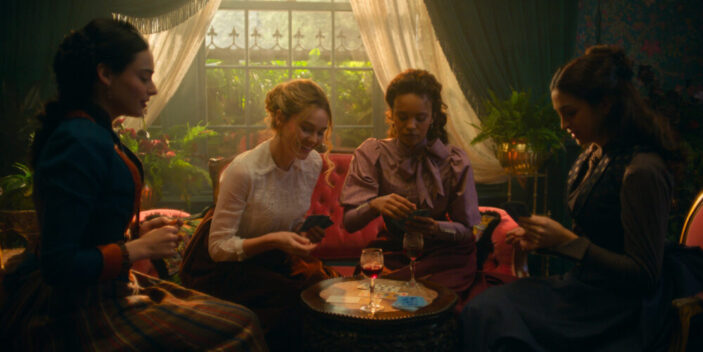
Apple TV+’s The Buccaneers aired the final episode of its second season last week, laying the groundwork for a potential third season. Whether it was a case of the pacing being hindered by the one episode a week release structure, or the show getting too far away from its original source material, this historical drama about five American heiresses taking the English aristocracy by storm didn’t quite hit its mark after a promising first season. However, there is a lot to like about The Buccaneers, not least its headstrong cast of fearless female characters, its subverting of the classic ‘marriage plot’ of 18th and 19th century fiction, and, of course, its stunning costume and hair design.
While many viewers may have been waiting with bated breath for the return of this show after that cliffhanger, the experience of watching season two felt at times like watching a different, much darker show. As marriage, money-troubles and menace have scattered our five heroines, the sisterhood dynamic which gave the show its heart is severely diminished.
The season begins with the newly minted Duchess of Tingtagel, Nan (Kristine Froseth), learning to navigate her new power. Under the watchful eye of her mother-in-law, the Dowager Duchess (Amelia Bullmore, a highlight of both seasons for her nuanced performance of a woman who understands sacrifice), Nan feels the weight of her new obligations and pines for the absent Guy Thwarte (Matthew Broome), whom she gave up in order to use the might of Tintagel to save her sister Jinny (Imogen Waterhouse.)
Meanwhile, back in London, Conchita (Alisha Boe) and Richard (Josh Dylan) have inherited the Brightlingsea titles, as well as a considerable debt. Conchita comes up with a business idea to save the family, despite Richard’s mother not really deserving any help from the (now broke) heiress she has bullied relentlessly for months. The change in family arrangements sees houseguest Mabel Elmsworth (Josie Totah) sharing a room with Richard’s sister Honoria (the delightful Mia Threapleton), but seeing as the two are secretly in love, this doesn’t pose as much of an imposition as expected. The inclusion of these queer characters is a refreshing addition to the plot of this show, which sheds some light on the perspectives of young women who might have ‘failed’ to enter the marriage market. Edith Wharton, who wrote the novel this show was based on, was never one for writing about women who followed rules or conventions, so Mabel’s increasing visibility and acceptance among her social circle is a bright point in an otherwise rather dark season; then again, the show has always hinted at darkness – don’t forget that the Brightlingsea boys were groomed by their governess, as revealed near the end of the first season.
Mabel’s older sister, Lizzy Elmsworth (Aubri Ibrag), has a surprising role to play in the events of this season. Arguably a minor character originally, after being coerced to lie naked on a chaise longue for hours during a game of hide and seek, Lizzy returned home to New York and was absent for a large chunk of the first season, returning for the later episodes. She was positioned as a kind of rival to Jinny in her pursuit of Lord James Seadown (Barney Fishwick), perhaps blinding Jinny to his true nature.
Now, in season two, a romance between Lizzy and Theo feels manufactured out of thin air. Their dalliance hits wrong, particularly as we barely know Lizzy, aside from the fact that all the other characters talk about how good she is. Her actions this season are anything but, and if this is meant to be growth in the form of her rejecting politeness at the expense of her own happiness, this motivation is unclear and obscured behind occasionally clunky dialogue. Paired with the incongruous modern pop music soundtrack (and a few particularly on the nose sequences of Theo brooding, storming around, and throwing things in Nan’s room like a giant walking red flag) this plotline seems to the biggest off note of the season so far.
In just an eight-episode arc, the show attempted to develop individual plotlines for five major characters, as well as countless subplots, and it seemed to me there simply was not time for any of these to fully unspool. In many ways the big issues that the story tries to tackle are worth applauding – women’s rights, domestic violence, class inequality, mental health – but with no guarantee how many future seasons there might be, everything has been crammed in at once, meaning the writing lacked space for each element to breathe. Rushed character development at times denied the show any sense of nuance, leaving villains like Seadown and Lady Brightlingsea feeling like cartoons, twirling their moustaches. This left me wondering why some of the lesser subplots (such as Guy’s drunken night with Paloma, Hector’s courting of Lizzy, and Conchita’s training of heiresses) were given so much airtime.
It’s hard to pinpoint exactly how much time is supposed have passed over the course of this series. Based on Nan’s big reveal in the final episode, we can conclude it’s been four months since Nan and Theo’s honeymoon, but factoring in sea voyages, the major events of The Buccaneers give the impression of happening in quick succession, when realistically there must have been weeks between some scenes. This makes Nan’s emotional flip-flopping as to which future – and which man – she will choose all the more confusing. Pacing issues may also be to blame for those stories that barely got a look in, such as the truth about Nan’s birth mother, and the woeful underutilisation of guest star Leighton Meester, whose inclusion was used as a major hook in all of the early trailers for the season.
The show is, of course, visually stunning (if wildly inaccurate at times), and special mention must be given to the hairstyles this season. Nan, who was very tomboyish in season one, grows into her role as a Duchess through increasingly elaborate hairstyles, with lush hairpieces giving her hair both volume and drama. Other characters undergo a similar treatment, which goes some of the way towards aging these girls into young women, and giving them all a measure of their growing power as they learn who they are outside of their parents’ homes.
In the final episode of season two, after Theo blows up all of Nan’s carefully laid plans, she and Lizzy finally have a big confrontation about what’s been going on. Nan tells her friend ‘we were supposed to be the love story’, referring to the five friends. While the shocking events of season two might have briefly brought them all together, they no longer feel close, and Nan laments that it seems to have been marriage and men that have made this so. This speaks to the core of why this season felt fractured for me—the sisterhood was what kept viewers coming back, and it felt broken this year. Here’s hoping that if season three happens, all of our Buccaneers figure out how to return to their pact from season one, that they will always come first, no matter what. A tall order, given that this kind of female self-empowerment is totally at odds with the social mores of England in the 1870s, but that’s for the showrunners to figure out.


THREE STARS (OUT OF FIVE)
All episodes of The Buccaneers are now streaming on Apple TV+.
